
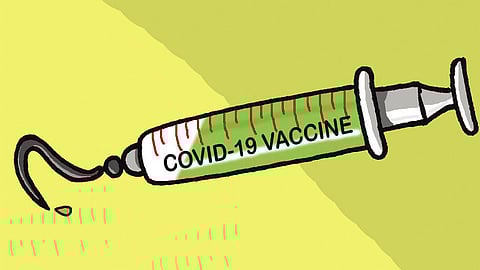
Vaccine roll-out challenges
The jury is still out on which Covid-19 vaccine is most effective, safe, easy to administer and available to most people. Even as the clinical trials on various versions of a vaccine are underway, most of them far from complete, reports are coming in about the Pfizer vaccine being responsible from a type of facial nerve paralysis known as Bell’s Palsy. Other news reports have mentioned that the Indian drug regulators have asked for additional data from Serum Institute of India and Bharat Biotech, two of the frontline vaccine manufacturers in India. Likewise, an allergy warning has been issued in the UK regarding one of the vaccines.
In the next few months, one can expect most of these issues to be resolved, as the clinical trials in various countries make progress. But the real challenges, the giant mountain to be climbed by each and every country in the world. It’s called Access (to the vaccines) in every part of the planet, while ensuring that the vaccines don’t get destroyed or degenerated due to inappropriate conditions of temperature, humidity, etc.
As healthcare workers everywhere know quite well, vaccines have to be stored at a relatively low temperature (2-8 degree Celsius) even in tropical countries, where the air temperature is usually much higher. This also applies to most other injectable medicines, blood for transfusion, other biological substances, etc. Hence, these products have to be transported under strictly controlled temperature, right till the point where they are administered to the patient. Even a temporary exposure to a higher temperature can result in deterioration of the product.
In fact, the vaccine varieties being developed by Pfizer and Moderna have to be stored at much lower temperatures – between minus-20 and minus-70 degree Celsius. Only then can they remain effective for their full life-span of about four months. This means that products of the two US-based companies could prove completely unsuitable for India and the neighbouring countries. The only choice therefore could be Covaxin (Bharat Biotech) and AstraZeneca’s Covishield, at least for the time being. Other products such as Russia’s Sputnik-V are still under trial.
The technology for maintaining such a cold chain has existed in India as well as other countries for the past many years. What appears insurmountable is the task of maintaining a couple of hundred million doses of vaccines in these stringent conditions. As a report from McKinsey, the leading global consultancy firm, the Covid-19 vaccine rollout has to be completed four times faster than ever before. Experts say that at least half the world’s adult population would have to receive a minimum of two doses before they can be declared safe.
In India, the existing cold storage facilities are not just insufficient but also lopsided. For one, almost 80 per cent is currently utilised for agricultural and horticultural products, while a minuscule 1 per cent is allocated to medicines, vaccines, sera and other therapeutic products. This will have to change drastically and at a frenetic pace.
The other crucial aspect is geographical location. According to a recent Bank of America Global Research report, there were 8,186 cold storage facilities in India with a total capacity of 35-37 million tonnes. Of these, a lion’s share is located in UP (2,406 facilities), followed by Gujarat, Maharashtra and Punjab, with less than 1,000 facilities each. For the Covid-19 vaccine campaign to be successful, these would have to be more evenly spread.
Clearly, this is beyond the capacity of the government-own refrigeration facilities. Hence, private companies such as Snowman Logistics, Siro Clinpharm and TCI Express will have to pitch in with additional investment and expansion plans very quickly.
An equally daunting task is to find trained people in sufficient numbers to administer the injectable vaccine. India simply does not have enough nurses and doctors to meet the need. Other categories of health professionals, such as Community Health Workers, can be roped in but they might need special training as well. The experience of the UIP (Universal Immunization Programme), which has been developed in the country over many years, would prove useful. But even that would have to be expanded in terms of numbers.
For the moment, all these are questions demanding answers from the country’s healthcare establishment. The extent to which they are able to overcome these challenges, will determine whether the war against Covid-19 is won or lost.