
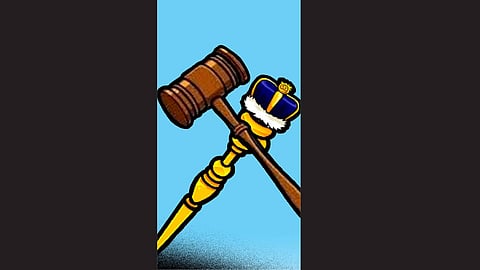
Tide turns, so does judiciary
Recently, a string of High Courts, Bombay to Patna, Madras to Karnataka, Delhi and Himachal Pradesh have raised questions and prodded governments, both in the states and at the Centre, on alleged mismanagement of the Covid-19 situation. In the face of such activism, even the Supreme Court has shed its passivity and observed that it cannot remain a mute spectator in the times of a national crisis. This is the same court which, by virtue of the jurisdiction it has under Article 32 towards the protection of fundamental rights, could have intervened on a plethora of national policy issues, which were engaging the attention of the civic-minded intelligentsia in the past, but chose not to do so.
Recall, for instance, the fate of the habeas corpus petition on the human rights situation in Kashmir; or the court’s response to the humanitarian crisis which followed following the national lockdown last year. Lakhs of migrant labourers were left in the lurch, but the top court refused to admit petitions seeking its intervention. By effectively not granting any relief, the court had denied the most fundamental right of access to justice, ensured under the Constitution. In doing so, it had also failed to perform as a guardian of the constitution.
Yet, we are now seeing a burst of judicial activism. Like the media which has begun to notice the Modi government’s administrative inadequacies and centralised structure and the voters who have begun to see the BJP in a different light (as in West Bengal), the judiciary too is getting assertive. It is as if, with the tide turning against the Modi government, people and institutions are suddenly finding their voice.
The Madras high court’s blistering observations against the Election Commission of India (ECI), widely seen as a toothless adjunct of the government, for not stopping political parties from violating the Covid protocol in their rallies for assembly elections is a case in point. The court went on to castigate the ECI in a series of sweeping observations, the most damning one being: “You should be put on murder charges probably”. Though, unfortunately, there were no strictures against the ‘real’ triggers that caused the rallies to evolve.
Recently, a bench of the SC, led by Justice Dhananjaya Y. Chandrachud, while hearing the matter of the surge in infections, registered suo motu (on its own) a petition, seeking to redeem the top court’s reputation. While asking for details of availability of medical oxygen; supply of essential medicines; ramping up of critical medical infrastructure; and the rationale of vaccine pricing from the Central government to assess its readiness; the bench said: “This is a national crisis and the Supreme Court of India, being the national constitutional court, cannot be a silent spectator. The court has jurisdiction under Article 32 towards the protection of fundamental rights.” While many have hailed Justice Chandrachud in the past for his bold judicial pronouncements, one wishes similar boldness had guided other judges of the top court in the past as well.
Of course, there have been honourable exceptions too. The Allahahad High Court, under the recently retired Chief Justice Govind Mathur, had constantly questioned the UP government making significant interventions from quashing the National Security Act charges in several cases and striking down the state’s ‘name and shame’ posters during the anti-CAA protests in 2019.
During the Modi reign, the country has not encountered the bitter experiences of Indira Gandhi-era, where judges were appointed, transferred and superseded at the whims of the executive. However, post-2014, there has been a considerable shift in the power dynamics over judicial appointments in a bid to influence the judiciary. To circumvent the Collegium system of judges, as a solution by the judiciary to guard its independence, the government has sought to establish ‘who will get to call the final shots’ over judicial appointments.
The government brought in an amendment to the Constitution to create ‘National Judicial Appointments Commission’ (NJAC), which had a short life, as, within 10 months, it was struck down by a constitution bench. After that, things have not been smooth between the Centre and the Collegium.
All this has led to a situation, where unfortunate presumption discernible in the Court’s response to any debate on policy matters was that the government is the best judge of the situation. In believing thus, the Court seemed to have forgotten that the Constitution does not fall silent in times of crises. Similarly, nothing prevents the Court from monitoring the situation itself directly, especially regarding the state’s obligations. Hopefully, the new awakening will see a change in the judiciary’s attitudes