
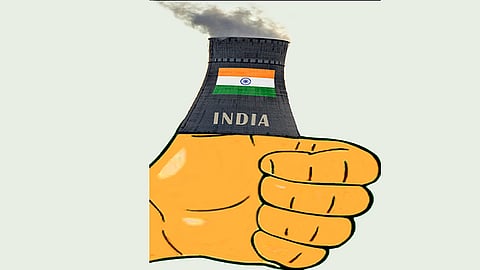
The 500 MW prototype fast breeder reactor (PFBR) at the Kalpakkam nuclear energy complex near Chennai has gone critical – meaning, a sustained nuclear chain reaction has begun inside the reactor, a prelude to electricity generation. By itself, this is not sensational news, considering that India had started harbouring such, nay, even bigger, ambitions of generating nuclear electricity when it inked the nuclear deal with the US in 2008. But it is a heartening milestone, never mind the fact that the PFBR suffered a 15-year delay and cost Rs8,181 crore, against the originally estimated Rs3,492 crore. The PFBR will help India transition from uranium-based reactors to a sustainable energy system that uses thorium, the development of which is being overseen by the Indira Gandhi Centre for Atomic Research.
The PFBR is fuelled by a mixture of oxides of plutonium-239 and uranium-238, both of which come from the conventional pressurised heavy water reactors that India runs. The PFBR is a ‘breeder’ – it produces more Pu-239 than it consumes, by converting U-238 into more Pu-239. Hopefully, the next two breeder reactors will use metallic fuel – a mixture of pure Pu-239 and U-238 rather than their oxides – to increase the breeding ratio, so that more Pu-239 is produced. Metallic fuels are the holy grail of fast breeder reactors; India should make the shift to metallic fuels, however tough, a high priority. Once sufficient inventory of Pu-239 is built, India can move to the thorium cycle.
Thus, the reactor's blanket, initially filled with uranium-238, will utilise thorium-232 to produce uranium-233 through transmutation, allowing for future thorium-based energy production. India has significant thorium reserves in coastal areas, which can be utilised for energy production through this reactor type. The ultimate aim of the Kalpakkam facility is to unlock the full potential of India's thorium resources, reducing reliance on uranium imports. Beyond the PFBR, studies on India’s molten salt breeder reactors and other designs, such as the advanced heavy water reactors, are ongoing for direct thorium use.
The trajectory of the Kalpakkam project has not always been hunky dory. At one stage, the time and cost overruns seemed unconscionably high. There were also protests galore against the project.
But, then, building fast breeder reactors is technically challenging. Only Russia operates them commercially; France and Japan abandoned their efforts after finding the technical challenge unnecessary, while the US stepped back largely on economic considerations. China’s CFR-600 is in its early stage of operation. Thus, India will be the third country in the world to have a commercial fast breeder reactor.
It will be 12-18 months before the PFBR starts supplying electricity to the grid, after tests and turbine synchronisation. It is important for the various arms of the department of atomic energy to ensure that all projects – those under implementation and planned – are fast-tracked. BHAVINI, the government company set up to build and operate breeder reactors, should lose no time in implementing the plan to build two more breeder reactors at the same site and four more elsewhere.
In that sense, PFBR is more than a reactor – it is India’s answer to energy insecurity. A nation that can produce more fuel than it consumes cannot be held hostage to global energy uncertainties. Imports account for a big chunk of India’s total primary energy needs. It imports 85-90 per cent of the crude oil that it depends on most, about 50 per cent of its natural gas and significant, though fluctuating, amounts of coal.
The Kalpakkam breakthrough has come at a time when energy importers worldwide are reeling from a massive disruption in supplies of oil and liquefied natural gas due to the near-closure of the arterial Strait of Hormuz in the aftermath of the Iran war. In today’s world, amid wars and geopolitical arm-twisting, energy can become a tool of control – turning nations into energy-dependents. The success of PFBR, if carried towards its logical conclusion, could fundamentally change that equation for India.
Even the International Energy Agency believes that the reactor at Kalpakkam “will use much less nuclear fuel than other reactors and lay a pathway towards a closed fuel cycle”, referring to the reprocessing and recycling of spent nuclear fuel. That said, achieving criticality is symbolically and strategically important, though the immediate impact on India’s energy mix is likely to be modest.