
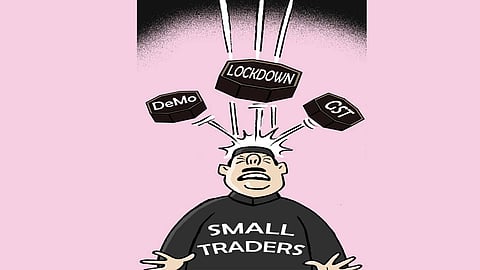
It is ironic that small traders and businessmen, once regarded as the core of the Bharatiya Janata Party’s support case, have to now strain themselves to be heard. This is a community that has repeatedly backed the Bharatiya Janata Party in national and state elections. In fact, the BJP at one point of time was known (though somewhat pejoratively) as the ‘party of traders’. But for some time now, the trading community in the country has been feeling disillusioned with the Narendra Modi government due to the problems they have been facing on several fronts, including on taxation, e-commerce and security for their businesses.
After the BJP came to power in 2014, the traders had great hopes about the new government’s approach towards them. However, their hopes appear to have been dashed. The ire of the traders is particularly directed against e-commerce giants like Amazon and the Walmart-owned Flipkart that are increasingly cutting into their business.
Could the government have prevented this? Last year, when Jeff Bezos visited India, he also attended the e-commerce giant’s event for engaging small and medium entrepreneurs. Traders organised a protest right outside the venue in New Delhi in which posters held by them read ‘Bezos go back’ – reminiscent of the British-era protests against the Simon Commission. The political fallout of the protest was immediately visible. Elections to the Delhi assembly were due and the BJP did not want to alienate the trading community.
So, none of the Central ministers entertained Amazon’s request to meet Bezos. This was despite Bezos’s offer to invest $1 billion in India over the next five years. The event underlined that, while traders do matter politically to the BJP, they somehow do not figure prominently in its overall economic policy matrix.
A recent report by Reuters that provided an inside look at the alleged cat-and-mouse game Amazon has played with government, adjusting its corporate structures each time new restrictions were imposed aimed at protecting small traders, has also become a lightning rod for the traders. They have now upped the ante and are demanding a ban on local operations of Amazon, accusing the global e-tailing giant of indulging in predatory pricing, deep discounting and inventory control. Amazon, however, has criticised the Reuters report as ‘unsubstantiated, incomplete and factually incorrect’.
The Confederation of All India Traders (CAIT) has demanded that the government release a fresh Press Note in place of Press Note No.2 of FDI policy and finalise the much-awaited e-commerce policy. Amazon is already under investigation by the Enforcement Directorate for alleged violation of foreign investment rules. Such probes typically take years and, in most cases, details aren’t made public. It appears that the ED will now also examine findings in the Reuters report. Another act of tokenism!
It is possible that a part of the campaign against Amazon is being fuelled by its home-grown rivals in view of the huge potential that e-commerce offers in India. But that does not detract from the somewhat step-motherly treatment that small traders and businessmen have been ostensibly getting of late. The first blow came in the form of demonetisation. For most traders and small businessmen, cash was king. Being deprived of it was akin to breathing air bereft of oxygen.
Then came the goods and services tax (GST) regime – an issue on which the CAIT has announced a Bharat Bandh in commercial markets across the country on 26 February. Traders want a review of the GST system and its tax slabs to simplify and rationalise it for easier compliance by traders. The argument advanced by CAIT makes sense: voluntary compliance is the key to a successful GST regime, as it will encourage more people to join the indirect tax system, increase tax base and boost revenue.
Despite almost 950 amendments made so far to GST rules in the past four years, the glitches in GST portal and the continuous increase in compliance burden are the major lacunae in the tax regime. These should be addressed in any case.
The third blow the traders are reeling under was the lockdown imposed to counter the spread of the corona-virus pandemic. The lockdown spurred the growth of e-commerce operations in India. Before the pandemic struck, there was talk of the government planning to assist small retailers by offering them subsidies to digitise operations and become part of the organised retail space.
Among other things, the government was considering a framework to finance card swiping machines or point of sale systems for small retailers to scale up digital penetration. These were moves in the right direction. Now is the time to implement them.