
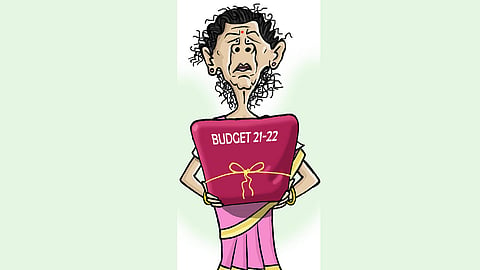
UK Chancellor Rishi Sunak ended 2020 as the most popular politician in his country, thanks to his £400 billion worth of spending to boost the Covid-hit economy. But, now that he has to work out a path to normalcy from the burst of generosity he displayed by way of stimulus, critics are crawling out of the woodwork. Even the former Prime Minister Theresa May subjected him to some withering criticism the other day for his cut to international aid spending. His budget in March will be the first exercise to show what the Boris Johnson government’s medium-term plan for the economy is. But, with the pandemic making a comeback with a deadlier strain of mutant virus, he may have to extend the furlough, instead of tightening the purse-strings. Indeed, ‘Dishy Rishi’ has a challenging time ahead!
Finance ministers the world over are in a similar predicament. As budget day approaches, our own Nirmala Sithraman is being closely watched. She did not win many accolades for her stimulus packages, which were somewhat niggardly. Also, she opted for a supply-side stimulation of the economy, by reducing corporate taxes and trying to facilitate credit to businesses at a time when the Covid-impacted system perhaps needed a demand-side booster dose. Most of the countries adopted the policy of demand-stimulation through cash in hand for the common people to get the economy out of the slump. Her strategy failed to check the contraction of the GDP, which probably stands at the highest for any nation in the world. The GDP declined 23.9 per cent in the first quarter and 7.5 per cent in the second quarter of 2020-21. The economy is officially projected to shrink by 7.7 per cent in the entire year.
Many like West Bengal finance minster Amit Mitra feel that Sitharaman should use the budget to ‘take a Keynesian approach, instead of relying on Say’s law’. The Keynesian approach, named after British economist John Maynard Keynes’ prescriptions, basically calls for boosting aggregate demand during a downturn and rejects the idea that free market economies have self-balancing mechanisms that lead to full employment. On the other hand, Say’s law, named after French economist Jean-Baptiste Say, is based on the premise that supply creates its own demand. It is the claim that the making of a product creates demand for another product by providing something of value, which can be exchanged for that other product. It is this law that Keynes had rejected. Whether Sitharaman will be able to resolve the Keynes-versus-Say dilemma on 1 February remains to be seen.
While economy may be showing slow signs of recovering from the turmoil caused by the pandemic, there is no certainty on how things will eventually pan out and when. The FM’s promise of a Budget ‘like never before’ has fuelled expectations towards significant reforms. From a direct tax perspective, the general trend of Budget reforms over the past few years has been to rationalise tax rates, accompanied by phasing out of exemptions. Will the pandemic now prompt Sitharaman to rethink this strategy?
This may present an interesting dichotomy – whether the government should continue with the same line of thinking of phasing out exemptions, or whether some key tax incentives can be brought back or broadened. There is high expectation amongst taxpayers for rationalisation of the personal taxation regime, in order to enable the common man to mitigate the financial burden following the pandemic.
One of the key expectations is that the upcoming budget will bolster Prime Minister Narendra Modi’s initiative of Aatmanirbhar Bharat (self-reliant India) for combating the pandemic. At the minimum, the government is expected to focus on stepping up spending in priority sectors, such as infrastructure, healthcare, etc. It may also be necessary for the government to mull over direct tax exemptions that have the potential to provide an impetus to the industry.
In a bid to incentivise household spending and stimulate demand, the Budget could introduce innovative tax incentives linked to consumption like the recent 'LTC Cash Voucher Scheme’ permits employees to claim tax exemption in lieu of leave travel allowance by purchasing qualifying goods and services carrying GST rate of at least 12 per cent.
The upcoming budget is being billed as a pivotal moment in determining the future of the Indian economy by reversing the downturn and enable India to continue its journey as one of the fastest-growing economies of the world. That is Sitharaman’s challenge. Unlike Sunak, who burnished his popular appeal during the pandemic, she has only the budget to turn to and cannot afford to disappoint.