
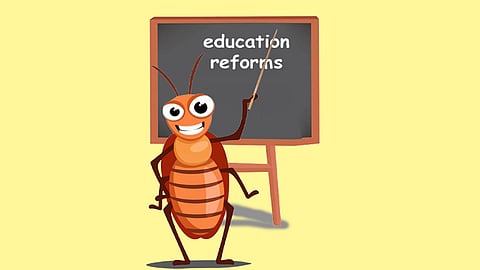
If anything has come out of the students’ protests which began in New Delhi’s Jantar Mantar and later spread to other urban centres, it is the glimmer of education reforms. The month-long protests prodded the Modi government to tighten the existing law, making it more stringent in terms of punishments and fines and setting up fast-track courts that will work to defined timelines. The change of Dharmendra Pradhan, Union minister for education, as also the harder law, however, are just the beginning. The momentum built by the students’ protests must not be lost – it must lead to larger and more meaningful changes in the education system and re-energise structures of accountability and reform. In the process, MPs on both sides of the aisle in Parliament must step up to the challenge. It is MPs’ responsibility now to ensure that Parliament opens its doors to let in the concerns and anxieties of the young that filled the streets.
Entrance examinations are the gatekeeping mechanism that determines which young Indians get to enter the narrow but reassuring world of formal employment later on, in a country where most work remains in the grinding unorganised sector. Repeated leaks across several examinations have turned an apparatus for testing merit into one of widespread graft. Close to 2 million candidates were made to take the NEET (Undergraduate) again after gruelling preparation that coincided with their school examinations. One hopes that this lacuna is seriously plugged once and for all.
Indeed, irregularities in education, as well as rampant unemployment, have been major issues in the country since the early 1970s. One of the main reasons for this is that economic growth that occurred after the economic reforms in the 1990s and later was not accompanied by broad-based investments in education. It failed to create jobs in the private sector, making the youth, particularly in the northern hinterland, more dependent on government jobs.
For the Modi government, the danger signals were clear as daylight even as Delhi was shrouded by clouds, which relentlessly drenched the large gathering. The grievance-bound youth across castes and religions, the very identities that political mobilisation in India has been confined to in recent years. A government that does not bend to the will of the people risks being broken. About 60 million youth will constitute the bloc of first-time ‘floating’ voters in the 2029 election. The sustained agitation by youth, led by the satirically named Cockroach Janta Party (CJP), is in a way a seminal moment in the unravelling of BJP’s dominance in Indian democracy, which allows little elbow room for a fragmented Opposition. Bypassing a television establishment largely aligned with the ruling dispensation, the faceless protesters had built support on social media within days. The high-handedness of the Delhi police and the attempts to throttle the Internet and mobility around the protest venues only swelled their ranks. The government eventually found that this agitation could not be crushed, swayed, split, distracted or left to dissipate, as others have been over the past 12 years. It was forced to negotiate, which made Pradhan’s continuation untenable.
If the Modi government now wants to cover the political ground it lost during the agitation, it must step up on education reforms in a more meaningful manner. This may require decentralising the management of examinations. Here, the problem is wider than the leaking of examination papers. The government must also better regulate tuition and coaching centres to ensure their marketing and activities are transparent and above board.
Then there is the issue of job creation. The government should also look at ways to improve work-integrated learning to give students better training in key fields. Another priority is reforming school and university courses so that young people can obtain the skills necessary to compete for private and public jobs, while also creating opportunities for themselves through start-ups. This is linked to a third issue – greater investment in schooling and higher education. Six decades ago, a commission set up by the government to examine the state of education in India recommended the government increase spending to 6 per cent of GDP. This hasn’t happened yet; the spending is just 4.1 per cent as of now. The education investment also needs to be smart. It should be targeted at curriculum review, improving the performance of institutions and staff, and speeding up the technological and infrastructural transformation in education.
A final theme emerging from the ‘cockroach’ movement is the need for the political establishment to respect and value young people. This starts with a better understanding of their capabilities, talents and skills. No amount of fear-mongering, whitewashing facts or using base rhetoric will now sway them.