
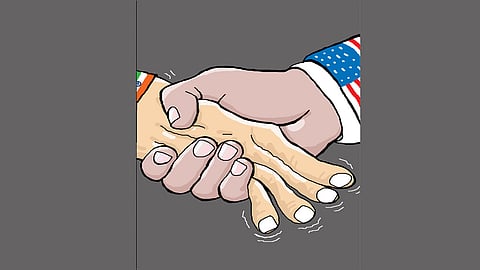
Martin Wolf, a respected economics commentator from the UK, recently said that he found it difficult to psychologise Donald Trump since he was ‘so unpredictable’. Many in India, who have been watching the twists and turns in the India-US relationship over the past two years, would agree with him. Other Trump-watchers see in his maximalist positions the deal-making tactics from his New York property days. There’s an echo of that in his repeated threats – of slapping tariffs, cancelling trade deals, destroying relationships and institutions, or even bombing the enemy. How does India do business with a man so full of himself and so full of self-contradictions?
After claiming the upper hand in trade negotiations with India, the US has softened the language on a fact sheet of the deal amid protests by farmers, who have accused the Modi government of compromising their interests. According to the original version of the fact-sheet released, India would ‘eliminate or reduce tariffs’ on a wide range of US food and agricultural products, including ‘certain pulses’, a dietary staple for millions in India that includes lentils and chickpeas. But a revised version removed any reference to pulses. The US government also changed the language that said India had ‘committed’ to purchase over $500 billion of US energy, information and communication technology, coal and other products. The updated fact sheet toned down the wording from ‘committed’ to ‘intends’. Also dropped was a section on digital services taxes, which said that India will remove its digital services taxes.
Piyush Goyal and his negotiators are heaving a sigh of relief. But how long is the good feeling going to last? India currently enjoys a trade surplus of over $40 billion with the US, and our government has agreed to purchase $500 billion worth of US energy products, aircraft and aircraft parts, precious metals, technology products and coking coal over the next five years. That looks like a tall order in view of the fact that India’s overall goods import from the US in 2024-25 amounted to $45.6 billion. It is in this context that the trade deal could also hit Modi’s vision of a Viksit Bharat. The high-level committee on Viksit Bharat goals had recommended the notification on coking coal – a vital input in steel making. Just recently, the government notified coking coal as a critical and strategic material under the Mines & Minerals (Development & Regulation) Act. This was the first step to reduce import dependency. India has coking coal reserves of 38 billion tonnes, but still imported 57 million tonnes in 2024-25. Of this, 29.6 million tonnes (mt) came from Australia, followed by 8.45 mt from the US and 5.26 mt from Russia. The US will clearly be looking to pressure India to cut back imports from Australia and Russia. If the US can bully India into not doing business with Russia and Iran, what is the guarantee that it will be more accommodating on this score?
Sooner or later, the deal may muddy the waters, which sustain India’s trade ties with its other partners. Complaints aimed at India are likely to mount in the World Trade Organization from countries which will not get the same unilateral tariff concessions being offered by New Delhi only to Washington. Is India ready to give short shrift to the WTO and other multi-lateral bodies like Trump is doing?
Addressing a business summit recently, Modi cocked a snook at the slow pace with which trade deal-making was done during the UPA years and highlighted how India is now racing to conclude FTAs with most countries, which are willing to sign them. Will this mean a reconsideration of the Regional Comprehensive Economic Partnership (RCEP)? Most Southeast Asian countries were annoyed with India for turning its back on the RCEP at the last minute before it was signed. The new ‘realities’ also call for resuming trade with Pakistan, because such a reversal of policy will help Indians in its border states. In fact, resumption of trade with Afghanistan logically calls for similar action with Pakistan.
Turning to the main problem, Washington under Trump suffers from a sense of entitlement towards India, because it presumably played a role in ending the border skirmish with Pakistan after Operation Sindoor. The thinking in the US capital is that it is entitled to call the shots. But, for how long? Trump’s tariffs are facing legal scrutiny as the US Supreme Court is set to rule soon on a case questioning the president’s legal authority to impose the levies. Republican lawmakers have joined Democrats to back a resolution that seeks to end the tariffs Trump imposed on Canada last year. The moment of reckoning could come anytime. India will soon have to decide that to deal with a bully, you also have to be rough and ready.