
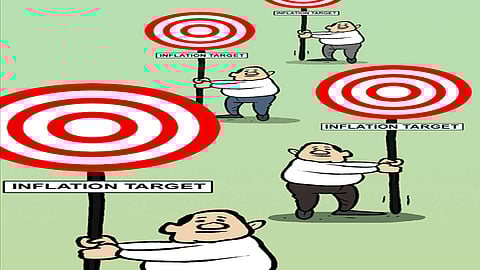
A tightrope walk for the monetary policy committee
The finance ministry is expected to review the inflation target for the next five years within the month in consultation with The Reserve Bank of India. This target is based on the finicky performance of consumer goods prices in the market, which are constantly on the move. The finance ministry has for five years aimed to contain inflation at four per cent, with tolerance levels between six per cent and two per cent.
A proposal before the government has suggested an increase in the band to 5 per cent from the current level, despite the fact that the RBI has been against relaxing the band to boost growth, arguing that the inflation targeting will then lose its meaning. It is likely that the target and the range around it will be retained for now.
The government uses a range around a target to recognise short-run trade-offs between inflation and growth, so that the target is set for the course of a business cycle. The range aims to accommodate data limitations, projection errors, short-run supply gaps and instability in agriculture production, as food articles have a major weight in consumer price inflation. It also nudges public inflation expectations on the centre of the range, to which the monetary policy aims to return the economy over the medium term.
Members of the Monetary Policy Committee use this prescribed target and range and tweak interest rates based on performance. They unanimously left interest rates unchanged at the last meet, so that the RBI may ‘persevere with its paramount objective’ of reviving the economy (from Covid-19-related damage) with measures relating to enhancing liquidity support to targeted sectors and liquidity management.
Market data has been mixed. The stock markets remain at elevated levels, even as physical markets resume on a path to recovery. A recent RBI survey notes an improvement in capacity utilisation in the manufacturing sector to 63.3 per cent in Q2 2020-21 from 47.3 per cent in the preceding quarter. Consumer confidence is reviving, and business expectations of manufacturing, services and infrastructure remain upbeat.
The movement of goods and people and domestic trading activity is growing at a robust pace. Electricity and energy demand reflect a broader normalisation of economic activity. And data for sales and new launches of residential units in major metropolitan centres also reflect a renewed confidence in the real estate sector.
And, yet, bank credit growth, which witnessed a slowdown in 2019-20, experienced a further setback in 2020-21. While credit to medium industries has risen, only loans to agriculture and services sectors have registered growth recently. And even this growth has been delivered largely by the public sector banks.
Should the markets continue to perform well, the threat of rising inflation will continue to increase. Inflation arrives from various quarters. In the past, the RBI has hiked or cut interest rates to contain the value of the rupee vis-a-vis other currencies. The size of government borrowings also has a bearing on inflation and thus the interest rate on 10-year government security is hovering at 6.07 per cent.
Bank interest rates, which are based on commercial interests, have been creeping up, which the RBI doesn’t like. But the market has a mind of its own. This is despite global money remaining easy. And higher rates also mean it is more expensive for the government to borrow; so, all the more reason government should try and cut inflationary pressures. And the easiest step is to cut petroleum prices amongst other things.
Domestic petroleum product prices have, perhaps. the highest impact on inflation. They are at historic highs in the local markets, as international crude prices have surged in recent months but high indirect taxes remain, both at the Centre and states. This leads to an increase in industrial raw material prices and results in an increase in the prices of services and manufacturing products.
If the Monetary Policy Committee fails to meet the inflation target, it must set out a report to the Central government stating the reasons for failure to achieve the inflation target; remedial actions proposed to be taken by the RBI; and an estimate of the time period within which the inflation target will be achieved.
Moreover, as the RBI puts it, price stability leads to higher financial savings and investment; reduced uncertainties for firms in investment and wage decisions; reduced term and risk premia in financial markets; and increased external competitiveness. It will be a tightrope walk for the monetary policy committee to balance once recovery is firmly in place. To prepare for that it still has time.