
Amazon Now and the art of quick delivery
Amazon India is gearing up for an aggressive expansion of its ultra-fast grocery and everyday essentials delivery service, Amazon Now, as it looks to strengthen its presence in India’s rapidly growing quick commerce market. Having pioneered the 10-20-minute delivery model for groceries and daily essentials in India, Amazon is now scaling up Amazon Now, after witnessing strong customer adoption. The company plans to expand the service to 100 cities across India by the end of 2026, significantly widening its footprint beyond its current markets.
The expansion will bring Amazon Now to a host of metro and non-metro cities, including Pune, Hyderabad, Chennai, Kolkata, Jaipur, Lucknow, Kanpur, Chandigarh, Ahmedabad, Meerut, Mysore, Panipat, Kochi, Amritsar, Mangaluru and Visakhapatnam, along with existing markets such as Mumbai, Delhi-NCR and Bengaluru. To support this growth, Amazon will significantly enhance its specialised fulfilment infrastructure.
The company plans to scale its network of micro-fulfilment centres (MFCs) to more than 1,000 from the current tally of 360. These neighbourhood-based fulfilment hubs are expected to play a critical role in enabling faster deliveries while improving inventory availability closer to customers.
Beyond customer convenience, the expansion of Amazon Now is also expected to create greater opportunities for local sellers and farmers. The company’s network will enable more than 16,000 farmers to directly reach consumers through sellers on Amazon Now, creating a more efficient supply chain for fresh produce.

Launched in mid-2025, Amazon Now is part of Amazon’s global push into faster commerce solutions. Apart from India, the service is available in select international markets including the UAE, Mexico, the UK, the US, Brazil and Japan.
Broader investment strategy
Amazon India is accelerating the expansion of its quick commerce offering, Amazon Now, as part of a broader investment strategy aimed at strengthening its operations network, enhancing associate well-being, and deepening its presence in one of the world’s fastest-growing e-commerce markets. The expansion forms part of Amazon’s recently announced investment of more than Rs2,800 crore, focused on improving associate safety, health and financial well-being, while further strengthening what the company describes as one of India’s safest, fastest and most reliable operations networks.
The investment also contributes to Amazon’s broader commitment to invest over $35 billion in India by 2030, with a focus on business expansion, AI-driven digitisation, export growth and job creation. This follows Amazon’s Rs2,000 crore investment in 2025, which supported the launch of 17 new fulfilment centres, six sortation centres and 75 last-mile delivery stations across the country. During the same year, Amazon had also launched Amazon Now and rapidly scaled the service to more than 300 micro-fulfilment centres (MFCs), laying the foundation for its quick commerce ambitions.
The response from customers has been encouraging. Prime members have tripled their shopping frequency after using Amazon Now, while order volumes are growing at about 25 per cent month on month, contends an Amazon spokesperson. The service offers a curated selection of thousands of products across categories, such as groceries, fruits and vegetables, frozen foods, personal care products, fashion and beauty, baby care, pet supplies, healthcare supplements and small appliances, all delivered within minutes.
“We are at an inflexion point,” affirms Srikant Sree Ram, director, Amazon Fresh, Amazon India. “Amazon Fresh has been operating successfully for years, and now Amazon Now is seeing a massive scale-up across India. We are all geared up to expand this service, as we are witnessing quite an impressive response. In fact, this ultra-fast delivery model was pioneered in India. India became the proving ground for the model and, from here, the proposition expanded globally to other markets.”
Available to both prime and non-prime customers, Amazon Now operates through a network of compact, purpose-built grocery facilities strategically located within 2-to-3 km of the neighbourhoods they serve. By positioning inventory close to customers, Amazon is able to ensure faster and more reliable deliveries, without placing excessive pressure on delivery timelines.
Srikant believes one of the most significant aspects of Amazon Now’s success is the fact that much of the technology behind the service has been developed in India. “What’s especially significant is that the technology backbone powering the experience was built in India,” he informs. “The in-app customer experience, the operational technology stack and the underlying systems were all developed here and are now being adapted for global markets. The core technology remains common but operating models evolve market by market, based on local consumer behaviour and infrastructure realities”.
The company’s growth strategy is built on a rapidly expanding logistics backbone. Micro-fulfilment centres form the final infrastructure layer before products reach customers. Typically measuring 3,000-10,000 sq ft, these facilities are positioned within a short distance of the communities they serve. In dense urban neighbourhoods, delivery distances can be as low as 500 metres.
Long-term investments
Each MFC is equipped with multiple temperature-controlled storage zones ranging from minus 18°C to 22°C, allowing the handling of ambient, chilled and frozen products. Facilities maintain hyperlocal product assortments, based on neighbourhood demand patterns, while incorporating multiple quality checks before products become available for customer orders.
“Our growth is not simply geographic – it is infrastructural,” says Karan Chugh, director, fulfilment centres, Amazon India. Every new market we enter and every fulfilment centre we open is supported by deliberate, long-term investments in the supply chain backbone that makes the fastest, safest and the most reliable operations network possible. Demand is moving beyond metros and we are moving with it.”
The infrastructure expansion is supported by an extensive sourcing network that increasingly connects farmers directly to consumers. Amazon works with more than 16,000 farmers and aggregators across India today, compared with about 6,000 two years ago. Through sellers on its marketplace, the company expects to enable six times more produce sourcing from farmers by the end of 2026 than in 2025 levels.
Nearly 70 per cent of fresh produce is sourced within 200 km of where it is eventually delivered, reducing transit time while improving freshness, traceability and inventory efficiency. Farmers supplying produce through sellers receive payments within four hours of delivery at collection centres, helping improve liquidity and demand predictability.
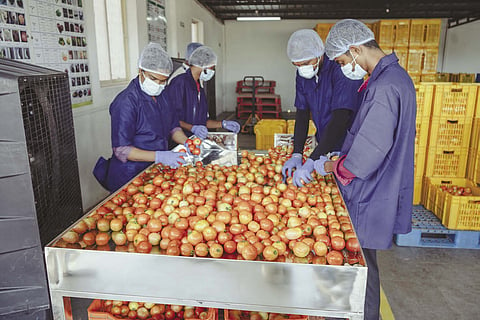
The fresh produce supply chain is built around multiple layers of quality control. At collection centres, produce is graded and sorted according to factors such as size, colour and consistency. These centres also mark the beginning of a continuous cold chain that extends throughout the logistics network.
Products then move to local processing centres (LPCs), where they undergo packaging, storage and additional quality validation. Different storage environments are maintained for various categories, including berries, leafy vegetables, chilled products and frozen foods. Only after further checks are completed do products move into micro-fulfilment centres for customer delivery.
Beyond infrastructure and sourcing, Amazon is also placing significant emphasis on workforce wellbeing. Associate safety remains central to its operating philosophy, the management claims, with climate-controlled facilities designed to provide safe working conditions throughout the year.
For delivery partners, Amazon has implemented a range of support measures, including app-based break reminders, moderated delivery loads where necessary, emergency helpline access, heat mitigation awareness programmes and no-cost ambulance support through Dial 4242.
A major component of this effort is Project Ashray, Amazon’s network of support centres for delivery associates. The company plans to expand the initiative to 250 centres by the end of 2026. These facilities provide access to clean washrooms, drinking water, seating areas, charging stations and first-aid support.