
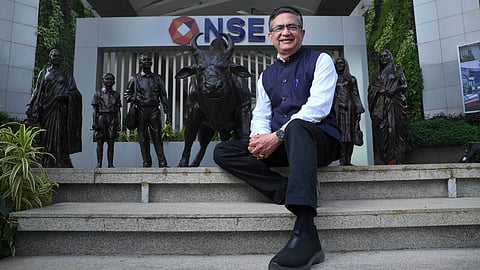
After struggling for the last several years, NSE finally gets the green signal for listing. It may well gatecrash into the top 10 companies.
Exactly 12 years ago (Business India issue dated 17 February to 2 March 2014), we carried a story on the transformation of the then 130-year-old Bombay Stock Exchange, the oldest stock exchange in Asia. The man who engineered the turnaround and invested heavily in technology was Ashish Chauhan, the current CEO of the National Stock Exchange. For more than 10 years, Chauhan led the transformation from the front before being asked to take charge of the National Stock Exchange.
NSE has been like a homecoming for Chauhan, as he was among the five-member founding team headed by R Patil, sent by IDBI, then a premier domestic institution, to start the new-age exchange. This was in 1992-93. The other members of the team were Ravi Narain, Chitra Subramaniam and R Kumar. Chauhan, being the only engineer from IIT Mumbai – albeit a mechanical engineer – took a keen interest in developing the IT platform and the delivery system through satellite-linked VSATs. Post his stint at IIT, Chauhan had also armed himself with an MBA from IIM Kolkata.

Chauhan played a major role in building NSE’s technological prowess, which was one of the key differentiating factors that saw the young, fledgling stock exchange become one of India’s leading exchanges, overtaking BSE. It took considerable effort to transform BSE, including that put in by Chauhan when he led the exchange for nearly 10 years. Chauhan and his team ensured that BSE became the fastest exchange based on the speed of matching transactions. Adopting Blue Ocean strategies at BSE, Chauhan built a mutual fund platform, grew the SME platform and introduced various products to ensure that BSE could compete with NSE. While BSE remained the number two exchange – the oldest, most respected and the fastest – NSE continued as the number one exchange.
Leadership problems at NSE and the surfacing of issues with the regulators saw Chauhan being brought back to NSE to sort out the problems. A lot has already been written about the issues of co-location, dark fibre and other matters, which need not be repeated here.
Chauhan had earlier worked with Reliance Infocom, thereafter as CIO of Reliance Industries, and also with the Mumbai cricket team owned by the Ambanis. He had played a major part in the Reliance Petroleum mega public issue. The IPO of BSE, which had been pending for nearly a decade, was completed in 2017 when Chauhan was CEO. Incidentally, NSE’s IPO has also been pending for well over a decade. The NSDL issue was also completed during his second innings at NSE.
SEBI recently gave the green signal to NSE, permitting it to proceed for its listing. NSE is not issuing any fresh shares, and the offer – which at best is likely to be under 5 per cent of the paid-up capital – will be an offer for sale by its existing owners to investors. Chauhan points out that none of the proceeds from the offering will come to the exchange.
Nevertheless, once listed, NSE will become an important, quantifiable market asset where it can legally use shares as currency to pursue further growth opportunities. Chauhan replies that NSE does not require cash, either earlier or at present. He is non-committal about future plans and says it is up to the board of directors to ultimately decide on them. He points out that a committee has been formed to look into the appointment of investment bankers and that a project manager will be appointed to oversee everything. “It will take around eight months before the NSE offering hits the market,” he says. Many experts feel that, having handled some marquee IPOs, Chauhan will be able to ensure wide ownership among domestic and international patient investors. “We would like to welcome long-term patient investors and ensure investors from various geographies participate in the issue.”
Wide investor base across geographies
People who know Chauhan are aware of the efforts he is making towards a seamless listing of NSE. “Chauhan is more than a technocrat. He understands business, not just exchanges. He thinks and acts like an entrepreneur,” says A Balasubramanian, MD & CEO, Aditya Birla Sun Life AMC.
“He takes a 360-degree view before implementing any decision. He focuses on customers. This helps him bring out relevant products. He invested in technology to transform BSE and help retail investors and the man on the street share in the wealth created through the exchange. He will do an encore with NSE and ensure wide participation to allow investors to share in India’s growth story. This is a rare ability. He is a hands-on person who empowers his team members, trusts them and is able to bring out the best in everyone. He does not believe in taking short cuts and stays on the right side of the law.”
Everyone agrees that Chauhan will be able to ensure the listing of NSE in a seamless manner. What is important is that the listing of NSE itself will be one of the most memorable moments for India. Globally, not many exchanges exist. The Abu Dhabi Securities Exchange, dubbed among the youngest, was set up in 2000. It has more than 200 companies listed and has grown to a 3 trillion dirham market, with 1.2 million investors from 200 nations trading on it. The Dubai Financial Market was also established in 2000. The Saudi Exchange was established in 2000. The point is that there is a scarcity of exchange businesses for investors. The NSE issue may sail through easily and secure a good valuation, better than that currently enjoyed by dealers transacting in unlisted shares privately.
Deven Choksey, MD and Founder of DR Choksey FinServ, points out: “Globally there are few listed stock exchanges. Given the rapid financialisation of assets, investors would like to have a listed exchange in their portfolio. NSE’s IPO will certainly see flows of capital from diverse investors across countries. Given the huge number of investors registered with NSE – around 13 crore unique client codes – and its presence across the length and breadth of the country, I am of the opinion that this figure may well multiply over the next decades. It would be worth having such a gem in any portfolio for large investors, including sovereign funds and pension funds. NSE’s IPO will draw in patient capital from around the globe. Besides, the exchange is not limited to equity but has various products and has the potential to introduce several more.”
NSE’s listing will be a high-profile one, and its valuation will set a benchmark for several fintech companies in the country. The institution, which has around 2,720 companies listed, has become a global leader in fund-raising, both for companies listed on the main exchange as well as on NSE Emerge, the SME platform, with consolidated revenue upwards of Rs19,000 crore, of which transaction charges account for nearly 71 per cent (see income graph). Like any technology platform company, it enjoys a high EBITDA. The consolidated EBITDA from operations is nearly 74 per cent (see income graph). NSE has already been building the exchange for the future by investing in technology and manpower. It is investing in AI-powered tools for real-time proactive and predictive monitoring, anomaly detection and risk mitigation. It is also making its workforce (1,757 as on 31 March 2025) future-ready. Thirty per cent of its workforce is under 30, and a third of them are women.
NSE, on listing, will enjoy a high P/E ratio, going by the trend of BSE, the only large exchange listed as of now. NSE’s market cap on listing may well see it gatecrash into the top 10 most valuable companies on BSE, where it will be listed (see box for details). Currently, the rules do not permit an exchange to list on its own platform. Post listing, Chauhan is expected to continue his work to make its international exchange one of the go-to exchanges for Asia-Pacific.
Asit Mehta, a prominent financial expert and founder of Asit C Mehta Financial Services, says: “Once listed, NSE’s confidence among global investors will also go up. Listing will bring in transparency and ensure good governance practices.” Mehta adds that Chauhan, an extremely capable administrator and visionary, “can try to attract companies from nearby countries like Sri Lanka, Indonesia, the Philippines, Vietnam and Malaysia. Companies with aspirations of expanding their global footprints are always looking to access a stable pool of capital, which Indian retail investors and institutions can provide.” Mehta says, that post listing of NSE, Chauhan can work on transforming NSE’s subsidiary in GIFT City to the next level.
Having already established itself in India, the next logical step would be to grow organically or inorganically. Says Mehta: “With the existing laws it may be difficult to take over exchanges in other countries. However, there is nothing to prevent tie-ups or running other exchanges. Ashish Chauhan can also look at exporting Indian expertise to countries for setting up, developing and running stock exchanges.” A Balasubramanian says: “I believe once NSE is listed, Chauhan may create more subsidiaries to make NSE an even more well-rounded exchange. He will certainly take a keen interest in growing his subsidiary at GIFT City and making it thoroughly global.”
Ajay Garg, Founder of Equirus Capital, a full-service investment bank, says: “The next step should be to make NSE the go-to exchange for the Global South.” Niren Shah also points out: “India has a robust foundation to become the preferred exchange of choice in Asia-Pacific. It already combines scale, technological sophistication, domestic liquidity and one of the world’s most active derivatives markets.” (See box for details)
“The biggest challenge for the exchange is to keep abreast of changing technology. Technology requires large capex and also becomes outdated fast,” says Deven Choksey. More than technology, NSE – as also other exchanges – faces a major challenge from Artificial Intelligence. Rogue traders can use AI with algos and smart technology, machine learning, to create havoc on exchanges, capable of disrupting trading as has been seen in the past. Fortunately, regulators are also seized of this emerging disruptor and are arming themselves to anticipate and pre-empt such moves accordingly.
While the fortunes of a tech-savvy platform company are linked to the health of the stock market, experts believe otherwise. Says Vijai Mantri, Founder of Mantri Financial Advisory Services: “Companies which run exchanges make more money than the index.” (See box on price-earnings for details) During the great gold rush, it was the vendors selling pots and pans who made more money than the actual prospectors. NSE’s listing could well reverse this. Not only will NSE be a gold mine, but it may also make money for its investors on the platform company.
Box 1
Listing services also lead to higher transaction income
One of the sources of income for NSE is the listing fees it levies on companies listed on its exchange. Currently, this accounts for around 2 per cent of total income, but going forward, with more and more companies getting listed, this share is bound to rise significantly. In a growth-oriented economy, one can expect the trend of new companies being listed to continue for several decades. Besides listing fees, NSE also earns processing fees and book-building fees. In the financial year ended March 2025, the total fees earned under these heads amounted to Rs314 crore.
With higher listings, one can also expect transaction volumes to rise, as newly listed companies bring with them both new and existing investors.
Besides the initial listing fees, most companies remain listed on the exchange for many years; hence, the pool of annual listing fees continues to rise as more companies are added year after year.
Based on the number of IPOs, India leads globally and is ahead of the USA and Hong Kong, though it is ranked No 3 in terms of total funds raised. In 2025, India saw 367 IPOs raising $22.9 billion. The USA raised $45.5 billion from 223 IPOs. (See table.)
In 2025 the funds raised from equity (IPO, follow-on and secondary OFS) was to the tune of R4.2 lakh crore. Debt raised on NSE platform in 2025 was Rs15.5 lakh crore. The total companies listed on NSE swelled to 2,358 on the main board with 784 on the NSE Emerge. The total market cap of the companies listed on NSE is approximately $5.3 trillion.
Box 2
Can India become the go-to market in the APAC region?
The value of a market is often compared on the basis of the total market capitalisation of the companies listed on a country’s stock exchange. In India, the two leading stock exchanges are NSE and BSE. NSE GIFT City is a subsidiary of NSE. Japan and China are the two countries that boast larger markets based on the market capitalisation of companies listed on their respective exchanges. The Shanghai market is the largest on this parameter at $9.1 trillion as at the end of last year. However, if one looks at size based on monthly volumes traded, Japan is the largest, with monthly volumes of $652 billion. Some of the leading exchanges in the APAC region are tabulated below, with the market capitalisation of all listed companies.
Post listing of NSE, Ashish Chauhan needs to position “NSE along with its subsidiary in GIFT City as a go-to market for the Global South”, says Ajay Garg, co-founder of Equirus India, a full-service investment bank offering a wide range of services. For one, India is a growing economy. The P/E ratios in Indian markets are relatively higher than those in markets such as the LSE, NYSE and Nasdaq. Valuations on NSE are often higher than those of companies listed on other exchanges. The investor population in India is larger than the entire population of several European countries. The equity culture is well developed. Compliance costs are lower.
Garg points out that Ashish Chauhan can channel capital from countries where India has inked bilateral trade treaties. What is required is that, similar to US markets, India needs a few globally recognised champion companies to be listed – on the lines of Amazon, Nvidia, Bharti Airtel or HDFC Bank.
NSE already has a subsidiary, NSE IX, often referred to as NSE International Exchange. It is a multi-asset exchange set up on 5 June 2017 and offers products such as Indian single-stock derivatives, index derivatives, currency derivatives, depository receipts and global stocks. The exchange also provides a range of primary market products – listing of equity shares, REITs, InvITs, depository receipts, debt securities and ESG debt securities – under the regulatory framework of the IFSCA (Listing) Regulations, 2024. The exchange has received exemptions from various regulatory bodies to allow US customers to participate in derivative contracts listed on NSE IX.
Niren Shah, Country Head, Norwest Partners, agrees that India has the potential to become a major market in Asia. “India has the robust foundation to become the preferred exchange of choice in Asia-Pacific. It already combines scale, technological sophistication, domestic liquidity and one of the world’s most active derivatives markets.”
This may not, however, be sufficient for NSE to become the go-to market. Shah says, “However, becoming the regional exchange of choice will depend on two critical factors: greater ease of cross-border capital and exchange flows, and expansion of institutional depth alongside retail participation to give global issuers confidence in long-term liquidity.” He adds: “If India can align openness with stability, it has a credible opportunity to position itself as the Asia-Pacific region’s next major capital market anchor.”
What is required is greater participation in GIFT City: a few high-profile board meetings and concerted efforts on the part of regulators to provide clarity, says another expert. Abolishing FEMA and allowing full capital account convertibility would be significant steps. As and when that happens, one could see companies from other Global South countries – say Malaysia or Indonesia – seeking listings in India to enjoy better valuations.
While niggling issues may remain, once the government realises the advantages of attracting global companies to list on Indian bourses, India will, as part of its Viksit Bharat drive, ensure that NSE becomes a go-to exchange for the Global South.
Box 3
High P/E of listed stock exchanges; NSE can easily gatecrash into the top 10 most valuable companies in India
Listed stock exchanges generally command a high P/E. The London Stock Exchange has a P/E of 40, Hong Kong has 39, while most exchanges trade at a P/E of over 25. This valuation is based not just on historical earnings; the price factors in growth over several years.
Stock exchanges are viewed as technology-based platform companies. This implies that, post the higher capex incurred during the initial exchange set-up stage, the incremental cost for handling higher volumes remains virtually unchanged. Scalability is inherent. NSE has the first-mover advantage as a technology-driven exchange. BSE, on the other hand, is seen as a traditional, historic and respected exchange, with technological transformation effected at a later stage.
Added to this is the network effect, where volumes attract more volumes on the exchange, further reinforcing scalability. Exchanges also enjoy high margins, as competition is limited. Setting up an exchange, given the heightened regulatory controls in each jurisdiction, is not easy.
The high P/E of exchanges is based not just on profitability but also on the strong moat, scalability and expected high EBITDA. It reflects not merely present earnings but anticipated growth over time. In India, the P/E is even higher in the case of BSE, which is trading at 52x on a trailing quarter basis.
If one were to apply similar criteria to NSE, the price, at an expected EPS of Rs60, would be upwards of Rs3,000, as against the grey market price of a little over Rs2,000. Logical or otherwise, less than 5 per cent of the shares are being disinvested. A scarcity premium, combined with expected demand from global investors and sovereign funds, is likely to push up the price on listing.
Based on this assumption, NSE’s market cap would easily place it within the top 10 most valuable companies in India, after Reliance Industries, HDFC Bank, Bharti Airtel, SBI, ICICI Bank and TCS: currently the six most valuable listed companies by market cap. Given the number of shares at 2,475 million and a share price of around Rs3,000, even in a worst-case scenario at Rs2,500, NSE would rank ahead of L&T, one of India’s most respected companies.
Vijai Mantri, Founder of Vijai Mantri Financial Advisory Services, a Mumbai-based firm, says: “Companies which run exchanges make more money than the index. Nifty 50 returns over the last 5 years have been around 13 per cent. Stock futures volumes have grown at 19 per cent CAGR. More importantly, index options turnover has risen at 50 per cent CAGR.” Fees from transactions have increased in a non-linear manner.
This is also one of the reasons many exchanges command a higher P/E than several of the companies listed on their platforms.
As the listing may take place towards the end of 2026, second-guessing the price may not be meaningful, as there are many imponderables that could influence market sentiment.
Box 4
AI vs AI
Artificial Intelligence, along with the smart use of technology and high-frequency trading, can make or distort the orderly functioning of markets.
Artificial Intelligence, along with smart technology, can become a game changer for markets. New machine techniques can read and assimilate data, news, corporate filings, results and many other facets, such as historical price movements, which any researcher would take at least a few hours, if not days, to capture and take a decision on.
There is nothing wrong in that, but sophisticated buy and sell signals emanating at high frequency from multiple accounts often distort price discovery and mislead retail traders and investors.
Heavy dumping of shares, often routed through fragmented accounts, can spark intense volatility and obfuscate reality.
Creating ghost liquidity in a non-transparent manner can mislead day traders. Retail investors, who are already losing on average up to Rs1 lakh annually in F&O, as per SEBI’s study, could see their losses increase even further with AI, HFT and high-tech ways of doing business.
Earlier, when exchanges used to run on the open outcry system at BSE, Asia’s oldest exchange, old-timers will recall that jobbers gave two-way quotes even as they held proprietary positions in the scrips. They would often fool brokers by seemingly buying large quantities when, in effect, they were net sellers in a big way, in a bid to cover their real trades, whether net buyers or sellers. The rationale was not to make it obvious to brokers throughout the settlement period, which used to happen every fortnight on alternate Fridays. Smart brokers at that time did not fall into the trap of second-guessing the jobbers’ trades or mimicking their real trades.
Unlike the few seconds in which two-way quotes were earlier given, today transactions are executed and cancelled within nanoseconds. This requires regulators to be even more vigilant and to deploy equally sophisticated tools and understanding to unravel the intricacies of trading, both legal and illegal. Fortunately, both exchanges in India, as well as the RBI and SEBI, are investing in AI in a big way. But as Ashish Chauhan admits, AI does pose a big challenge to exchanges worldwide, and regulators have to be on their toes at all times.
AI can also pull trade away from one exchange to private exchanges, which, as of now, is not such a threat in India.