
Is peace near?
On the first day of April, on April Fool’s Day, US President Donald Trump made a post on Truth Social that the Iranian government had asked for a ceasefire – a claim that Tehran dismissed in no time as false and baseless. Trump demanded that the Strait of Hormuz be opened ‘free and clear’. He threatened to blast Iran into oblivion – back to the Stone Age. But the IRGC retorted that the Strait would not be opened to the ‘enemies of the nation’.
The following day, the US strikes hit the B1 bridge – the highest in the Middle East – which connected Tehran to Karaj, killing eight people and injuring 95. The timing was particularly grim: Iranian families had been gathered in the parks below the bridge to celebrate Sizdah Be-dar, the traditional 13th-day Nowruz holiday, when Iranians picnic outdoors. Several international lawyers immediately labelled the attack a potential war crime. Trump gloated about the attack. Asked by a reporter whether he was concerned about committing a war crime, Trump said simply: ‘No’.
In the first week of April, Pakistan had put forward a peace proposal: a 45-day, two-phased ceasefire framework. Iran rejected it forthwith, countering it with a 10-point plan, which included an end to the US-Israeli attack on Iranian and pro-Iranian forces in Lebanon and Iraq, security guarantees against future attacks, war reparations, and international recognition of Iranian sovereignty over the Strait of Hormuz.
Responding to the Iranian rejection of the Pakistani proposal, Trump told the reporters on the White House South Lawn: “Every bridge in Iran will be decimated by midnight (on Tuesday). Every power plant in Iran will be out of business, burning, exploding and never to be used again. It will happen over a period of four hours – if we want it to.”
The following day, Trump again posted on Truth Social: “A whole civilisation will die tonight, never to be brought back again.” Hours later, with the deadline bearing down, Pakistani Prime Minister Shehbaz Sharif posted on social media that “the Islamic Republic of Iran and the US, along with their allies, have agreed to an immediate ceasefire everywhere, including Lebanon and elsewhere, effective immediately.” Trump again wrote on Truth Social that he had agreed “to suspend the bombing and attack of Iran for a period of two weeks,” on the condition that Iran reopen the Strait of Hormuz.

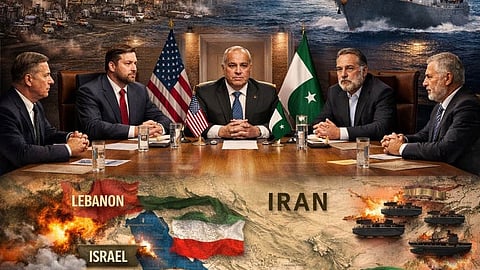
The most dramatic diplomatic episode of the month unfolded over 21 hours across 11 and 12 April in Islamabad, where, for the first time in the war, face-to-face negotiations between the US and Iran occurred. The US sent a 300-member team led by Vice-President JD Vance, alongside special envoys Steve Witkoff and Jared Kushner. Iran fielded a 70-member delegation headed by Parliamentary speaker Mohammad Bagher Ghalibaf and Foreign Minister Abbas Araghchi. Pakistan’s mediating team was led by Prime Minister Shehbaz Sharif, Field Marshal Asim Munir and Deputy Prime Minister and Foreign Minister Ishaq Dar. The talks ran through three rounds, the first indirect and the second and third direct. They failed.
Vance came out of the negotiation room and told reporters that the talks failed. “We just could not get to a situation where the Iranians were willing to accept our terms. I think that we were quite flexible,” Vance said at the press conference.
From Tehran, a different narrative emerged. An IRGC member, Esmail Kowsari, claimed the US had suffered a ‘humiliating defeat’ and said Trump was trying to secure a face-saving exit from the war, according to IRNA. Iran’s foreign ministry said there was no fresh proposal from Tehran.
With the Islamabad talks collapsed and the ceasefire strained, Trump announced on 13 April that the US Navy would enforce a maritime blockade of all traffic entering and leaving Iranian ports. In response, the IRGC Navy warned that any military vessel approaching the strait would be considered a ceasefire violation and would meet a ‘severe response’.
Promoting peace
Pakistan continued to work on the ceasefire. Field Marshal Asim Munir flew to Tehran for meetings with Iranian diplomats. After the meeting, Araghchi said Tehran remained committed to promoting peace and stability in the region. Separately, Pakistan’s Foreign Minister Ishaq Dar, speaking at the Antalya Diplomacy Forum in Turkey, gave the most optimistic public assessment to date: a US-Iran peace agreement was ‘more than 80 per cent’ complete, he said, adding that Pakistan ‘will leave no stone unturned’ in its efforts to achieve peace.
Meanwhile, Israel and Lebanon agreed to a 10-day ceasefire. Netanyahu said he agreed to the truce ‘to advance’ peace efforts. Iranian Parliament speaker Ghalibaf told his Lebanese counterpart that Tehran considered achieving a ceasefire in Lebanon as important as its own ceasefire with the US.
On 17 April, Iranian Foreign Minister Abbas Araghchi posted on X: “In line with the ceasefire in Lebanon, the passage for all commercial vessels through the Strait of Hormuz is declared completely open for the remaining period of ceasefire, on the coordinated route as already announced by Ports and Maritime Organisation of the Islamic Republic of Iran.”
It was not a permanent reopening but a conditional gesture, explicitly tied to the 10-day Lebanon truce, the durability of which remained uncertain. Trump hailed the announcement and thanked Tehran – but immediately added that the US blockade of Iranian ports ‘will remain in full force’ until the two sides reach a permanent peace deal.
What we have at the moment is a two-week US-Iran ceasefire, a 10-day Israel-Lebanon truce and a conditionally opened Strait of Hormuz. It remains to be seen whether a deal can be reached before the deadline on 21 April.