
Gulf Wars: How will the fourth oil shock impact India
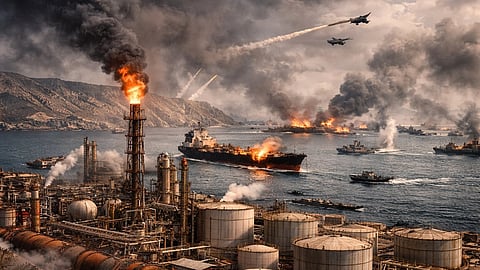
War has no winners. This time, however, in the case of the war on Iran mounted by the US and Israel, the repercussions are not just limited to the three countries but have spread across several countries in the Gulf region and beyond. Iran, which was targeted by the US-Israel combine, has instead of direct confrontation tried to attack US army bases in the Gulf across neighbouring countries including Kuwait, Saudi Arabia, Iraq, the United Arab Emirates, Qatar, Bahrain, Turkey and Oman. While the US and Israel mounted the attack, Iran, as a strategy, sought to widen the battlefields from countries adjoining the Red Sea as well as those bordering the Persian Gulf, even as it kept up pressure on Israel through air strikes and indulged in proxy wars across Israel’s borders. Clearly, it is fighting back with a vengeance to ensure that when negotiations do take place, as seems likely to end the hostilities, it does not approach the talks from a weaker position against a global giant. Iran, which is almost half the size of India, has demonstrated that it is unwilling to play dead. After firing munitions at Israel, it has slowed down, leading some to believe that it is conserving its armaments to prolong the war. It has even fired at Saudi Arabia and the UAE as well as the port of Oman. Iran’s rationale is to rattle the Gulf countries so that they can question the US and possibly pressurise it into bringing about a cessation of hostilities in the region.

The ripples of war have managed to cause tremors beyond the Gulf region, extending into Asia and Europe as well. The biggest casualty in the war, for countries not directly involved in the theatre of conflict, is crude oil.
Fourth oil shock
The war in Iran has triggered what may be known as the fourth oil shock. Crude has already touched $100 a barrel due to the stoppage of supplies through the Hormuz Strait. In the second week, insurance rates had gone up swiftly to $375,000 for a ship valued at $100 million, which is more than $100,000 per voyage. While the US has said it is willing to underwrite the risks for ships passing through the Hormuz Strait, there do not appear to have been any takers for the US offer so far. The US, which has its own fleet of mariners, is now requesting countries to send escort vessels to help keep the Hormuz Strait safe. Saudi Arabia, which has a geographical advantage over other Gulf countries, can ship crude through its east-west pipeline and route oil through the Red Sea. But this can only account for a fraction of the oil that normally passes through the Hormuz Strait. A couple of Very Large Crude Carriers (VLCCs) have reportedly sailed through to Asia, according to the latest reports.
India is fortunate that it has a strong partner in Russia, which has offered to sell both oil and gas, even as disruptions in the Gulf have forced many other ships to go through the Cape of Good Hope route. This will mean higher freight charges. With India buying crude from Russia, the price for an Aframax vessel (a ship with a capacity to carry between 600,000 and 700,000 barrels: one barrel averages 159 litres) has gone up to $15 million from $10-12 million per ship in February. Aframax vessels are smaller than VLCCs, which are meant for long-haul routes. These larger vessels have the capacity to carry on average around two million barrels. Suezmax vessels are smaller, and Russian crude can be transported through them. A couple of ships carrying Russian Urals crude have also come through the Suez Canal.
Iran has also allowed Indian-flag crude carriers safe passage. At the time of writing, two ships have sailed through the Hormuz Strait, with a few more in the pipeline. India has also gone on record to state that it will send escort ships to ensure against untoward incidents en route to Kandla, where the vessels are expected to berth. Says Captain Vinay Singh, MD, Marine HR, Anglo-Eastern Shipping Group: “Only Iranians want the Strait of Hormuz to be closed. So, if they permit, then it may certainly be possible for the Indian Navy to escort Indian ships from the Persian Gulf to India.” Reliance Industries has booked VLCCs to transport crude from Venezuela at elevated freight rates. Reliance Industries and Nayara Energy Ltd (earlier Essar Oil) are the only two companies that can refine Venezuelan crude oil. That is probably one of the reasons why RIL has been wooed to invest in the new Texas-based refinery coming up in the US.
More recently, another problem has arisen with the US bombing the island of Kharg, which houses Iran’s military and oil assets. In a social media statement, Trump said that at his direction the United States Central Command carried out “one of the most powerful bombing raids in the history of the Middle East”, claiming US forces had “totally obliterated every military target” on Kharg Island. Iran has retaliated and bombed US assets in the UAE. Bombing oil assets, the closure of gas refineries and the disruption of oil supplies have resulted in Gulf producers losing around $15 billion, according to preliminary estimates. Even after hostilities cease, pumping may not start immediately and would result in further losses being borne by Gulf producers.
While Russia will fill the gap created by the disruption of crude oil supplies, it remains to be seen at what rate it will sell crude to India. Given the looming global shortage, it may well reduce or totally do away with the discount altogether. Some reports indicate that Russian oil will, for the first time, be priced higher than Brent crude by $5-6 per barrel. Despite the higher price, securing supplies in a time of disruption will be beneficial for India, which reportedly has only a couple of days’ reserve of crude and petroleum products, unlike Japan which holds the third-largest strategic reserves after the US and China. During the Iraq war, the US had sold crude from its strategic oil reserves. This time, even the US is finding it difficult to source jet fuel on its eastern coast, as it had been dependent on supplies from the Gulf.
LNG is also a big worry, petrol and diesel prices unchanged
Besides crude oil, India’s LNG supplies have also been disrupted in a significant way, with Qatar having shut down its LNG plants. Supplies from the Hormuz Strait have dried up and India will have to import gas from Russia. Russia is sitting on huge gas fields in the Arctic region and Gazprom has inked agreements with GAIL for supplying LNG till 2030. There were some problems earlier which have since been settled. However, with Qatar’s supplies having totally dried it is a moot question as to when and to what extent Russia will be able to immediately fill India’s growing demand for LNG.
India has the ability to source LNG from various sources, including Australia and other countries. Besides Russia and Australia, the US is also a large supplier of LNG apart from the Gulf countries. While industrial prices have soared in the wake of the war, the Indian government has raised only the price of LPG cylinders by R60 per cylinder. It has also gone on record to say that it will not immediately raise the price of petrol and diesel. It should be recollected that even when prices were considerably lower, the government had not reduced the retail prices of petrol and diesel, allowing refineries to earn substantial profits for most of FY2026.
Biofuels – higher blending of ethanol beyond E20 required
While one hopes that the hostilities will not continue for months and may hopefully end in a few weeks, India needs to build a more robust energy security strategy in the long run. Brazil is one of the leaders in biofuels and has been able to save considerably on imported crude by ensuring that all its automobiles run on flex fuel (either ethanol or gasoline, or both). It produces ethanol from various sources, not just sugarcane and sugarcane molasses. India can also look at increasing ethanol blending beyond 20 per cent, a target which has already been achieved.
“When we talk of energy security for our nation, it is part of development on a large scale. We need to have a long-term strategy and work hard towards executing it,” says Tarun Sawhney, Vice-Chairman and MD, Triveni Engineering. Sawhney, who is also the Chairman of the National Committee on Bio Energy, CII, explains that India has done exceedingly well in completing the 20 per cent ethanol blending target. “It is a great achievement to have completed the target 5 years ahead of schedule. We have witnessed accelerated capital investment and high production capacities have been built. We now have capacities which can produce more than the 20 per cent demand of our refineries.”
Sawhney questions whether ethanol is being considered a serious contender for auto fuel. “We have to target a hybrid model on the lines of Brazil, which has significant agrarian output. In our case too, agricultural output has grown by leaps and bounds. Sugarcane yields have gone up, as has the yield of maize. We now have to seriously look at what comes after E20. The Central government can redefine transportation and promote flex-fuel cars. Brazil took 25 years, but we can learn from their example. Targets can be increased by taking the automobile industry into confidence. We have to look at the holistic picture of fuel blends and the environment. Higher blends with petrol can help the country save a huge amount of costly imports. Ethanol can be produced from rice, maize, sugarcane and several other crops. The government needs to look beyond E20 now and consider revising the pricing of ethanol. The procurement price has remained static for the last 2 years.”
Like sugarcane, where yields have gone up considerably over the last few years, production of maize has also increased sharply due to expanded acreage as well as the use of better seeds.
Several experts feel that India should ramp up the biofuel blend in petrol. Says Vijay Banka, MD, Dwarikesh Sugar Industries: “We can take ethanol blending up to 30-35 per cent. The government needs to take SIAM into confidence and revise the procurement price taking into account inflation and the increase in raw material costs.”
He agrees that the government’s earlier enthusiasm needs to be revived now that the E20 target has been achieved. Banka adds: “There is enough capacity built to increase ethanol production. Recently, a tender for 1,200 crore litres of ethanol saw offers for 1,700 crore litres. Once a clear roadmap is drawn, ethanol capacity can be quickly ramped up.” India, like Brazil, will have to encourage automobile companies to tweak their production so that hybrid fuels can be used without damaging engines, as is sometimes feared.
Brazil, besides its emphasis on clean energy, which has increased considerably, has also been fortunate in discovering offshore oil located at depths of 5,000-7,000 metres below sea level. These pre-salt oil fields, as they are called, hold nearly 100 billion barrels of light crude. While it is difficult to extract oil from such depths, advanced technologies for handling high pressure, CO2 and floating production and storage platforms are required. Petrobras, the main producer controlling around 98 per cent of the reserves, has tied up with several international companies to help extract oil from such depths.
While India has reportedly discovered offshore oil off the coasts of the Andaman Islands, it is too early to make firm claims about it. From a medium- to long-term perspective, the country should look at increasing its sources for producing biofuels. Besides sugarcane, it can utilise overripe fruits, vegetable waste, maize and other feedstocks. It should also look at developing alternative logistics routes instead of relying heavily on trucks for transporting petroleum products. Developing coastal routes is one step in the right direction.
More emphasis on building Strategic Reserves, Infrastructure Projects
For a country which depends on meeting over 90 per cent of its crude oil requirement through imports, one would have imagined India would have done much more to shield itself from oil shocks. The government’s strategic reserves should ideally have been at least 75-100 million barrels of crude and petroleum products. Sadly, we have just a little over 5.33 million metric tonnes of crude held by Indian Strategic Petroleum Reserve Ltd (ISPR), a wholly owned subsidiary of the Oil Industry Development Board under the Ministry of Petroleum and Natural Gas.
The company has three underground storage facilities – two in Karnataka (Padur and Mangalore) and one in Visakhapatnam. The current storage is hardly able to meet 10-12 days of the country’s demand. Besides ISPR, refining companies also maintain reserves of both crude and petroleum products, which can enhance the reserves by a few more weeks. ISPR was mandated with the task of retaining buffers to meet any major global supply chain disruptions and extreme crude price volatility, especially due to external factors.
An agreement inked with the Abu Dhabi National Oil Company (ADNOC) in 2018 allowed it to use part of another cavern at Mangalore with a capacity of 5.8 MMT. As per the agreement, ADNOC could sell 50 per cent of the crude from this facility to Indian customers while ensuring that the balance remained as a national reserve. A similar agreement was inked for Visakhapatnam. Renting out storage capacity is a good initiative as it also allows ISPR to generate income, but what is required is to fast-track projects that were planned years ago. Way back in 2018, the then Minister for Petroleum and Natural Gas, Dharmendra Pradhan, had stated in a written reply in Parliament that, in-principle, permission had been accorded for setting up two more strategic reserves – one at Chandikhol in Odisha (4 MMT) and another at Padur (2.5 MMT) – which would increase reserves by another 6.5 MMT. However, work has not started in Odisha due to problems of illegal quarrying. The government is contemplating identifying more locations for storing oil and is also looking at executing projects in the public-private partnership mode.
India is an associate member of the International Energy Agency (IEA). It aspires to become a full-fledged member of the IEA, which mandates member countries to hold at least 90 days’ worth of strategic reserves based on the previous year’s imports. Even when accounting for reserves held by refineries, India’s strategic reserves may not yet reach the mandated levels. As of 30 March, 2026, India’s strategic reserves (including those held by refineries) are estimated to cover roughly about 45 days of consumption. The government has to fast-track the building of strategic reserves irrespective of whether it becomes a full-fledged member of the IEA or not.
While one may argue that it does not augur well to think of building reserves when crude prices are above $100 per barrel, it still makes sense to begin work on building the necessary infrastructure at this stage to ensure that we have adequate strategic reserves when the next crisis hits. India can commercially rent out storage to oil companies and also build up reserves when prices come down to the $50-60 per barrel range.
Stock markets unnerved – should investors buy during the crisis?
Nervousness in Indian stock markets was felt even before the first missiles were fired on Iran by Israel and the US. The BSE Sensex had fallen by more than 8 per cent since 27 February. At 74,563, the Sensex is down by more than 11,000 points from the recent intraday high of 85,871. FII net sales in the first fortnight of March were more than Rs47,000 crore, one of the steepest fortnightly declines witnessed in recent times. This was despite DIIs offsetting the sales by purchasing nearly Rs70,000 crore worth of equities in the same period. One possible reason for the steep fall, despite the spirited buying by DIIs, could be the concentrated selling of index heavyweights. DIIs would have purchased both index and non-index shares, with the majority of retail investors probably staying put.
Markets rationalised that the sharp rise in crude could impact a host of industries including aviation, fertilisers, city gas distributors, tourism, aluminium, banks and several other manufacturing sectors. Investors fear that an extended war in the Gulf could also dent the country’s GDP. Rising crude prices would also induce higher inflationary pressure besides having an adverse impact on exports and imports. Disruption in crude supplies also put pressure on the currency, with the rupee dipping against the dollar by R1 to R92.70 in the first two weeks of March. Even so, panic has not yet set in. If panic had escalated further, the fall would have been much steeper.
Navneet Munot, MD and CEO, HDFC Mutual Fund, one of India’s largest private sector AMCs, points out: “While $100-plus oil undoubtedly presents a headwind in the near term, it is important to distinguish between cyclical shocks and structural shifts.” He adds: “India today is better anchored than in previous shocks of a similar kind. Our robust macroeconomic buffers and the depth of domestic capital flows act as a significant shock absorber. Rather than reacting to the noise of fluctuating oil barrel prices, investors should focus on the long-term compounding story. A disciplined approach to asset allocation and continuing with SIPs remain the most prudent strategy for navigating the turbulence.”
Retail investors do not really have a clue as to when the crisis will end, nor do they have unlimited funds to keep averaging in a declining market. However, such crises do test one’s conviction in the India growth story – and whether one should lose the opportunity to benefit from a crisis.
Vikas Khemani, founder of Carnelian Capital Advisors, which has an AMC managing more than Rs14,000 crore, counting HNIs, family offices and partners among its investors, says: “Energy prices and supply chain disruption are two major problems. We had seen this during the Ukraine-Russia war earlier too. Till the situation settles, we will see a weak environment.” He, however, adds: “Good prices and good news do not come together. If one has the capital and the stomach to bear risks in the short term, this crisis offers a good opportunity for investors.”
Rationality, however, demands that the first step for investors during a crisis is to ensure sufficient liquidity. Investors would first try to deleverage and maintain adequate bank balances. Rebalancing the portfolio would be the subsequent step. Dinesh Thakkar, Founder Chairman and MD, Angel One, which has one of the largest retail investor bases and who has witnessed several stock market crises, says: “Based on my past experience across many crises, the most important thing for investors is to stay calm and avoid impulsive decisions. Markets often react sharply to global events in the short run, but over the long run it is companies’ fundamentals and corporate earnings that drive value creation. In that context, I believe India remains on a strong growth path. Investors should review their allocation and the fundamentals of their portfolios rather than reacting to headlines. Periods of volatility can be used to rebalance portfolios. The key, however, is to remain disciplined and diversified, and make future investments with a long-term perspective rather than trying to find the exact bottom.”
It would indeed be an exercise in futility to try and second-guess the lowest point to which markets might dip. Mutual fund advisers will say expand your allocation to mutual funds and increase your systematic investment plans during a crisis. Some may even advise going for gold, but one has to consider several other factors dispassionately rather than act impulsively.
“Never let a crisis go to waste” was an oft-repeated saying popularised during the sub-prime financial crisis of 2008. At that time too, FIIs had sold in panic in the wake of Lehman Brothers and a few other banks going bust. During that period many blue-chip companies were trading at absurdly low prices. Hindalco had touched a lifetime low of Rs34, RIL was around Rs150, Tata Steel (face value Rs10) was at Rs140-150, while ACC had dipped to Rs450. Had investors acted in a contrarian manner, they would have seen the wealth from their investments multiply manifold.
Markets have not corrected to such levels and, hopefully, if there is even a hint of cessation of hostilities through negotiations, markets will be the first to react and move up swiftly.
For conservative investors, an opportunity to buy would be to act immediately when the market moves up decisively rather than trying to emulate experts who follow a contrarian approach. For those willing to follow the contrarians, it may make sense to look beyond the war and invest in companies that could benefit from the reconstruction phase in the affected countries. Shipping companies may also benefit from the surge in freight rates.
Many investors expect that the war will end sooner rather than later. War, as they say, is the most expensive form of stupidity. However, in the eventuality of prolonged hostilities in the Gulf, it would be a matter of concern for many countries, particularly those in Asia and Europe. It would be foolhardy to assume that Iran will be totally destroyed, or Israel, for that matter. The days of carpet-bombing cities are largely gone. The killing of innocent civilians would also result in severe backlash from the populations of the countries indulging in such barbaric acts.
We do not foresee prolonged hostilities as all sides realise the significance of crude oil, which remains the most valuable asset in the region. A prolonged war would only lead to the destruction of this prized resource. Even if hostilities end, it is unlikely that everything would return to normal immediately once a truce is declared. It may take several weeks before production resumes and supply chains are restored to near-normal levels. Underestimating an adversary’s capabilities or resolve has often led to serious miscalculations, as history has repeatedly shown in many wars.
Box
Impact on property
One of the fallouts of the Gulf War and the attacks on US bases in the Gulf region, particularly in Dubai and other UAE locations, has been nervousness among new investors. Many HNIs, including celebrities, had bought villas in the upmarket regions of Dubai. The attacks on what was once seen as a safe country, far removed from such violence, have created considerable concern among investors. Abhinandan Lodha, Chairman, The House of Abhinandan Lodha, points out: “India has emerged as a strong and stable economy during the crisis. We have good relations with several countries including the US, Russia, Israel and Iran. Several Indians used to invest in properties abroad, with an estimated $10-15 billion flowing to foreign countries including Dubai. Dubai was seen as a safe haven and also offered geographical diversification. Compared to the UK, where property prices have not risen significantly, Hong Kong being prohibitively expensive, and regulations in Singapore discouraging investors, the Middle East was the natural choice. Now, with the Middle East’s image as a safe haven coming into question, there is bound to be dissatisfaction among investors.”
Lodha, who has seen several of his clients make significant gains by investing in properties identified in India, says: “The immediate impact will see people stop making fresh investments in the Gulf. In case of prolonged escalation in hostilities, in stage two, we could see investors increasing their allocations to India.”
Not just property investors, India could also see a few industries relocating to the country.