
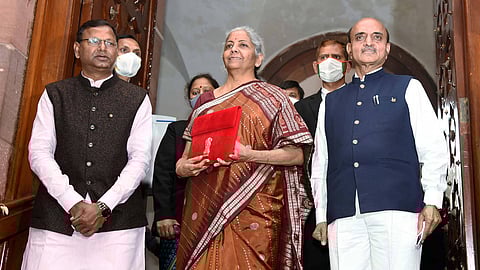
As the Indian economy grows, despite the recent hiccups, budget numbers are getting bigger and bigger. It’s not difficult to look for the big number in Budget 2022-23. It is the Rs7.5 lakh crore set aside for capital expenditure in the coming fiscal. This marks a 35.4 per cent increase over Rs5.5 lakh crore in 2021-22. The last time that the percentage capex share touched a similar big figure was when it came in at 19.32 per cent for 2004-05. The capex for 2022-23 will be 2.9 per cent of the gross domestic product (GDP). Effective capex of the Central government (including grants to the states) is estimated at Rs10.68 lakh crore, which will be 4.1 per cent of the GDP.
These numbers are important because, in the absence of private investment, it is public investment that the Modi government is hoping will drive the economy. It is also the only hope for the economy as the government has for some strange reason blocked off the traditional route of reviving the flagging consumer demand through a combination of tax breaks, perhaps lower duty on fuels and even handouts (for the poor). Such a strategy could have again made consumption the lynchpin of our economic growth.
It could have neutralised the impact of the pandemic-induced erosion of incomes and savings. Instead, the government has upped the capex beyond the 29 per cent in 2021-22. Finance minister Nirmala Sitharaman’s calculation is that the capex booster will ‘crowd in’ private investment. Already, she says, the productivity-linked incentive (PLI) schemes across 14 sectors have received an excellent response, with investment intentions worth Rs30 lakh crore received.
The government has zeroed in on infrastructure and feels that investment in this sector will have a trickle-down effect – spurring private investment in the cities, and enabling self-employment and small-scale entrepreneurship in the towns and villages. In her budget speech, Sitharaman emphasised the importance of PM Gati Shakti National Master Plan, driven by seven engines – roads, railways, airports, ports, mass transport, waterways and logistics infrastructure – in her scheme of things.
“These engines are supported by the complementary roles of energy transmission, IT communication, bulk water and sewerage and social infrastructure. The approach is powered by clean energy and Sabka Prayas (efforts of the Central government, the state governments and the private sector together), leading to huge job and entrepreneurial opportunities for all, especially the youth,” she said. The four focus areas will be: planning; financing (including through innovative ways); use of technology; and speedier implementation.
World-class infra dream
“The touchstone of the master plan will be the world-class modern infrastructure and logistics synergy among different modes of movement and location of projects. This will help raise productivity and accelerate economic growth as well as development,” the FM said. Among its major components will be a Master Plan for Expressways to be formulated in 2022-23 to facilitate the faster movement of people and goods.
The national highways network will be expanded by 25,000 km during the year. Contracts for the implementation of multimodal logistics parks at four locations through the PPP mode will be awarded. Railways will develop new products and efficient logistics services for small farmers and small and medium enterprises – the list goes on.
In theory, this is classical Keynesian economics at play – at a time when the private sector is reluctant or averse to invest, given the poor demand conditions, the government is weighing in and borrowing more to spend more. The expansionary nature of the Budget can also be gauged by the fact that government will, in 2022-23, go for a borrowing of Rs14.95 lakh crore – up from Rs12 lakh crore estimated for 2021-22.

Expenditure-driven
That’s where the gamble lies. Record borrowings may force the government to lean on the Reserve Bank of India to buy its bonds by printing new money. But with the US Federal Reserve embarking on an aggressive monetary tightening campaign, extending the pandemic-era glut of easy rupee liquidity may be risky. A combination of loose fiscal and monetary policies at a time of high trade deficits and an inflationary buildup could destabilise the rupee. The worst-case scenario will be that it may scare away foreign investors from India’s asset markets.
The budget is also silent on the inclusion of Indian bonds in global bond indices – something that was expected to attract more inflows from foreign investors. The silence on bonds, combined with the government’s record borrowing plan raises some concern that there may not be enough credit to fuel corporate growth. The fears about debt supply also come in at a time when global central banks are tightening interest rates and the Reserve Bank of India is also expected to do so.
The government and the RBI will now have to ensure that the borrowing programme for 2022-23 does not ‘crowd out’ the private sector. T.V. Somanathan, secretary, finance, feels the Centre's budget projections are realistic and that the borrowings will not spill over what is projected. Also, if small savings collections exceed the budget number, the government may borrow less from the market.
However, economists like Jahangir Aziz, chief Asia economist, JP Morgan, feel that, with growth for the time being driven by the public sector and debt already at a high level, this strategy could prove to be challenging. It is unlikely to prove sustainable in the long run.
Besides, as China has begun to realise, excessive focus on infrastructure as a long-term job creator can be a flawed strategy. China’s economy is more dependent on investment spending than any other major economy in the world, with some 43 per cent of its GDP coming through investment each year. Close to a fifth of that comes from investment in infrastructure.
The need to create jobs has resulted in the infrastructure sector continuing to expand in an attempt to fill that gap. Unprofitable projects arising out of this expansion had pushed China’s government debt to 73 per cent of its GDP before the pandemic, according to the IMF. Last year, China’s leading real estate giant Evergrande became the world’s most indebted company.
Not much politics this time
So, the Centre appears to have embarked on an economic gamble of sorts, though its efforts to maintain a tight fiscal space are evident. Despite the elections in Uttar Pradesh, Punjab, Uttarakhand, Manipur and Goa being round the corner, the budget has refrained from announcing freebies. It was being speculated that this would be done via increasing cash transfers to farmers under PM-Kisan from the current Rs6,000 per year, or by providing income tax relief to the middle class. Even the outlay on MGNREGA has been slashed to Rs73,000 crore, from Rs1,11,700 crore in 2020-21 and Rs98,000 crore in revised estimates (RE) for 2021-22.
Sitharaman’s rationale for ruling out for any feel-good interventions (read: tax cuts, sops) is that, with the economy reviving, its relief measures targeting the most vulnerable, such as free food, will no longer be needed. It remains to be seen if the government perseveres with this strategy as the 2024 general election draws nearer. We may, however, see a burst of munificence in 2023 and 2024.
The absence of giveaways provoked strong criticism from the Opposition parties, including from Congress leader Rahul Gandhi, who said that Prime Minister Narendra Modi’ s economic policies had led to the creation of ‘two Indias’ – one for the rich and the other for the poor. Gandhi’s latest speech in Parliament touched upon a range of issues concerning the budget – from the silence over jobs and, what he called, the ‘decimation’ of the small and medium industry to the concentration of capital in the hands of ‘AA’ (a reference to Ambani and Adani).
Even the RSS-affiliated Swadeshi Jagran Manch says that the budget, while being growth-oriented, lacks a push for employment. A ‘quantum jump’ of 35 per cent in capital expenditure, taking it to over Rs7.5 lakh crore, can improve the future growth prospects in the country, it said. However, only ‘limited efforts’ have been taken towards promotion of small-scale industries and creation of employment in the country.
It was to counter such criticism that Modi stepped into the fray, telling BJP workers at a hastily organised event that the massive four-fold jump in capex compared with the UPA years of 2013-14, will bring more investment and open multiple job avenues for the youth.
Market endorsement
Market experts seem to back the government’s strategy. “Such a massive growth of 35.4 per cent in fiscal capex will trigger business growth for sectors like infrastructure, capital goods, industrial, metals and manufacturing,” says Vinod Nair, head of research, Geojit Financial Services. Deepak Jasani, head of research, HDFC Securities, too, feels that the higher spend on infrastructure will augur well for construction, capital goods, metals, cement and pipe manufacturers. For instance, the government has allotted Rs48,000 crore for housing projects under the affordable housing scheme, which would boost the prospects of cement companies, while the Rs60,000-crore allocation for providing access to tap water to 38 million households will be a positive for pipe manufacturers.
The economic premise of the capex booster also is that it will generate jobs, contends Sushil Kumar Modi, former deputy CM of Bihar and now MP, Rajya Sabha. “The employment will be a by-product of 9.2 per cent GDP growth projected by the government. It’s not jobless growth. It’s development, along with employment.”
Job creation, says the BJP MP, who once headed the empowered committee of state FMs on GST, is not done in silos. It is achieved by steps such as the ones outlined in the budget. The production-linked incentive schemes alone will generate as many as 6 million jobs in five years. Be it Nal Jal Yogna (the tap water scheme) or PM Awas Yojana, they will create jobs, be it at the lower level. The Rs1 lakh crore, 50-year interest-free loan given to the states for capital expenditure is another addition to the government’s plan to boost long term growth and job creation.
Besides, as senior bureaucrats in the finance ministry say, there is a repeated emphasis on domestic manufacturing across sectors (including defence and electronics) which, if successful, could mean jobs apart from self-reliance.
Other positive elements
While Sitharaman’s fourth budget will distinguish itself for its capex boost, it has other elements of interest as well. The proposals for Indian Railways have enthused the rail industry. Taking a decisive step towards engine-less propulsion system for passenger trains in future, the budget talks of manufacturing 400 new Vande Bharat trains in the next three years. This will be in addition to 102 Vande Bharat trains already in the pipeline.
The trains, running at a maximum speed of 180 kmph, will mostly be made of light-weight aluminum, making them more energy efficient. It will mark the upgradation of our rail transport in a substantive manner, akin to the introduction of Shatabdi trains in the 1980s. Alongside, 100 greenfield multi-modal cargo terminals will be constructed. The Vande Bharat trains and cargo terminals will be built under the PM-Gati Shakti scheme.
How soon the jobs will be generated is moot, as big projects have long gestation periods, unlike MSMEs, which when in full flow can create jobs overnight upon receiving orders.
That apart, there are small flourishes in the budget, which distinguish it from the previous exercises. A National Tele-Mental Health programme has been launched to tackle the problems of mental health of people of all ages accentuated by the Covid-19 pandemic. There is a clear focus on reducing the economy’s carbon intensity (and footprint) – from pushing the cause of solar (through a boost to local manufacturing of modules) to sovereign green bonds to implementing recycling policies across 10 sectors to a push for public transport in urban areas to a battery swap plan for electric vehicles.
There is a continued push on the digitisation front, which is also evident in the 50 per cent increase (to Rs79,887 crore) in the information technology (IT) and telecom expenditure budgeted for 2022-23. There is a nod to the future – not just in the decision to adopt a central bank digital currency, but also in plans for areas such as Artificial Intelligence, genomics, space and efforts to bundle high-tech into plans and policies across sectors.
And, there is the demonstration of the ability to leave well enough alone. There are no new worrisome or meddlesome taxes (the one on crypto and digital assets was perhaps required). All of this has been achieved with a fiscal deficit that is estimated to be 6.4 per cent of the GDP in 2022-23.
On the upcoming policy front, Sitharaman announced that the government will undertake ‘Ease of Doing Biz 2.0’ and take steps to accelerate the pace of exits for businesses. Also, the insolvency & bankruptcy code (IBC) will be amended to enhance the efficiency of resolutions and also introduce a comprehensive framework for cross border insolvency.
While betting on investment rather than consumption, the budget also clearly focusses on boosting economic growth over fiscal stringency. The fiscal deficit for 2021-22 was 6.9 per cent, which overshot the previously budgeted 6.8 per cent. For next fiscal, the fiscal deficit target has been pegged at 6.4 per cent, even as Sitharaman noted that she was mindful of the medium term fiscal deficit target of 4.5 per cent for 2025-26 announced in the last year’s budget. This stance on fiscal deficit and promised capex spend increase clearly cheered the capital markets.
Conservative math
While on the subject of the deficit, the math of the budget appears to be conservative. It assumes a nominal GDP growth of 11.1 per cent, which is low. In 2021-22, it assumed a nominal growth of 14.4 per cent, but ended up seeing nominal growth in excess of 17 per cent – which also found a reflection in its buoyant tax revenue. This seems to suggest that the tax revenue for 2022-23 could also beat the budget estimates.
The government will be hoping because of the tax revenue windfall, the actual fiscal deficit could be substantially lower than the budgeted one. To be sure, it is also possible that this conservatism is born out of fears about downside risks, including ongoing supply constraints and the rising price of oil that may push down real growth from the 8-8.5 per cent mentioned in The Economic Survey.
The increase in total expenditures is quite modest, says C. Rangarajan, former governor of RBI and later head of Prime Minister Manmohan Singh’s economic advisory council, while welcoming the emphasis on capital expenditure. “The capital expenditures are expected to increase by 24.5 per cent over revised estimates. This should help to catalyse private investment.
But, increase in total expenditure is modest. The increase is only by 4.6 per cent over revised estimates. Also, the subsidies – both on food and fertilisers – have been brought down. It is not very clear how this will be achieved. With respect to expenditure, the major concern is how well they will be executed.”
Indeed, like all other plans built around public investment, Budget 2022-23’s success (or failure), will finally come down to the timely disbursal, and the efficient utilisation of this money. Also, if the overall spend is up just 4.6 per cent, this will be lower than what inflation will be next year.
Health, education not in focus
Another surprising element is that public health is down to Rs41,011 crore. One wonders if this is because of reduced vaccination costs, which is now Rs5,000 crore. If so, this means that the government isn't going to offer free booster doses to everyone.
This is a clear sign that the government is now leaving it to the states to vaccinate people, observes Pronab Sen, the former chief statistician of India, who is the country director of the International Growth Centre. This also means that some states, possibly the richer ones, will do so more effectively and comprehensively, whilst others would do so less well. This means that the potential for infection continuing and breeding new variants will remain and that, in turn, could endanger the rest of the country.
Montek Singh Ahluwalia, former vice-chairman of Planning Commission, regrets that the government which aspired to have 100 per cent vaccination coverage for adults by 31 December 2021 could manage only about 62 per cent. It should have used the budget to make a statement on its vaccination targets by placing orders with vaccine manufacturers. “Nothing will increase the credibility of a country’s potential performance than the perception that it has got the Covid pandemic under control,” he feels.
Education too has not got the priority it deserves. During the pandemic, long spells of school closures due to the lockdowns and a stark digital divide have had a ‘significant impact’ on the education sector affecting hundreds of thousands of schools and colleges across the country. Children have lost nearly two years of formal education due to the disruptions.
The National Education Policy 2020 (NEP) calls for public investment in education to 6 per cent of GDP. Though budgetary outlay has been hiked by 11 per cent over last year’s allocation, it is stuck at 3.1 per cent of GDP. Without a well-educated and skilled workforce, it will be difficult to expand India’s knowledge economy.
Divestment, asset monetisation
There is some worry among market observers on disinvestment receipts. The budget has scaled down the revised estimated to Rs78,000 crore for the current fiscal as against Rs1.75 lakh crore at the Budget estimate level. For 2022-23, the disinvestment receipts has been pegged at Rs65,000 crore. Asset monetisation also finds scant attention.
Perhaps, this is because the strike rate has been poor this year (barely 30 per cent of the projected Rs88,190 crore). Were the recent protests by young job-seekers over limited public employment opportunities in Bihar and UP, along with the opposition-fanned perceptions of a ‘sell-off of national assets’, responsible for Sitharaman not making an aggressive pitch on privatisation or asset monetisation in her budget this time?
But the fact remains that, in a year of record capital raised by the private sector, including the likes of Zomato, Paytm and Nykaa, the poor receipts from disinvestment and asset monetisation and the paltry receipts projected for the coming year, send out a wrong signal. Sitharaman’s defence is weak – she says that with the strategic transfer of Air India ownership having been completed and strategic buyer for Neelachal Ispat Nigam Ltd (NINL) selected, it is a matter of time before other PSUs marked for sale find buyers.
She said that, during the pandemic, the stock market was indeed performing well, but it is not just the stock market that decides whether a public asset to be disinvested. Disinvestment needs to happen with all the processes in place and the timing has to be right. “There are so many other factors. I have to take everybody on board and move,” she said.
Farm strategy?
The government hasn’t announced a plan for agriculture, after having burnt its fingers on the three reformist farm laws. Farmers are expected to up the ante any time on Minimum Support Prices, an issue that was left unresolved when they called off their agitation.
After the backlash on farm laws, the government has decided to go slow on long-pending reforms like raising urea prices and bringing it under the nutrient-based subsidy regime or to phase out the current open-ended minimum support price procurement of wheat and paddy. It appears that the possibilities of such reforms appear remote ahead of the General Elections of 2024.
It would be somewhat uncharitable to surmise that the budget to a large extent does good, by not doing bad. Perhaps, the markets have heaved a sigh of relief not only because of the step-up in capital outlays, but also because of the absence of any proposals on wealth or inheritance tax or grandiose new schemes. Now, the focus shifts to implementation of schemes that are already drawn out, such as PLI schemes and PM-Gati Shakti, the ambitious platform for multi-modal connectivity. For the Modi government, growth is not just an economic necessity, but also a political imperative. Clearly, jobs will hold the key to its return in 2024.