
Can India-Russia ties be rebooted?
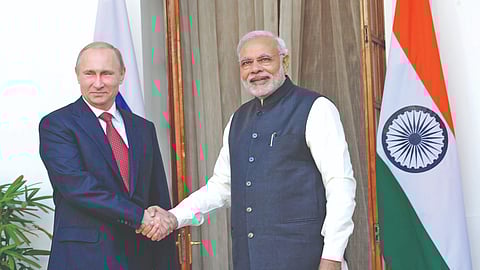
It was a cold December evening (by Delhi’s standards) on 4 December when Russian President Vladmir Putin’s plane touched down at the Palam Airport. Putin must have felt the sting in Delhi’s acrid air, as he stepped down the aisle to be greeted by Prime Minster Narendra Modi. The Air Quality Index (AQI) in Delhi was well nudging 300 whereas, in Moscow, it was a breezy, comfortable 60. But other things possibly weighed on his mind.
First, there was an important geo-political angle to the visit. Facing increasing isolation from the West, Putin wants to prove that efforts to isolate Russia over the war in Ukraine have failed. Flying to India and meeting Modi is one way of doing that. He did that by travelling to China and holding talks with Xi Jinping three months ago on the sidelines of the SCO summit. He is sending out a message: Moscow may be isolated in Europe but it has connections to Asia and the Global South. Economically, that is the future. In that sense, he wants to see Russia return as the main actor in these parts of the globe, like the erstwhile Soviet Union.
By coming to India, Putin has signalled that he wants Russia to be less technologically and economically dependent on China, which has leveraged the asymmetry in the relationship, by using Russia as a market to absorb its exports. Following Russia’s full-scale invasion of Ukraine, Chinese exports have soared – the surge especially pronounced in strategic sectors like cutting edge machinery and electrical equipment.
On the eve of Putin’s visit, his spokesman Dmitry Peskov announced, among other things, that Russia was looking at increasing imports from India and, for this, a forum of importers was coming to find ways at achieving this. “We are aware that we’re selling much more than we buy from India,” he said. “And we know that our Indian friends are concerned about that. We’re working together with our Indian counterparts in order to find ways to increase the amount of goods that we can purchase from India – not only goods but maybe services too”.
A tall order
Putin, while addressing the India-Russia Business Forum, said that, while he and Prime Minister Modi have set a $100 billion trade target by 2030 between the two nations, the early signing of the preferential trade agreement between India and the Eurasian Economic Union (EAEU) will reduce barriers to facilitate the movement of goods, services and capital. India and the EAEU held the first round of negotiations for the free trade pact a week before. Russia, Armenia, Belarus, Kazakhstan and Kyrgyzstan are the five member countries of EAEU. But, enhancing trade will mean reducing barriers for facilitating the movement of goods, services and capital between the two regions – a tall order to be accomplished in the immediate future (see Box: Tough nut to crack).

Yet, there are signs of an incipient economic underpinning to our bilateral ties. Russia’s central bank has opened an office in Mumbai to ‘advance the interest of the Russian financial sector’. Russian lenders Gazprombank (partially owned by energy firm Gazprom) and Alfa Bank (Russia’s largest privately-owned lender) have sought clearance to begin operating in India, which is already hosting Russian lenders Sberbank (which recently announced it had launched a rupee-denominated letter of credit with deferred payment for purchases in India that will help Russian companies increase imports) and VTB Bank.
Both have agreed to continue jointly developing bilateral settlement systems via national currencies in order to support bilateral trade seamlessly, according to a joint statement following the talks. The share of settlements in national currencies between Russian and Indian companies is 96 per cent. The two sides also intend to continue consultations on integrating national payment systems and financial messaging systems, as well as central bank digital currency platforms.
Clearly, India matters to Moscow because with a burgeoning population and economic growth exceeding 8 per cent in the recent quarter, it is a hugely attractive market for Russian goods and resources – especially oil. Before the Kremlin’s full-scale invasion of Ukraine, only 2.5 per cent of India’s oil imports were Russian. That figure jumped to 35 per cent, as India took advantage of Russian price discounts, prompted by sanctions against Moscow and Russia’s restricted access to the European market. Putin would like this arrangement to continue somehow, despite the pressure being exerted by pare down these imports. His declaration, standing next to Modi, that Russia will ensure uninterrupted fuel supply to India, suggests that the two countries are devising a strategy to keep the crude flowing, despite the sanctions.
Selling weapons to India
Weapons sales to India are another priority for Moscow and have been since Soviet times. Russia has historically been, and remains, our largest supplier of military hardware and spares. Operation Sindoor, the limited armed conflict with Pakistan in May this year, proved the indispensable role of Russian platforms like the S-400 air defence systems in repulsing Pakistani attacks. But it also showed the vulnerabilities that the country urgently needs to fix. Reports suggest that India wants to buy the upgraded S-500 systems and the Russians are keen to sell the Su-57 fifth-generation fighter jet. However, there was no mention of this in the joint communique released at the end of his visit and India-Russia defence deals have always remained off the books at summit-level meetings.
Besides, Russia is facing a shortage of critical components due to sanctions and the war in Ukraine. The deadline to deliver some units of the S-400 have reportedly been delayed to 2026. India is seeking some guarantees on timelines. Besides, India is turning to the West for military hardware and has also amped up its domestic production. It is possible that the Russians may now be more amenable to the joint production of some military hardware. Peskov has highlighted Brahmos missiles as a symbol of India-Russia defence co-operation and said that the two sides are working on ‘quite a variety of complicated systems’.
Russia is also keen to expand the export basket to cover, among other things, small modular nuclear reactors (SMRs) and floating nuclear power plants. A sizeable nuclear industry delegation was accompanying Putin. Russia has a lead in the nascent field of SMRs, which are advanced nuclear reactors that have about a third of the generating capacity of most traditional nuclear power reactors but can produce a large amount of low-carbon electricity. But no announcement on this was made, possibly because the Americans too are sending a high-level delegation of their nuclear industry soon.
However, Putin’s visit coincided with a statement by Russia’s state-run nuclear corporation, Rosatom, confirming the delivery of its first consignment of nuclear fuel for the first loading of the third reactor at the Kudankulam plant. The nuclear plant, being built with Russian help, is set to have six reactors with a total capacity of 6,000 MW. The first two reactors were connected to the power grid in 2013 and 2016, while the remaining four are still under construction.
Two labour agreements signed during the summit could create safe pathways for Indians to work in Russia, which is suffering from a manpower shortage. These deals could also safeguard Indians from getting trapped by scammers as a result of which they have been forced to fight with the Russian army against Ukraine. The pacts also open new avenues for Indian professionals to work across a wide range of sectors in Russia at a time when the US is restricting immigration. If leveraged to its full potential, implementation of the pact could cultivate an Indian diaspora in Russia, comparable in scale to that in the Gulf.
“Russia needs 5 million manpower,” says Manish Kumar, vice-chairman, Moscow Chamber of Commerce & CEO, Soltex Group, underlining the potential for India to integrate more closely with the Russian economy through its skilled workforce. “Russia is our close ally and we should integrate with their economy with our skilled labour, so that we both are in a win-win position. We need employment for our youth and Russia needs skilled workers,” Kumar told Business India.
Kumar also outlined his group’s initiative to train welders for the Russian market. “From 15 December, we are starting a technical programme with one prominent Russian university for welders,” he informed. “Welders will be getting all the training on Russian welding machine we are importing from Russia. Everything is already tied up, and when the programme starts, trained welders with technical knowledge of the Russian language will go there. After that, we are planning for robotics, drones and other areas that Russia requires. We have to create that kind of ecosystem in India, where the skilled labour will be trained as per the Russian requirement.”
As for Modi, despite coming under intense pressure from Western governments to criticise Russia over its war in Ukraine, he has maintained that dialogue was the only way to resolve the conflict. This is all about ‘strategic autonomy’ – with India occupying a unique place in the geopolitical order by having close ties with Moscow, while maintaining his relationship with the West at the same time. Of course, Trump’s weaponisation of tariffs upon his return to the White House had queered the pitch.
Balancing act
In this context, Putin’s visit assumes more significance for Modi than ever before, because it will test India’s geopolitical autonomy. He was forced to walk the proverbial diplomatic tightrope which he did by declaring that India’s position was not about being neutral but about achieving lasting peace. A possible visit of the beleaguered Ukraine President Volodymyr Zelensky could be another manifestation of the balancing act.
Besides, the Putin visit provided Modi an opportunity to show his domestic audience and the world outside that he still counts Putin as his ally and hasn’t given into pressure from US President Donald Trump, who also was earlier referred to as his ‘true friend’. The trick was to ensure that the strengthening of India-Russia ties does not overshadow the ongoing FTA talks with the US and the proposed trade partnership with Europe.
Modi’s other priority was to unlock the potential of bilateral trade between India and Russia. Indeed, the economic relationship between the two strong allies has underperformed for decades with neither the Indian corporate elites nor Moscow’s oligarchs sensing opportunities to do business with each other or in each other’s countries. If the bilateral trade rose to $68.72 billion at the end of March 2025 – up from just $8.1 billion in 2020 – it was largely due to India sharply increasing discounted Russian oil purchases. This has skewed the balance heavily in favour of Russia and that is something India wants to correct.
With Indian firms like Reliance already reducing oil purchases from Russia to avoid sanctions from Washington, the two countries will look at other areas to boost trade. Both sides have set an ambitious target of $100 billion in bilateral trade by 2030, but New Delhi has made clear that the growth must come with greater balance.
Currently, consumer-oriented and high-visibility categories remain marginal: smartphones ($75.9 million), shrimp ($75.7 million), meat ($63 million) and garments at just $20.94 million underscore India’s limited penetration in Russia’s retail markets and electronics value chains. Piyush Goyal, Union commerce minister, says several sectors hold strong potential for expanding Indian exports to Russia. These include consumer goods, food products, automobiles, tractors, heavy commercial vehicles, smartphones and other electronic equipment, industrial components and a wide range of textiles. The services sector – already a global strength – can also contribute significantly to enhancing trade with Russia.
Shyam Saran, former foreign secretary and one-time boss of S. Jaishankar, present-day external affairs minister, sees the visit as a political win for Putin and a reinforcement of the fact that Russia is a stable partner of India. “Europe is most unhappy about the red-carpet welcome given to Putin at a time when he is escalating the war in Ukraine. But Europe has more to fear from the US’s unreliability and its repeated bullying of Ukraine.”
An economic escape route?
The visit of Putin to India must be seen in the context of the uncertainty inherent in evolving situation in Ukraine and his dependence on India as an economic escape route of sorts. During the last two years, India has been an important source of energy revenue for Russia. Crude petroleum and mineral fuels formed the single largest export, accounting for about $56.8 billion in 2024-25 and over a third of India’s total oil imports. Besides, India is a significant importer of Russian fertilisers, with trade valued at around $1.84 billion in 2024-25. Trump has in the past said that the money coming to Russia from exports to India is financing the war in Ukraine.
Despite Russian forces encircling Ukraine and gaining an upper hand militarily, there have been continued Ukrainian drone attacks on Russian oil infrastructure. Ukrainian drones have been striking oil refineries and ports from the Black Sea to the Baltic coast with seeming impunity, sometimes traveling as far as 2,000 miles deep into Russia to targets in Siberia. Even as Putin was preparing to leave Moscow for New Delhi, Ukraine hit the Druzhba oil pipeline in Russia’s central Tambov region. This was the fifth attack on the pipeline that sends Russian oil to Hungary and Slovakia. Though the pipeline operator and Hungary’s oil and gas company said that supplies were moving through the pipeline as normal, crude oil futures traded higher.
Putin’s visit comes in the wake of a significant internal economic fracture in Russia. As his war on Ukraine enters a fourth winter, Russians are coming to grips with its growing impact on nearly every aspect of their daily lives. They have started to feel the economic toll. From households cutting back on food spending to struggling steel, mining and energy companies, the country’s economic engine is feeling multiple pressures and the earlier resilience spurred by massive fiscal stimulus and record energy revenues is being tested.
The fallout is hitting just as the US applies pressure to curb oil & gas revenue flowing to Moscow as part of Trump’s plan aimed at reaching a ceasefire. Despite the bluster, Russia is keeping the door open for a deal.
Moscow is not averse to working behind the scenes on a package that would give Kremlin the sanctions relief it wants.
During the early stage of the war, when gross domestic product was expanding on the back of military-linked investments, it had driven an almost 20 per cent growth in wages in 2024, boosting consumer demand though also contributing to inflation. Russia’s central bank hiked rates to a record 21 per cent in October last year, to cool inflation and slow an overheated economy but even as borrowing costs have eased the economy is increasingly showing the delayed impact of monetary tightening. In the process, deeper imbalances have been exposed in a country that’s retooled for war while still supporting a civilian economic sector.
Inflation eased to about 6.8 per cent in early November, but the key reason is weakening consumer demand. Russians are reported to be cutting back on food as the average bill for weekly grocery purchases has more than doubled in recent years. Economic growth has slowed down to 0.6 per cent in the third quarter, missing estimates, while the budget deficit hit 1.9 per cent of GDP in October and the finance ministry expects it to grow to 2.6 per cent of GDP by year-end. The all-important oil & gas revenue dropped by over a fifth in January-October from the same period a year ago to 7.5 trillion roubles.
Meanwhile, the recent talks between the US and Russia to end Ukraine war have ended without any result. However, Trump said the meeting between Putin and US envoys was ‘reasonably good’. Speaking to reporters at the Oval Office, Trump said the US special envoy Steve Witkoff and his son-in-law Jared Kushner briefed him about the talks. Their impression from the meeting was that Putin would like to make a deal. “What happens now, however, is unclear,” Trump said. Market players feel that an end to the war between Russia and Ukraine would help increase crude oil supplies to the global markets. But that isn’t likely unless Russia manages to get swathes of the Ukrainian territory under the US-brokered deal and Europe agrees to it.
At a time when Putin is under pressure from the US and the West to accept a ceasefire in Ukraine and India has been slapped with tariffs for continuing to buy Russian oil, it was significant to see both Modi and Putin make it clear that neither side is willing to give up on the time-tested friendship between the two nations. While their summit was heavy on talk and thinner on the actual outcomes, it could pave the way for more substantive deals in the coming weeks and months. We need to wait and watch.
Box 1
A tough nut to crack
India-EAEU FTA has its own pluses and minuses
The gains
Big market access
The FTA will open access to a $6.5 trillion Eurasian market, helping India increase exports in pharmaceuticals, engineering goods, textiles and agriculture.
Reduced dependence on the West
India-EAEU trade touched $69 billion in 2024, growing 7 per cent from 2023. This helps India diversify away from the US and EU amid rising tariff pressures.
Stronger energy security
Russia already supplies 35-40 per cent of India’s crude oil imports. An FTA can ensure stable and long-term access to oil, gas, coal and other minerals at competitive prices.
Lower costs for Indian businesses
Removing or reducing tariffs across EAEU countries can make Indian MSME exports cheaper and more competitive, especially in textiles, pharma and machine parts.
Boost to connectivity
The FTA will support major trade routes like the International North-South Transport Corridor (INSTC), which can reduce transit time between India and Russia from 40 days to nearly 20 days.
The hurdles
Complex tariff structures
India and EAEU (Russia, Belarus, Kazakhstan, Armenia & Kyrgyzstan) have different tariff regimes; harmonising these across five countries slows negotiations.
Sanctions on Russia
Over 14,000+ Western sanctions on Russia complicate payment systems, logistics and compliance for Indian companies.
Trade imbalance
India’s trade with EAEU is $16-17 billion and over 85 per cent is dominated by Russia, creating dependency and imbalance.
Connectivity barriers
INSTC and Chabahar routes are still not fully operational; cargo movement takes 35-45 days, increasing cost and reducing competitiveness.
Regulatory & standards issues
India and EAEU follow different standards for pharma, engineering goods and food products, requiring alignment before tariff cuts.
Limited market awareness
Indian exporters have low awareness of EAEU demand patterns; only 3-4 per cent of India’s global exports go to this region, limiting immediate gains.
Box 2
‘This is the Soviet moment for Indian businesses’
It is important to develop special purpose vehicles (SPVs), which should be immune to sanctions between India and Russia, says Anil Trigunayat, former ambassador of India to Jordan, Libya and Malta and a distinguished fellow of Vivekananda International Foundation, as also head, West Asia group. In conversation with Yeshi Seli, he describes India’s relationship with Russia as trusted and time-tested
How significant is the annual India Russia summit, as also President Putin’s present India visit?
Annual summits were institutionalised a quarter century ago with Russia. And, this state visit of President Putin is the 23rd Summit. Prime Minister Narendra Modi and President Putin have met about 19 times during the past 11 years, which indicates the importance attached to the bilateral relationship and exceptional comfort level and chemistry between the two leaders. Apart from bilateral issues, President Putin has also possibly explained his position and rationale with regard to the conflict with Ukraine. Besides, US President Donald Trump’s Peace Plan is still under discussion. Ending the war is important for India, as it gets dragged in as collateral damage.
What has India gained in terms of trade?
Until now, defence and energy security had been the primary movers; but, the phenomenal growth in trade (exceeding $68 billion from mere $10 billion) due to import of discounted and non-sanctioned crude from Russia has led to a trade deficit for India. Therefore, balancing the trade through expanding the basket and reducing regulatory bottlenecks have become a priority for both sides. Pharmaceuticals, medical equipment, automotive sector, electronics, food & marine products, shipping & services exports in general, etc, could be the potential areas of expansion. Russia has been inviting Indian companies to the Far East for trade and investment.
Indian companies have to be proactive and the government has to support them in market access and financial support. SMEs must be encouraged. Focussed Trade delegations and trade exhibitions must be arranged with higher frequency. Ultimately, for big ticket times, it is important to develop special purpose vehicles (SPVs), which should be immune to sanctions. Bilateral national currency and settlement mechanism must be smoothened, which should happen with the UPI being interlinked with Russian SFMS and banking architecture. In any case, both sides have agreed to enhance trade to $100 billion by 2030. The Indian businesses must understand that this is the Soviet moment for them and should think after the Russia-Ukraine war landscape.
Will the recently concluded visit have an impact on India’s trade negotiations with the US?
India’s relationship with Russia is trusted and time-tested and will continue to expand as has been underscored during President Putin’s visit. If the US takes a unifocal and vindictive approach, it might have an impact because the US is taking a totally irrational approach, which might damage the bilateral relationship which India still wishes to salvage.
Since terrorism has also been deliberated on, will this visit help India in dealing with terror threats from Pakistan, as also help in settling challenges within Bangladesh?
Russia has also suffered from terrorism and, hence, fully understands India’s challenges, which was clearly evident during the Pahalgam and Op-Sindoor, when President Putin called PM Modi and assured support. We have significant intelligence and counter-terrorism co-operation with Russia.
Will the recently concluded Summit help in further improving ties between India and China?
Russia wants that their two important strategic partners, India and China, have a non-conflictual relationship and so has often acted as cupid. The Kazan Summit, when PM Modi and President Xi Jinping met in 2023, is an example. During the recent SCO Summit at Tianjin too, pragmatism was at full display with Russian, Indian and Chinese leaders in the same frame. But, as President Putin says, both leaders are wise and can take reasonable decisions on their own.
Do you see the RIC (Russia, India China) trilateral restarting?
RIC is also part of BRICS and has similar or overlapping agendas. In the past, we have had meetings of foreign ministers and other track 2 representatives, which might be continued.
With the reduction in oil imports, which sectors will gain from the bilateral trade?
Energy security for India is important and, for that, the reliable supplies are also important. Russia has proved it time and again. But then we can’t put all our eggs in one basket; hence, diversification of sources will be inevitable. Fertilisers, pharma, automotive, food, engineering items, organic and inorganic chemicals and, more importantly, greater investments with buy-back arrangements could continue the pace of trade. This time, an agreement has been signed for a manufacturing joint venture in Russia by Indian Potash Ltd, with buy-back arrangements.
How much of trade between India and Russia is done in local currencies?
According to the information available, more than 90 per cent the trade is conducted in bilateral national currencies between the two countries. This is significant and provides immunity from third country unilateralism and reduces transaction costs. India and Russia are fully conversant and experience in rupee-rouble trading mechanism since Soviet times. The Russian central bank has just opened an office in India, which should address and co-ordinate glitches, if any.