
Translating Indian scientific heritage into global technological impact, the HHV story
Six decades ago, it was rare for an individual embracing communist ideology to become a businessman. There was a fundamental, ideological conflict involved therein. The principles of communism perceived business as symptomatic of capitalism, which operates within a profit-driven system.
But young S.V. Narasaiah, fondly called SVN, bucked the trend. A believer in communist ideology, he still wanted to engage in business, while advocating self-reliant technology and promoting ethical practices for worker protection. These, he felt, were important for the country’s economic growth, rather than outright opposition to capitalism. He believed that a majority of his colleagues in the party were not looking at the larger picture of building a sustainable economy. It was a time when India imported almost all scientific instruments. When others saw it as a challenge, he found it an opportunity. With his clear passion and understanding for vacuum technology and optics, he founded Hind High Vacuum Co Pvt Ltd (HHV) in 1965, which began its journey as India’s first home-grown vacuum technology enterprise then onwards. Indeed, a true example of the ‘Make in India’ movement, long before it became our national slogan!

Vacuum technology involves creating and controlling an environment with pressure significantly lower than normal atmospheric pressure. This necessitates using pumps to remove air and other gases for various processes like insulation, material processing (coating, drying, degassing), particle acceleration and food packaging, by altering chemical reactions, reducing molecular collisions or minimising heat transfer. It ranges from creating partial vacuums to ultra-high vacuums, with applications stretching from everyday vacuum cleaners and thermos flasks to advanced scientific research in space simulation and semiconductor manufacturing.
Born in 1924 in Taduvai in the Guntur district, Andhra Pradesh, SVN was a student leader of the Communist Party and a protégé of the popular Communist leader P. Sundarayya. He moved to Chellapalli town for his early education and attended Guntur AC College. He was actively involved in writing in support of the party and used to edit Praja Shakti, a local newspaper. An avid photographer, Narasaiah also covered the whole of Eastern Europe during its post-war reconstruction activities. He developed a passion for vacuum technology and optics, too, and moved to Bangalore in 1964 to look for avenues to further his passion for vacuum technology, with the help of his mentors, Satish Dhawan and H.N. Nanjundaiah, eminent scientists in the Indian Institute of Science. He started HHV in 1965 as a small-scale industry in Bangalore.
Taking up the challenge
Following India’s first nuclear test, the Western nations imposed technology embargoes and cut off the supply of critical high-vacuum and thin-film equipment. HHV became a national resource, taking up the challenge of developing indigenous substitutes for restricted technologies. In 1986, his sons Nagarjun and Prasanth Sakhamuri joined him in the business. Nagarjun, now 68, holds a Bachelor’s degree in Mechanical Engineering from Wayne State University in the US, while Prasanth, 62, has a Master’s in Business Administration from IRMA, Anand. They learned the nitty-gritties of the business and progressively grew the business. Meanwhile, SVN, the doyen of vacuum technology in India, passed away in 2021, at the age of 97.
The closely held and Bengaluru-based HHV is India’s premier thin film and vacuum technology group today, with over 60 years of expertise in designing and manufacturing high-vacuum equipment for research and industrial applications. The foresight and strategy of the founder, who also had enormous experience in engineering, have paid the company rich dividends.
HHV’s products are integral to multiple sectors, including aerospace, automotive and defence. As much as 60 per cent of the group’s revenue comes from the government. The group faced several ups and downs of the business cycles, but careful implementation of new-edge technology helped the company to stay relevant. Today, it reflects a mindset of being innovative, well supported by investment in research and service. “The driver of our success has been winning the customer’s confidence for offering sustainable solutions, efficiency and staying current with technology,” explains Nagarjun Sakhamuri, MD, HHV.
To sharpen focus and faster growth, HHV was reorganised into two key entities: HHV Thermal Technologies (HHVTT), for vacuum furnaces and specialised process equipment; and HHV Advanced Technologies (HHVAT), for thin-film deposition systems and precision optics. During the last five years, the group has doubled its revenue (Rs195 crore as on 2024-25) and is today employing nearly 750 people. HHVAT constitutes over 55 per cent of the group’s revenue. Nagarjun and Prasanth, as MDs of HHVTT and HHVAT, respectively, focus on their respective areas for growth.
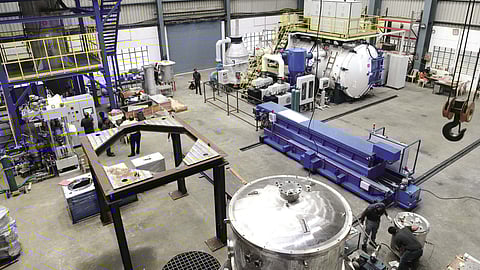
HHVTT designs and makes large vacuum furnaces and space simulation chambers, as well as graphitisation and siliconisation furnaces for various carbon composite materials for space, aerospace, astrophysics, defence, as also automotive and metallurgy industries. Its full-fledged design centre, with 3D designing facilities, designs systems with international standards, adhering to NADCAP specifications and certified for CE. The modern manufacturing facility is situated at Peenya Industrial Area in Bengaluru. The company produces all equipment through home-grown technology, which is recognised by the Department of Science & Technology and granted R&D status.
Taking competition head-on
“Sustainability and innovation are more than just buzzwords,” contends Nagarjun. “We at HHVTT put more emphasis on continually improving product performance by adopting an innovative design and engineering, with respect to current technological trends for the specific applications. This has helped us to stay abreast with global competition.”
Recently, the company designed and made a large-sized vacuum-sintering furnace for St Gobain, India. Now, a similar one is under process for Germany, which is of useable hot zone size of 1.2m x 1.2m x 4.5m, meant for sintering/infiltration of silicon metals into Silicon Carbide jobs at a temperature of 2,000 degree C under vacuum/inert gas atmosphere. Nagarjun claims that HHVTT is the market leader in the field and way ahead in competition.
The company takes pride in its role as a leading specialist in plant engineering. The after-sales services are meticulously designed to ensure uninterrupted performance of the furnace, eliminating unexpected downtime and disruptions.
“HHV has been associated with us for almost three decades, supplying us with our requirements,” says Srinivas Reddy, MD, MTAR Technologies. “Excellent products are now being made in India by them, which saves us extra-cost; they offer good service support too and ensure that all our lines are operational.” The Bengaluru-based MTAR makes components and equipment for clean energy sectors, defence and aerospace. Vacuum furnaces and vacuum ovens form a part of the process tools for vacuum brazing.
HHVAT, the other business entity, provides thin film solutions, which include chemical vapour deposition (CVD) and physical vapour deposition (PVD) coating machines, coating as a service and high-precision optics. It is India’s premier thin film and vacuum technology maker for optical, decorative, functional coatings and astronomical telescope mirrors and special-purpose vacuum equipment, produced in its state-of-the-art facility at Devaspet, Bengaluru, equipped with ISO 7, ISO 8 clean rooms.
The company produces over 100,000 optical components every year for domestic and international markets. With sales offices in the UK and global distributor presence, HHVAT exports to about 75 countries, including the US, the UK, Germany, Italy, Turkey, Switzerland, Singapore and China. HHV acquired the thin film business of Edwards, a leading vacuum company in the UK, in 2014 and established HHV Limited in the UK to handle international marketing, service and support, gaining global recognition. Currently, HHVAT exports 38 per cent of its products.
Rise of the third generation
Smriti Sakhamuri (Prasanth’s daughter) is a member of the third generation, who joined the group seven years ago to support the business. She holds a Bachelor’s degree in Mathematics from the University of Warwick and a Master’s in Applied Economics from the University of Michigan. She spearheads the HHVAT as executive director. “I’ve realised that our brand is incredibly strong, but we’re not leveraging it. So, my focus is to have a real presence in the market, and I have been aggressively pushing us in the export market. The effort has yielded positive results, with our exports increasing by 10-15 per cent,” says Smriti.
The company was also awarded certification of qualification by the Indian Space Application Centre, ISRO, for its thin-film metalised substrates. The seeker heads for all the Nag and Helena missiles, hybrid micro-circuit for Chandrayaan, and periscope prisms consist of ITO-coated heater plates that are laminated through an autoclave process for sealing and encapsulation used for submarines and battle tanks for defence. These are some of the high-level precision coatings done in the HHVAT plant.
“We have an order book of Rs140 crore carried forward in advanced technologies,” says Prasanth. “Our roadmap includes expansion of the optics campus, deeper international collaborations and greater participation in aerospace, semiconductor and photonics supply chains.
HHV has contributed to India’s space programme by supplying hybrid micro-circuits and lenses used on the moon, developed coating machines for large telescopes like those in Kavalur, Hanle, and successfully installed a 3.7-metre telescopic mirror coater at Mount Abu. The creation of indigenous space simulation chambers capable of high vacuum and temperature cycling to replicate deep space conditions, and supplied optical components for defence periscopes and drones.
It was reported that a reputed mobile phone manufacturing company approached HHV for the coating technology for the handset. The trial run is on, but the company is tight-lipped about the development.
HHV has been closely working with Jawaharlal Nehru Centre for Advanced Scientific Research (JNCASR), a top national multi-disciplinary research institute, under the Department of Science & Technology. “HHV do not shy away from collaborating with academic practitioners,” says G.U. Kulkarni of JNCASR. “Whether it is buying ready or custom-made products, R&D related or even translating basic research ideas into knowledge-based products, I found HHV to be a good partner to work with.”
The company focuses on organic growth, developing indigenous technologies rather than relying on imports, and is expanding into new markets such as the solar and semiconductor industries as part of its plans. The company set up a 50:50 joint venture with engineering specialist ASM Technology for making tools and sub-systems for the solar and semiconductor sectors. It is yet to start. “We have set up this company in advance to gather technology know-how to build the expertise, because today there is no direct demand in the country,” explains Dinesh Kamath, CFO, HHVAT.
India’s vacuum technology and thin film coating market is experiencing robust growth, driven by escalating demand from consumer electronics, automotive, aerospace and renewable energy sectors, with opportunities in advanced processes like ALD and PVD for high-performance coatings. However, challenges exist in high costs, supply chain and competition. The market leverages fundamental vacuum principles for oxidation prevention and quality, seeing investment in both equipment and services, positioning India for significant future expansion in this high-tech domain. HHV invests about 7-8 per cent of its revenue in R&D, and focuses on continuous innovation to meet new customer demands and maintain technological leadership.
The group plans to go public in the next five years, when it achieves a turnover target of Rs1,300-1,400 crore and both its business verticals become healthy with 50 per cent of the revenue from exports. “It is good to go public. The company will get a huge facelift and enhance the trust factor. Going public comes with a certain commitment to good governance,” says Kamath. “However, as of now, our focus is only on optics coating. But we have to venture into other areas of coating like metal coatings, which need to create capacity for large volumes and that will generate interest in the company in the market.” Within the group, it’s HHVAT that is considered the suitable entity for an IPO.
“The HHV story is about vision across generations, translating Indian scientific heritage into global technological impact,” Smriti affirms. The group has demonstrated its ability to move with the times. With immense brand value and established markets, the company will continue to retain its leadership position.