
Titagarh Rail Systems: Moving on the right track
When the erstwhile Titagarh Wagons Limited decided to venture into the passenger rolling stock business to reduce its reliance on the wagon business over a decade ago, the move surprised its peers in the wagon industry. They saw it as a high-risk and technology-intensive hurdle, but the company saw it as an opportunity and took the challenge for the growth of its business. Looking at its success, others are now trying hard to enter the high-value passenger mobility segment. The company changed its name to Titagarh Rail Systems Limited (TRSL) in 2023 to reflect its expanded focus beyond the wagon business.
“The transition needed technology upgradation of global standards,” explains Umesh Chowdhary, vice-chairman & managing director, TRSL. “To address this, we acquired Firema SPA, an Italian train manufacturing firm in 2015, to get access to modern-day commuter railway technology and knowledge.” The credential helped the company to win the Pune Metrorail order, and it did not look back thereafter, he recalls. The company outbid large overseas and domestic players in passenger rolling-stock manufacturing and won the Rs1,200 crore-order for designing and manufacturing 102 ultra-modern aluminium metro rail coaches for Pune Metro in 2019. It was a big boost for the company as a new entrant in the metro coach market.
Today, TRSL is a leading comprehensive mobility solution provider of diverse requirements of passenger rail systems (PRS) like semi-high-speed trains, urban metros and passenger coaches, as well as a wide array of freight rail systems (FRS), wagons and specialised wagons. It employs 7,000 people. “We are India’s first and only private manufacturer of passenger rolling stock,” says Prithish Chowdhary, deputy managing director, TRSL. “To stay ahead, we are adaptable and quick to respond to any changes.”

TRSL pushed its early-bird advantage to the full to gain a significant position in the PRS segment. The Rs3,800 crore (as on 2025-26), Kolkata-based listed entity, with a total order book of Rs14,455 crore in the pipeline, of which PRS alone constitute Rs10,791 crore (77.33 per cent) as on December 2025. “The right strategy, backed by technology with inherent engineering experience, has paid the company a dividend and also built up a formidable reputation,” says Anil Kumar Agarwal, deputy managing director, TRSL.
The industry’s woes
“Despite a muted financial performance during the year, we remain constructive on the long-term outlook for TRSL, supported by a PRS-heavy order book and a multi-year execution pipeline,” informs Amitoj Singh, research analyst, B&K Securities, who has been tracking TRSL. The wagon industry or freight rolling stock has been struggling over the last few years due to the uncertainty of orders from the Indian Railways, which has even reduced wagon orders by private players in core sectors. Supply chain bottleneck for critical components, rising input cost and the intense competition have added woes to the wagon industry.
While acknowledging the current situation, Agarwal points out that the wagon industry has always been cyclical and that the situation will change. “Going forward, I believe there would be substantial demand,” he affirms. “Because the infrastructure that Indian Railways has been investing steadily in for modernisation to strengthen overall freight movement would definitely need more freight-rolling stocks.”
The last big wagon order issued by the Railways was in May 2022. It was for 60,000 wagons, of which TRSL received an order for 25,000 units. The company is still executing the orders, which should be completed during the current financial year. While other manufacturers have been going through uncertainties, TRSL has quietly focused on developing new specialised wagons for modern applications and strengthening its competitive advantage.
Also, the industry is expecting good demand from private customers. Large players like Adani, UltraTech, as well as big cement companies and steel plants, have floated enquiries for a large number of wagons.
Founder J.P. Chowdhary has built the company through acquisition. His journey sets a perfect example for today’s aspiring entrepreneurs. He began his career as an account assistant in a Darjeeling tea estate called Silcoorie and later moved to Calcutta to join a steel casting company for the Indian Railways. From being an accountant, he rose to be the CEO of the company. However, his interest was in becoming an entrepreneur. And so, in 1982, he acquired the foundry division of the government-owned Britania Engineering at Titagarh, which was closed, and started producing railway casting, such as bogies and couplers, under the name of Titagarh Steels. Later, in 1994, he acquired Titagarh Paper through BIFR, but it turned out to be a misadventure because, when the government abolished import duty on paper, the plant became unviable. Chowdhary then started manufacturing crossing components for the railways. His luck turned in 1997, when he set up a manufacturing unit called Titagarh Wagons as part of a forward integration, with a production capacity of 180 wagons a year.
Eyeing new opportunities
Today, the company is the largest wagon maker in the country, with a total capacity to produce 12,000 units per annum. The company then entered into diverse portfolios, and so, was renamed as Titagarh Rail Systems. Chowdhary, 85, is now executive chairman of the company, with his son Umesh, 52, as vice-chairman. Umesh has been looking for new opportunities and synergy for the company and has grown the business multiple times. He is also the honorary consul of Switzerland in Kolkata. His only son, Prithish, 24, is now deputy managing director, looking after the day-to-day operations, along with the senior executives of the company. He is also often seen with his father in the corridors of power in Delhi.
Following the successful delivery of the initial order of the Pune Metro coaches and the infrastructure set-up, TRSL has proved its expertise in modern coach manufacturing. The company participated in several tenders for the PRS segment and successfully won several orders like Mumbai, Ahmedabad and Surat metros, including the order for the Vande Bharat train coaches. All orders are under execution now.
A consortium of TRSL and Bharat Heavy Electricals Limited (BHEL) has been awarded the contract to design, make and supply 80 Vande Bharat sleeper stainless steel train sets by 2029, as also provide maintenance for 35 years. The total order value is estimated at Rs24,000 crore, with price variation applicable for both supply and maintenance. While TRSL and BHEL emerged as the second lowest bidder, the TMH Russia-RVNL consortium was the lowest bidder and received orders for 120 train sets.
The Vande Bharat trains represent a significant advancement for Indian Railways under the ‘Make in India’ programme launched by the government. And, it is for the first time that the Indian Railways has awarded a contract of this value to an Indian consortium for the design and manufacturing of complete train sets, as also maintenance.
The prototype of the train set is scheduled to roll out during 2026-27 from the TRSL facility at Uttarpara, West Bengal. There will be 16 coaches in each train, with the capacity to accommodate more than 880 passengers in total. The trains have the speed to run at 160 km per hour. TRSL has experience in passenger and metro coaches already, whereas BHEL’s strong electrical knowledge will come in handy, proving to be a perfect match in executing this high-value contract. “Being part of this landmark project is a matter of great pride,” says Umesh. “It motivates us to continue strengthening our manufacturing capabilities, investing in technology and contributing to India’s goal of becoming a global hub for modern rail systems and high-quality rolling stock”.
In addition, TRSL has also signed a contract for designing and manufacturing a three-car configuration for 72 stainless steel train-sets for the Surat Metro Rail Phase I, with an order value of Rs857 crore and 30 train-sets for the Ahmedabad Metro Rail Phase II project, valued at Rs350 crore. The company has made a significant achievement by delivering its first driverless train-set for Bengaluru Metro, made in its facility in Uttarpara, under a contract with China Railway Rolling Stock Corporation (CRRC). The stainless steel fully automated set has been designed to operate on a 19 km stretch, connecting the electronics city & technology and business hub to the rest of Bengaluru.
The company has four manufacturing facilities – two units in Titagarh (one for wagon and another for steel casting unit), as also shipbuilding and engineering units at Uttarpara (for the passenger rail systems unit) and Bharatpur in Rajasthan (for special purpose wagons and loco shell manufacturing and maintenance products). The company’s three engineering centres are located in Kolkata, Hyderabad and Bengaluru.
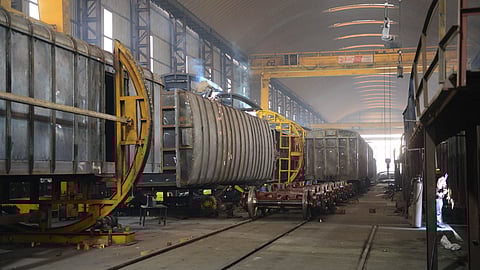
The Uttarpara plant has undergone a complete transformation in the last few years through systematic investment. This manufacturing unit has a G105 certificate and advanced machinery for passenger rolling stock to boost production through the integration of smart technology. The self-monitoring upgraded system is capable of analysing performance data in real time and diagnosing potential issues without human intervention. Some distinctive features include robotic welding, automatic mixing paint booth, water shower test, in-house bogie assembly and load test, among others.
Expertise in propulsion
TRSL is one of the few companies having the expertise in propulsion and electrical equipment, which includes traction converters and power electronics, auxiliary power supply, traction motors, etc. “The company’s backward integration strategy and technology transfer partnership with ABB for propulsion systems should further strengthen its competitive positioning,” explains B&K analyst Singh.
“This is a highly modern and integrated facility, capable of producing both aluminium and stainless-steel passenger coaches and propulsion systems,” informs Vijay Subramanian, CEO, passenger rail system, TRSL. “Today, we can produce 300 coaches per annum for Metro Rail and Vande Bharat”. The company is also planning to ramp up the capacity to 500 coaches by 2029-30.
Passenger rolling is a glamorous business, but the timely execution of the orders will determine its success in the long run, affirms an industry expert. Echoing the view, Singh says: “Despite the strong order book visibility, execution remains a key monitorable. Any delay in project execution or cost overruns could weigh on earnings and pose a downside risk.”
TRSL has acquired 40 acres of land contiguous to its existing factory at Uttarpara, from the West Bengal government, for Rs137 crore. Incidentally, the state government has reclaimed close to 400 acres of land from Hindustan Motors’ closed Ambassador factory in Uttarpara, cleared through a Supreme Court order last year. The strategic nature of this land parcel provides crucial space for establishing enhanced production infrastructure. TRSL is planning to lay a 1.6 km-long dedicated testing track, making it possible to carry out pre-dispatch tests of the Vande Bharat coaches. “Having invested about Rs500 crore in upgrading our PRS and FRS verticals over the last three years, we are now committing another Rs500 crore over the next 12 months to accelerate the growth of the PRS business,” says Saurav Singhania, CFO, TRSL.
TRSL’s engineering centres for excellence integrate skills of 200-plus expert engineers in Kolkata, Bengaluru and Hyderabad, driving the future of rail mobility. The Train Control Management System (TCMS) lab at Bengaluru is a dedicated space for research, development and deployment of intelligent train control systems. “TCMS is basically the brain of the train, as also its nervous system. The software used here is highly complex. Today, we are really transitioning from a fabrication wagon company to a futuristic technology-oriented company,” claims Prithish.
Strategic divestment
TRSL has now announced that Titagarh Firema SpA, its Italian associate, has completed the sale of its business unit to the Italian government-owned Fabbrica Italiana Treni SpA for a net consideration of €66.09 million. The strategic divestment is aimed at stemming the financial drain, as Firema had been incurring substantial losses despite repeated cash infusions from TRSL over the last few years. TRSL directly and indirectly holds 40 per cent of Firema’s stake. In a regulatory filing, the railway major has stated that the proceeds from the sale have been utilised to settle payments for Firema’s secured and unsecured creditors.
There is always a demand for wheels met through imports from Ukraine. But after the war broke out in Ukraine, the import shifted to China. But China’s domestic demand for the wheel has increased, and so the supply has become limited. Today, the waiting period for wheelsets has increased significantly. Also, the rail wheel factory, a unit of the Indian Railways, produces wheels only for the railways’ requirements. To reduce the railway’s import dependence, the government had invited the industry to set up a facility to produce wheels, which will primarily be used for semi-high-speed trains.
The consortium of TRSL and Ramkrishna Forgings Limited had participated and become the lowest bidder to set up a wheel manufacturing facility in Chennai. The plant is now almost ready for its trial run and commercial production, which is expected to commence in the next few months for Phase 1 and in April 2028 for Phase 2, respectively. The total investment for the plant is about Rs1,000 crore. The capacity is projected at 2,28,000 wheels per annum, out of which 80,000 wheels per annum are guaranteed off-take for Indian Railways. The remaining capacity will be utilised to cater to private customers and export markets, while also contributing towards reducing import dependency on wheelsets from China.
The shipbuilding & maritime systems business of the company has been transferred to Titagarh Naval Systems (TNSL), a subsidiary of TRSL, in 2024-25. So far, it has successfully delivered coastal research vessels, fuel barges, tugs, naval vessels, ferries and has demonstrated strong expertise in building complex, high-precision vessels.
Ship ahoy!
The company is shifting its shipbuilding facility from Titagarh to Falta in South 24 Parganas in West Bengal, to expand its shipbuilding operations. The new location is spread across 50-odd acres, with a 400-metre waterfront – the facility being designed to construct vessels of up to 160 metres in length, with an annual capacity of up to 18 vessels. “We would not like to be a fringe player in the shipbuilding anymore and not let it get overshadowed by railway products. This will pursue the growth opportunity independently or via induction of strategic partners or investors, as the case may be,” says Singhania. Its current order book is over Rs500 crore.
The rolling stock manufacturers face a high attrition level, driven by intense competition for specialised talents, and TRSL is no exception. The company’s attrition level is 22 per cent, as against its peers’ 25 per cent, claims Shrija Chandak, chief human resources officer, TRSL. “We believe most sustainable leadership are built internally.” The company’s ‘build from within’ philosophy focuses on identifying high-potential employees early and nurturing them through structured development programmes, mentoring by senior leaders and cross-functional exposure. The approach not only prepares the next generation of leaders but also reinforces long-term career growth within the organisation.
TRSL has reported annual revenues of Rs3,865.82 crore in 2024-25, as against Rs3,853.30 crore in 2023-24. The profit after tax had marginally risen to Rs303.43 crore in 2024-25 from Rs296.91 crore in 2023-24. For the nine months ended December 2025, the company achieved revenues of Rs2,310.39 crore, as against Rs2,862.18 crore for the corresponding period of the previous year. The net profit till December 2025 declined to Rs145.23 crore, as against Rs224.91 crore in December 2024. The current market cap of TRSL is Rs8,375 crore, with a current share price of Rs630. The promoter & promoter group holds 40.46 per cent of the company, while FIIs have 10.66 per cent; DIIS, 12.59 per cent. The balance of 36.29 per cent is with the public and others.
“In the PRS segment, we are progressively improving the ratio from R257 crore in March 2025 to Rs366 crore during the nine months till December 2025. But the true catalyst for growth in PRS will be the commencement of Vande Bharat coach deliveries in 2027-28,” Singhania points out.
Over the last three years, there has been significant progress in track expansion and modernisation, creating a stronger foundation for increased train operations and capacity. The high-speed-capable track length has nearly doubled from 31,445 km in 2014 to 84,244 km at present. In addition, the Union Budget allocations for railways have seen a substantial increase. Another key driver is the replacement of ageing train fleets with modern, semi-high-speed trains, such as Vande Bharat Express. In addition, the rapid expansion of the metro rail network will generate huge demand in the sector. Umesh believes the Indian railways’ ambitious modernisation plans and its focus on indigenous manufacturing will create significant opportunities across the entire rolling stock manufacturing sector.
The company is built on hard work and innovation, along with far-sighted capital allocation from the promoters, which defines its success. All these efforts will ensure that TRSL is always an important player in the industry.