
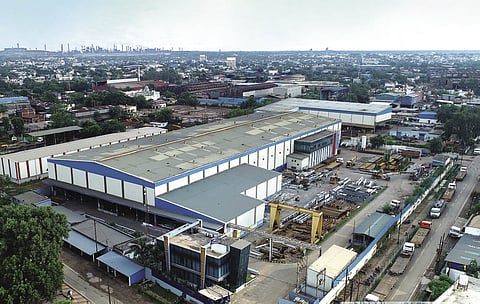
Tested by fire and steel, SISCOL gears up for next phase of growth
“The biggest challenge we are facing is the need to keep adding production capacity, because demand has been exceeding supply,” says Ravikant Uppal, CMD, Steel Infra Solutions Co Ltd (SISCOL). The comment reflects a shift in India’s infrastructure cycle, where demand visibility is strong, and execution capacity has increasingly emerged as the binding constraint for structural steel fabricators.
Founded in 2017-18, SISCOL has built its business around the advantages of usage of structural steel in place of RCC in high-rise buildings, bridges and infra projects – be they airports, stadiums, refineries, steel and pallet plants, power facilities, metros and railways, hospitals, hotels, warehouses, mines and data centres – and an end-to-end delivery model covering design, engineering, fabrication and erection of structural steel. Over its seven years of operations, the company has executed 199 structural steel fabrication projects and delivered about 296,000 tonnes of fabricated steel. “Our work spans a variety of building activities, reflecting the breadth of steel-intensive construction underway across the country,” adds Uppal, an IIT-Delhi graduate in mechanical engineering. He also holds a postgraduate diploma in business administration from IIM-Ahmedabad, as also a degree in advanced management from the Wharton School, University of Pennsylvania.
Uppal brings more than four decades of experience in engineering and infrastructure, having earlier held senior leadership roles at ABB India, Larsen & Toubro, Volvo Group (in India) and Jindal Steel & Power. Over these years, he observed a persistent gap in the domestic fabrication ecosystem – while steel production capacity expanded and EPC capabilities deepened, large infrastructure developers continued to face execution risks arising from fragmented fabrication responsibility, inconsistent quality and weak coordination between design, manufacturing and site erection.
Good customer relationship
SISCOL’s execution history reflects an attempt to address these gaps. The company’s customers include large engineering, procurement and construction contractors, project management consultants and industrial end users – many of them operating under compressed schedules and complex site interfaces. Over time, SISCOL built repeat relationships with several of these customers, particularly where multi-location coordination, schedule discipline and site readiness were critical.

SISCOL ranked among the top three structural steel fabricators in India in 2024-25 on the basis of installed capacity and tonnage handled, affirms a CRISIL report. This places the company in the upper tier of a largely fragmented fabrication market. Its customer list includes Adani Power, ArcelorMittal Nippon Steel India, Deepak Fertilisers, Haldia Petrochemicals, KMV Projects, Larsen & Toubro group, Lloyds Infrastructure & Construction, Megha Engineering & Infrastructures, Ray Engineering, Shapoorji Pallonji & Co, Tata Projects, Tata Steel, Tecnimont, et al.
As SISCOL scaled its execution footprint, the company’s formation was rooted less in opportunistic entry and more in long-standing professional relationships and a shared assessment of how India’s infrastructure and industrial construction landscape was evolving. “The company was formed around the conviction that large EPC contractors and industrial customers increasingly required structural steel partners, capable of delivering design, fabrication and erection as a single, integrated offering, rather than fragmented, multi-vendor solutions,” Uppal explains.
“SISCOL’s financial performance over the last three fiscal years reflects steady scale-up alongside improving operating efficiency,” says Rajagopal Kannabiran, whole-time director and CFO, SISCOL. Revenues from operations increased from Rs511.71 crore in 2022-23 to Rs636.1 crore in 2024-25, translating into 11.49 per cent CAGR. During the six months ended 30 September 2025, the company reported revenues from operations of Rs348.39 crore. Growth has been supported by rising fabrication volumes and higher capacity utilisation across manufacturing units.
Profitability has expanded at a faster pace than revenues. Operating EBIDTA increased from Rs40.71 crore in 2022-23 to Rs66.31 crore in 2024-25, representing 27.63 per cent CAGR. Operating EBIDTA for the six months ended 30 September 2025 stood at Rs35.34 crore. Profit after tax rose from Rs17.53 crore in 2022-23 to Rs32.96 crore in 2024-25, while PAT for the six months ended 30 September 2025 was Rs16.07 crore, reflecting operating leverage and tighter cost control as scale increased.
The balance sheet reflects moderate leverage associated with capacity expansion and working capital requirements. The company has no term loans, as all capacity expansions were financed from equity/internal accruals. As of 30 September 2025, the company reported fund-based net working capital borrowings of about Rs100 crore, excluding liabilities for long-term lease accounting, as per guidelines.
Long-term borrowings have been rated A– with a stable outlook by CRISIL, indicating credit comfort, despite the working-capital-intensive nature of the structural steel fabrication business. Since 2018, the credit rating has been upgraded four times in a short span of eight years, reflecting the company’s ability to improve operational parameters rapidly.
Professional association
Uppal and Rajagopal brought to the venture a professional association spanning more than two-and-a-half decades. The two had worked closely across leadership roles at ABB India & Asia Pacific, ABB Switzerland and, later, at Jindal Steel & Power, where they held senior executive responsibilities, including those of president and CFO. Their combined experience across engineering, manufacturing, finance and large-scale industrial operations formed SISCOL’s operating philosophy from inception, particularly its emphasis on execution discipline, financial control and accountability to customers. The company’s digital focus and its application in terms of using integrated ERP/SAP systems for all its operational/functional aspects, coupled with integrated portals, have supported its volume growth efficiently.
Over the years, Uppal also built professional relationships with the other promoters – Ranjan Sharma, the Chaudharis of Surin Holdings, and Zarksis Parabia – who had engaged with him across different business contexts. They came together around a shared confidence in his leadership approach, operating judgement and emphasis on ethical conduct, as well as a common assessment that the structural steel fabrication sector was positioned for sustained expansion alongside India’s infrastructure and industrial investment cycle.
Early financial investors, including Madhu Kela of M.K. Ventures and Meridian Investments, Bengaluru, aligned with this assessment after evaluating the scalability of the business model and the depth of the management team. Their backing was anchored in SISCOL’s differentiated proposition of offering fully integrated structural steel solutions tailored for EPC contractors and original equipment manufacturers executing large and complex projects.
This foundation shaped SISCOL’s operating structure. The company integrated in-house design, engineering, fabrication and erection capabilities to retain control over quality, sequencing and delivery timelines. Its in-house design and engineering team of 107 engineers operates from Bengaluru, Chennai, Hyderabad and Bhilai, using advanced software tools for structural analysis, constructability modelling and fabrication detailing. These capabilities allow fabrication sequencing to be aligned closely with site readiness, reducing congestion, rehandling and rework risks.
Structural steel execution at scale is less about standalone manufacturing and more about synchronising multiple activities across parallel timelines. In large infrastructure projects, fabrication often runs alongside civil construction, with erection schedules dependent on foundation readiness, crane availability and interface with other contractors. Any misalignment between fabrication output and site preparedness can result in idle inventory, additional handling costs or erection delays.
SISCOL’s operating model addresses this sequencing challenge through close coordination with EPC contractors during the design and planning stages. Rather than fabricating components in bulk, the company phases production in line with erection priorities, enabling customers to advance critical-path structures ahead of secondary buildings. This approach reduces site congestion and limits downstream disruption when late-stage design changes occur.
Logistics forms another critical layer of execution. Fabricated steel structures are oversized and heavy, requiring route planning, transport co-ordination and site-level unloading arrangements. SISCOL manages logistics through third-party transporters but retains responsibility for scheduling and coordination, particularly on multi-location projects where deliveries must be staggered. In export projects, this coordination extends to customs documentation, port handling and shipping schedules.
End-to-end coordination
Erection introduces additional variables, including safety management, weather conditions and interface with civil contractors. While SISCOL engages empanelled erectors, it retains overall responsibility for supervision, safety compliance and progress monitoring through on-site project managers. This end-to-end coordination is particularly critical in sectors such as power, hydrocarbons and transportation, where delays in structural packages can cascade into commissioning timelines.
The company operates six manufacturing facilities – four in Bhilai, one in Vadodara and one in Hyderabad – with a cumulative installed fabrication capacity of 100,000 tonnes per annum as of 30 September 2025. SISCOL plans to add about 15,000 tonnes of capacity at its Vadodara facility by 2026-27, informs Kannabiran, reflecting a calibrated expansion approach aligned with order visibility. Facilities are equipped with CNC plasma cutting machines, laser cutting systems and high-speed drilling equipment to improve precision and reduce fabrication errors.
Client feedback underscores the importance of execution discipline. “SISCL delivered the structural steel scope for Adani Power’s Raipur Phase II project in line with committed timelines,” says Subramanya Malalagam, GM, Adani Power. “The execution involved large volumes and complex interfaces, and SISCOL’s on-ground co-ordination ensured steady progress without schedule slippages. Quality and timeliness are critical in power-sector construction, and SISCOL has met its contractual obligations across these parameters.”
“SISCOL has been working with L&T Construction since 2018 across multiple infrastructure, commercial and institutional projects,” says Mathan Kumar B, deputy GM, procurement, L&T Construction. “In projects where execution speed and quality are critical, SISCOL has delivered as committed, and we are satisfied with the workmanship and overall execution.”
Structural steel fabrication is inherently working-capital-intensive. Raw material procurement, fabrication lead times and staggered billing milestones often result in cash outflows preceding inflows, particularly on EPC-led projects. SISCOL’s contracts typically include advances against mobilisation and raw material procurement, delivery-linked payments and retention amounts, with payment terms varying by customer and project scope.
Steel price volatility remains a structural risk. Prices fluctuate, based on global demand-supply dynamics, input costs, trade measures and logistics disruptions. SISCOL mitigates this risk through contract structuring, inventory planning and escalation mechanisms on longer-duration or higher-volume orders. Under shorter-duration contracts, escalation clauses are often unavailable but mitigated by finalising procurement orders early to avoid/minimise negative impacts.
One factor underpinning execution stability is the visibility offered by SISCOL’s order book-driven operating model. At the end of September 2025, the company’s pending order book was about Rs930 crore, which had increased to Rs1,100 crore at the end of December 2025, on the back of increased order Inflow.
Competitive tendering
Projects are typically secured through competitive tendering processes that involve detailed technical qualification, cost estimation and delivery scheduling. Once awarded, these contracts translate into firm orders with clearly defined milestones linked to fabrication, delivery and, where applicable, erection. Over the last three fiscal years, the average tenure of orders has ranged from six to 24 months, allowing the company to plan capacity utilisation across its manufacturing units while retaining flexibility to adjust sequencing in response to site readiness and customer priorities
Performance guarantees form part of most EPC-led contracts. SISCOL is typically required to furnish bank guarantees of 2.5-5 per cent of the total contract value, covering performance and warranty obligations. Payment structures generally include mobilisation advances, advances against raw material procurement, delivery-linked payments and retention amounts. While these mechanisms provide partial cash-flow support, management notes that execution discipline remains critical to avoiding working-capital strain during peak fabrication and erection cycles, particularly when multiple large projects progress simultaneously.
L&T Energy Hydrocarbon has been working with SISCOL since 2018 on multiple large structural steel packages. These engagements covered under multiple orders received over a period for an aggregate steel volume of nearly 20,000 tonnes received with a combined project value of about Rs200 crore, reflecting the company’s track record of execution progress in line with agreed schedules, supported by consistent quality standards.”
From a governance standpoint, the company emphasises internal controls, project-level monitoring and financial discipline as scale increases. The separation of operational oversight and financial management between the managing director and the chief financial officer is intended to ensure that expansion decisions remain aligned with balance-sheet capacity and execution readiness. As fabrication volumes rise and international exposure increases, management views compliance, risk monitoring and lender communication as integral to operational resilience rather than back-office functions.
Human resources form a critical component of SISCOL’s operating model. SISCOL has built a scalable organisation structure to create appropriate focus/accountability at various management layers, both in operational level and functional levels, with a focus on succession planning as the company grows in terms of production facilities/project sites. As of 31 October 2025, the company was employing about 3,100 employees, with about 700 full-time employees in the managerial/staff/ skilled workmen category and about 2,400 workmen on a contractual basis based on project requirements. “This blended workforce model provides flexibility, allowing manpower levels to be scaled in line with fabrication and erection intensity”, says Uppal.
Skill depth is particularly important in welding, fitting, machining and inspection, where workmanship directly affects structural integrity. The company conducts periodic training programmes combining classroom instruction with on-the-job supervision. Safety management is central to erection activities, with dedicated safety teams overseeing compliance at project sites.
International footprint
Beyond domestic operations, SISCOL has begun building an international footprint. “The company has supplied fabricated steel structures for oil and gas projects in Algeria and provided design and engineering services to customers in the US and Singapore. Export revenues accounted for nearly 8 per cent of total revenue,” Uppal says.
SISCOL operates within a broader sectoral environment shaped by India’s infrastructure push, Uppal says. Domestic steel demand is projected to grow from 152 million tonnes in 2024-25 to 210-230 million tonnes by 2029-30. The structural steel fabrication market is expected to expand from Rs1.01 lakh crore in 2024-25 to Rs1.70-1.75 lakh crore by 2029-30, driven by construction, transportation, energy and logistics investments.
Against this backdrop, SISCOL has filed its Draft Red Herring Prospectus with the Securities & Exchange Board of India for an initial public offering. The IPO comprises a fresh issue of equity shares aggregating up to Rs96 crore and an offer for sale of up to 14.2 million equity shares. Proceeds from the fresh issue are proposed to be used for capacity expansion, working capital requirements and general corporate purposes. DAM Capital Advisors is the sole book-running lead manager, and the shares are proposed to be listed on the National Stock Exchange of India and the BSE.
Looking ahead, SISCOL is evaluating selective entry into adjacent fabricated products such as defence-related structures, large power transformer tanks and steel shipping containers. These initiatives remain at the feasibility stage, with management emphasising incremental expansion over diversification-led risk. India’s steel consumption levels also point to significant headroom for long-term growth. While India’s share of global finished steel consumption has been rising steadily, its per-capita steel consumption remains well below global and industrial benchmarks. Global average per-capita steel consumption is estimated at 215 kg, compared with India’s substantially lower levels, reflecting the country’s still-evolving infrastructure base. By contrast, mature industrial economies such as South Korea consume close to 1,000 kg of steel per person annually, while China’s per-capita consumption is estimated at 600 kg.
“This wide gap underscores the scale of latent demand in India, as urbanisation, transport infrastructure, industrial capacity and housing construction continue to expand over the coming decade,” says Uppal. The next phase of growth will depend on execution capacity and discipline, he believes, though infrastructure activity is strong and steel usage is rising across sectors, sustaining performance will depend on how effectively capacity is scaled while maintaining delivery reliability.