
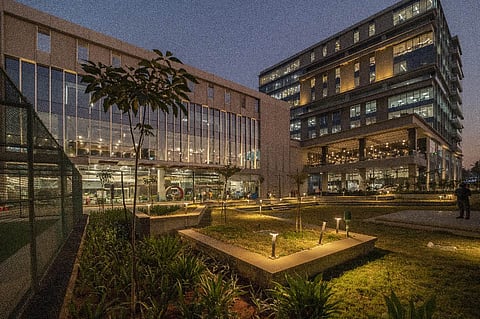
Strategic repositioning: Vaishnavi Group targets high-end homes and offices
Twenty-eight years after C N Govindaraju began building small government housing projects, his Bengaluru-based company is making its sharpest strategic turn yet. Vaishnavi Group, now run day to day by his sons Darshan and Kishan, is moving away from volume housing towards premium homes and offices in prime locations, and intends to do so without leaving its home turf.
Govindaraju, a civil engineer, founded Vaishnavi in 1998. Early projects ranged from about 14,000 sq ft to one lakh sq ft, residential and commercial, but were always in established, premium parts of the city rather than speculative frontiers. Today, Darshan says, the group has delivered about 20 million sq ft of residential and commercial space across roughly 45 projects in Bengaluru and Mysuru (its brand profile says ‘more than 40’). The company currently has eight million sq ft of space under development. It reports over 7,000 customers and more than 40 industry awards, and its office buildings house Aon, EY, Gartner, Standard Chartered, Toshiba and Zomato, among others.
Darshan Govindaraju, executive director, joined in 2015 straight from Babson College in Boston; his younger brother Kishan followed two years later. Darshan runs residential development, sales, marketing and customer experience and is expanding the commercial portfolio, while Kishan leads technology, operations and sustainability. The founder remains involved in a reduced role. Joining the business, Darshan says, was always the plan; his studies abroad were simply the education cycle to be completed first.
He divides Bengaluru property into the pre- and post-Covid periods. Before Covid, the game was volume. The target buyer was in the Rs60-110 lakh bracket, which worked only at scale, with 400 to 1,000 apartments in a project, and developers raced to discover new micro-markets. Construction costs were about Rs3,750-4,000 per sq ft, net of GST, rising at a predictable 5-7 per cent a year. RERA and demonetisation changed procedures, not foundations. Co-living and student housing were fashionable enough that Vaishnavi itself considered entering these segments.

Covid ended that debate. It reinstated, Darshan says, the importance of owning a home, and demand returned first for second homes, bigger spaces and villas. Even buyers in the R70 lakh-one crore bracket wanted more green space and amenities within the community, so that they would not need to commute. A handful of Bengaluru projects had sold above Rs10,000 per sq ft before 2020; prices of Rs10,000 and Rs15,000-plus per sq ft became mainstream afterwards. Vaishnavi repositioned itself for that buyer, whether a family paying R2.5 crore for an apartment or one spending R16 crore on a villa. What unites them, he argues, is that they buy to live, not to chase returns.
The cost equation
The pivot has hard-nosed logic behind it. Over the past six to eight months, Darshan says, construction costs have climbed about 17 per cent amid geopolitical tensions, and materials are harder to source, a shock he rates as worse than Covid. Vaishnavi’s answer is to maintain a wider gap between selling prices and construction costs. “We do not control the cost,” he says. “What we can control is the product we put out in the market and the price that transacts at.” Building costs are broadly the same in the central business district as on the periphery, so the premium paid for land and location drops into the margin. At Rs40,000-45,000 per sq ft, a developer can spend Rs7,500-10,000 on construction; at Rs15,000-17,000, the spend is nearer Rs5,500-6,000.
Would buyers accept a company long seen as mid-market in the premium bracket? Darshan rejects the premise. Vaishnavi, he says, has always been known for quality and early delivery, whatever the price point. Since RERA took effect, every project has been handed over at least three months ahead of its RERA date, and the best-performing project was delivered 17 months early. The buyer changes, he argues, not the promise: homes delivered on time, strong specifications and no maintenance headaches. The marketing needs fine-tuning; the brand does not.
The company puts about 1 million sq ft into the market a year, averaged over a four-year cycle, and has held its mix at roughly 50:50 residential and commercial since 2018. As of August 2026, the pipeline comprised about 2.4 million sq ft of saleable residential space and 2.8 million sq ft of commercial space, plus a plotted development in Mysuru.
Five residential projects were in the works, two on sale and three due for launch within months of receiving sanctions. The flagship is At-One Krishna Brindavan in Banashankari, off the 100 ft Ring Road: two towers of about 32 floors on five acres, with 359 units across roughly 800,000 sq ft, priced from about Rs3 crore to Rs4.5-5 crore. Launched on 31 October 2025, it had sold around 220 units, with delivery due in 2029. Vana in Banashankari, Vistara in J P Nagar and Life in Mysuru, a plotted project of about 50 acres due to launch shortly, follow.
On the commercial side, Vaishnavi generally holds its buildings, selling portions to long-standing investors while managing and leasing the assets for them and for itself. Recently completed projects include the 710,000 sq ft Vaishnavi Tech Park on Outer Ring Road, designed for IGBC Gold certification, and the 520,000 sq ft Vaishnavi Senate on Bannerghatta Road. Hospitals are a speciality, among them the 300,000 sq ft At-One Sushrutha for Manipal on Kanakapura Road, completed in 2025. Darshan says the group will stick to boutique CBD offices of 1-1.2 lakh sq ft, as with At-One Central on Race Course Road, while its largest bet is the planned three-million-sq-ft Vaishnavi Technology Centre on Bellary Road.
Quality over scale
Land in Bengaluru is acquired either through outright purchase or joint development with the owner, and Vaishnavi does both. Darshan expects redevelopment to become a third route: it requires the consent of every allottee today, but he anticipates Mumbai-style majority rule as apartment stock built from the mid-1980s ages, and says the government has signalled that rules are forthcoming. On growth, he is protective, since the group does not license its name to other projects. “Our objective is not to have our name on every street corner,” he says. “If our name is associated, we need to take ownership for that.” That caps scale, he concedes, but keeps growth organic and under the company’s control. External capital has played a small part: private equity funded two projects in earlier years, with healthy exits, but none has come in since. An IPO is not planned, though, he adds, “never say never”.
For the next 5 years, Vaishnavi’s strategy is deliberately focused: identify the best land parcels in Bengaluru, develop products that stand out in terms of location, design and quality, and strengthen its position as a premium developer. Rather than expanding rapidly into new geographies, the group wants to deepen its presence in markets it understands well. Mysuru will remain its only other market for now. Darshan says the company would consider expanding beyond Karnataka only if a specific build-to-suit commercial opportunity came its way, rather than acquiring land speculatively and waiting for demand to emerge.
The group is also evaluating adjacent opportunities that complement its existing portfolio. Senior living is one such segment, which could be integrated into its apartment and villa communities, allowing it to cater to an emerging demographic requirement without moving too far from its core business. Student housing, however, is not on its immediate agenda. The emphasis, Darshan says, is on measured expansion, maintaining execution standards and retaining control over the quality of every development. “Real estate is a regional play,” he says. “We are absolutely a regional and local player, and that suits our strategy.”
Whether Bengaluru’s premium buyers reward this repositioning will become clearer as Krishna Brindavan’s sales progress and the group’s upcoming residential and commercial launches enter the market. For now, Vaishnavi is betting that its established strengths in timely delivery, product quality and prime locations will help it move up the price ladder without compromising the discipline that has shaped its growth over nearly three decades.