
How ULCCS ushers in a social transformation
In 2025, it completed 100 years. The origins of Uralungal Labour Contract Co-operative Society (ULCCS), founded in 1925 by young workers, are rooted in a movement for social upliftment. ULCCS is now the world’s third-largest cooperative in the industry and utilities sector, ranking behind Spain’s Corporación Mondragón and Denmark’s Andel group. A century on, that spark has transcended the realm of construction, catalysing employment generation and advancing social welfare, buoyed by its diversification into information technology, education and agriculture.
ULCCS was conceived in the quiet hamlet of Uralungal in Kerala’s northern Malabar region, born of the belief that dignity in labour and equal opportunity could heal a society fractured by caste, superstition and poverty. The founding members, moved by spiritual leader Guru Vagbhatananda’s teachings on self-reliance and social justice, registered the cooperative on 13 February 1925.
Vayaleri Kunhikkannan Gurukkal, popularly known as Guru Vagbhatananda (1885-1939), was a social reformer, philosopher and founder of the Atmavidya Sangham, a movement that promoted self-knowledge and social reforms. “To begin with, these young worker members undertook small projects such as erecting kaiyalas (bunds) and velis (fences), roads and minor infrastructure projects. As Kerala grew, Uralungal also expanded its services. We now have Rs5,400 crore of assets, while our annual turnover was about Rs2,400 crore in FY25. This is a natural progression built on solid groundwork,” explains Rameshan Paleri, chairman, ULCCS, who has led key initiatives such as establishing UL Technology Solutions to handle IT and software/digital service projects; launching UL Cyberpark, India’s first Special Economic Zone (SEZ) owned by a labour contract cooperative society; running the Indian Institute of Infrastructure and Construction (IIIC), a distinguished centre for skill development training, bridging the gap between industry and professionals; and creating Sargaalaya Arts & Crafts Village in Kozhikode and Kerala Arts & Crafts Village in Thiruvananthapuram to revitalise local artisans, generate rural tourism and provide alternative livelihood options.

These diversification steps happened gradually over the past 10-15 years, especially accelerating post-2010 as the demands of members changed (education, tech jobs, welfare), and government schemes increased infrastructure investment.
By 2018-19, its turnover reached approximately Rs1,100 crore, driven by its involvement in large-scale projects for government agencies and local bodies. The cooperative model gave it a unique advantage: a motivated workforce with a direct stake in the organisation’s success. In 2024, ULCCS entered its centenary year with an annual turnover of around Rs2,011 crore, having completed over 7,500 projects over its history.
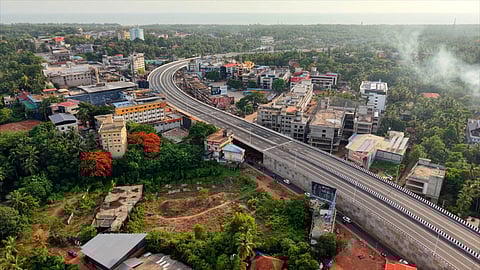
Over the past 100 years, ULCCS has evolved from constructing fences and wells to executing some of Kerala’s biggest projects, such as Valiyazheekkal Bridge, Perumbalam Bridge, AC Road, Unity Mall and the six-laning of NH-66 from Talapady to Chengala. Employing more than 18,000 personnel and completing over 8,000 projects, it remains a major force. “We operate as a not-for-profit firm, driven by a mission of social upliftment through the dignity of labour, with a focus on marginalised communities. Profits from our projects are reinvested into future initiatives, directed towards worker welfare, skill development and social programmes in education, agriculture and the care and welfare of differently-abled and elderly citizens. Keeping with our cooperative ethos, we distribute 80 per cent of the profits among workers, while 20 per cent is kept as reserve funds for growth and to meet statutory requirements. We also provide marriage and education assistance, industry loans and financial support to our employees,” adds Paleri. As per cooperative law in Kerala and India, 15 per cent of the net profit is mandatorily transferred to the General Reserve Fund. A portion is also allocated to statutory funds such as the Education Fund and the Co-operative Development Fund, which ultimately benefit members. The remaining amount is distributed among members as dividends or profit share, strengthening both individual and collective welfare.
“This ensures equitable wealth distribution, and revenue goes to 18,000 pockets, not to a single individual. Since the workers are also the owners, there is no conflict between them and the management. We have created a model work culture for the state, where labour and leadership work in harmony,” he explains.
Unique structure
In Kerala – a state renowned for its high political awareness and frequent labour strikes – ULCCS stands as a rare exception, having not witnessed a single day of labour unrest in its 100 years of existence. As ULCCS is registered under the Co-operative Societies Act, it ensures that all workers are owners too, not just employees. The members elect a 13-member board to oversee operations and management. The election is a democratic process, and the board is formed through a consensual system that organically originated in its early years in the pre-Independence era. It is a member of the National Labour Co-operative Federation and the International Co-operative Alliance. The United Nations has documented its story as a model of sustainable development and inclusive growth.
“ULCCS is different from others because we do not subcontract our work. Also, we have our own skill development institute and a world-class material testing laboratory to ensure quality control,” says Paleri.
Beyond infrastructure, ULCCS has diversified into IT services, tourism, skilling and education, agriculture and residential development. Its charitable foundation runs a training institute in Kozhikode for the neurodivergent community, reflecting the society’s commitment to social inclusion.
In 2009, ULCCS ventured into IT, setting up an IT park and starting its own IT firm in 2011 in Kozhikode. The IT park, UL CyberPark, is spread across a 25-acre SEZ, currently supporting a workforce of more than 3,000 professionals. With a total built-up area of 4.82 lakh sq ft (43,750 sq ft per floor), it houses a diverse mix of IT and ITeS companies, including start-ups, mid-sized firms and global service providers. The facility was designed to accommodate over 80 firms, making it a preferred destination for technology-driven enterprises seeking expansion in northern Kerala.
“Our core mission is employment generation. But as the number of educated youths in Kerala increased, they wanted better jobs and better pay. That’s when we decided to explore new opportunities, including IT,” adds Paleri.
In February this year, coinciding with its centenary, ULCCS launched U-Sphere, a subsidiary to construct pre-engineered and precision-built structures. Later in June, U-Sphere secured its first private project: constructing a facility for Canada-based Ceenex Global Computer in Thiruvananthapuram.
“U-Sphere prioritises speed, smart solutions and sustainability. By leveraging advanced technologies, we intend to slash construction timelines by up to 50 per cent compared with traditional methods. Most importantly, we try to deliver projects ahead of deadlines,” says Shaju S, MD at ULCCS.
Uralungal also runs skilling institutes, particularly for engineering and IT graduates, and finishing schools to prepare them for the job market. The Indian Institute of Infrastructure and Construction, located at Chavara in Kollam, Kerala, has advanced classrooms, workshops, simulation labs and residential facilities to ensure high-quality training.
Wayanad rehabilitation
ULCCS is a key partner in the Wayanad rehabilitation initiative, a Kerala government-led effort to restore lives devastated by the landslides of 30 July 2024 in Mundakkal and Chooralmala. The cooperative society is spearheading the construction of Kerala’s largest rehabilitation township across 64 hectares in the Elstone and Nedumbala Estates. Once completed, the township will offer permanent housing and essential infrastructure to displaced families. Although the official deadline is January 2026, ULCCS, which has already showcased a model home, intends to complete the project by this December. The township will have 410 independent houses, each measuring 1,000 sq ft and built on seven-cent plots, with provisions for future vertical expansion.
“The extended rains have delayed the work. But we are on schedule, and we hope to complete it on time,” says Shaju, adding that ULCCS is mobilising over 300 workers for the project.
The landslide, which claimed about 298 lives and displaced thousands, prompted the Kerala government to identify 459 families for rehabilitation, of which 104 opted out after taking Rs15 lakh each in compensation. Each house in the township, which follows a cluster model to foster community interaction, is designed to withstand natural disasters and includes road access, compound walls and waste-management systems. Basic amenities like a public library, market, anganwadi, laboratory, pharmacy, school, playground, open-air theatre and multipurpose hall are also being readied.
“This is not just construction – it’s a commitment to healing and rebuilding lives. As we mark our 100th year, we see this as an opportunity to serve Kerala,” explains Paleri.
ULCCS envisions not merely another transformative decade but a century of continued progress. Having grown from a modest Rs300 crore turnover in 2015 to Rs2,400 crore now, it aims to scale this tenfold to Rs30,000 crore over the next 10 years. “For the next decade, our goal is to embrace robotics, artificial intelligence, mechanisation, education and new construction materials. We already have the foundations in place, including modern infrastructure and training institutes, advanced material testing facilities, and a strong workforce ready to adapt to new technologies,” observes Paleri.
Tourism is poised to become a major focus area for ULCCS, with plans to integrate cutting-edge technology into immersive cultural experiences. ULCCS intends to start laser shows, like those in Dubai and Singapore, at its crafts villages, narrating Kerala’s rich heritage. A soft launch is planned for 1 January. Moving into its second century, ULCCS will further explore green construction practices and expand its footprint beyond Kerala.
“We will focus on tourism in the Malabar region, which has immense potential but receives fewer tourists compared to south Kerala. Our upcoming plans include setting up hotels, homestays, tourism infrastructure projects and events that showcase Malabar’s heritage and culture. The goal is to uplift Malabar’s tourism economy, create jobs and bring global attention to this region,” adds Paleri.
ULCCS will also undertake new projects across segments through special purpose vehicles (SPVs) for which funds will be raised from small and medium-sized private investors, such as non-resident Indians from West Asia. However, the cooperative – which is not keen to divest stakes – will avoid large investors whose terms may conflict with cooperative principles. ULCCS also intends to expand beyond Kerala through U-Sphere, now eyeing Karnataka and Tamil Nadu as the next growth corridors. U-Sphere is targeting Rs2,000 crore from public infrastructure, commercial and industrial projects over the next 5 years, while the firm intends to add about 1,000 employees by 2030.
A key initiative supporting this vision is U-Sphere, ULCCS’s dedicated venture into futuristic, high-tech and eco-friendly building construction solutions, launched as part of its 100th anniversary celebrations. With U-Sphere focusing on private-sector projects and geographic expansion, the aim is not merely to grow in scale but to amplify impact – delivering the same commitment, values and excellence that have defined ULCCS for a century while embracing new opportunities to contribute to society. Alongside U-Sphere, ULCCS will continue to diversify through IT, skill development and education initiatives, tourism infrastructure, artisan and craft villages, housing and sustainable construction ventures. Developing tourist circuits, eco-tourism centres and heritage conservation projects provides promising avenues in tourism and cultural infrastructure. These initiatives diversify revenue streams while reinforcing ULCCS’s commitment to community development and sustainable livelihoods for members and local populations.
Through this combination of diversification, strategic partnerships and government-aligned tourism projects, ULCCS aims to scale sustainably, maintaining its cooperative ethos and social responsibility while positioning itself as a forward-looking, innovative infrastructure leader.
“We are actively expanding into airport and seaport infrastructure projects in Kerala, leveraging our extensive experience in large-scale public works and cooperative governance. By collaborating with trusted partners and pre-qualifying for upcoming projects, we aim to diversify our portfolio and strengthen our presence in critical infrastructure sectors. We have already begun this journey. Our involvement includes the Thiruvananthapuram International Airport revamp, where we are executing airside development works, and we are exploring opportunities at the Vizhinjam International Seaport. These initiatives reflect our commitment to enhancing connectivity, supporting economic growth and delivering high-quality infrastructure solutions, while staying true to our cooperative values,” sums up Paleri.
Box 1
Malabar’s IT moment
In 2003, a team from Kerala’s Uralungal Labour Contract Cooperative Society (ULCCS) set out in a Tempo Traveller on a cross-country journey to study India’s fast-emerging infrastructure and identify new avenues for job creation back home. Starting from Kozhikode, they travelled across states, exploring IT parks, real estate projects and infrastructure hubs. The journey reflected Kerala’s changing social fabric. As joint families gave way to nuclear households, education emerged as the top priority. Young people increasingly aspired to white-collar jobs, but opportunities were scarce. At the same time, traditional blue-collar jobs were on the decline.
“ULCCS’ mission has always been to build livelihoods and nurture society. Back then, our aim was to create opportunities aligned with the aspirations of a new generation. That’s when the idea of venturing into IT came up,” recalls Kishor Kumar TK, COO at UL CyberPark.
In 2007, during a breakfast meeting in Thiruvananthapuram, the ULCCS team realised that while Thiruvananthapuram had Technopark and Kochi had Infopark, there was a vacuum between Kochi and Bengaluru. “This was our opportunity. We immediately met the then Kerala Chief Minister VS Achuthanandan, who announced an IT park in the Malabar region the very next day. That’s how the idea took shape,” says Kumar.
But translating the vision into reality was as arduous as the earlier road trip. Critics questioned why a cooperative rooted in construction would step into IT. One industrialist told the team that “IT is not ULCCS’ cup of tea” and advised them to “take a nap”. A senior banker mocked the plan outright.
Despite the scepticism, ULCCS stayed the course. “Our chairman was clear – if we chose to move ahead, we had to be prepared for the challenges,” Kumar remembers.
In 2007, ULCCS – then with a turnover of just R15 crore – presented a Rs600-crore project report, only to be rejected by banks. Revised versions of Rs385 crore and later Rs210 crore faced similar hurdles before finally finding support. Initial funding came from a consortium led by Punjab National Bank and Indian Bank. Later, cooperative banks stepped in, forming a cooperative consortium to finance the project. ULCCS also roped in Japanese architectural giant Nikken Sekkei to design the campus.
The cooperative first acquired 10.54 acres of land but later expanded to 24.7 acres to meet requirements. It became perhaps the first cooperative to secure SEZ status and environmental clearance for an IT project. On 27 February 2016, then President of India Pranab Mukherjee inaugurated UL CyberPark.
Today, UL CyberPark is home to 43 companies employing over 2,800 professionals. Tenants include Tata Elxsi, QBurst, Runbook, Nucore, ULTS, Kerala Startup Mission and ICT Academy of Kerala. The park is also Kerala’s second-largest green building.
“Nearly 80 per cent of our workforce is under 40. That’s not just a statistic – it’s our strength. We are shaping a future where world-class IT jobs, space-tech exposure and grassroots education converge to transform Malabar. We are proud to be the youngest workforce among cooperatives,” says Kumar.
Built on a ‘Walk to Work’ concept, UL CyberPark spans 30 acres, with residential complexes located just 400-600 metres away. Currently, it has 8 lakh sq ft of built-up space across two major buildings (4.82 lakh sq ft and 3.5 lakh sq ft). The target: expand to 32 lakh sq ft. The upcoming Software Development Building-2 (SDB-2) will add 5 lakh sq ft at a cost of R400 crore. A R500 crore residential complex is also in the pipeline. Phase II of the park is expected to be operational by FY28.
“We have already received positive enquiries from IT companies. New firms are likely to invest around Rs1,000 crore in emerging technologies like AI, robotics, fintech, digital marketing and app development,” adds Kumar.
For ULCCS, the project is not just about profits. “We are not here to accumulate wealth. Our goal is to give back to society. UL CyberPark is built on the cooperative spirit, where every decision is rooted in social commitment. Unlike corporates, our strength lies in developing communities and working toward a collective purpose,” Kumar concludes.
Box 2
Pushing smart building
In February this year, ULCCS launched U-Sphere, a subsidiary to construct pre-engineered and precision-built structures. U-Sphere, launched in ULCCS’ centenary year, aims to build on the society’s successful business model.
“The rationale behind U-Sphere was to propel the cooperative into the next era of infrastructure development – one defined by speed, innovation and smart construction. This initiative will also carry ULCCS’ legacy of driving economic impact by creating jobs and improving lives. The mission – to redefine the future of the industry – remains unchanged,” says Biju Mahima, CEO of U-Sphere, formerly VP at Jindal Steel & Power Ltd.
In November 2023, Kerala’s Minister for Industries, Law and Coir, P Rajeev, announced the state’s first Unity Mall under the Prime Minister’s Ekta Mall initiative to promote the One District One Product (ODOP) scheme. Unity Mall is a state-run project announced in the Union Budget to create a marketplace for artisans, including GI-tagged goods.
Kerala’s Unity Mall is a R120 crore project, which was originally planned as a traditional RCC structure. However, ULCCS reimagined it using steel frameworks, Expanded Polystyrene (EPS) and Autoclaved Aerated Concrete (AAC) panels, and smart building technologies.
The mall, a four-storey commercial complex with 2 lakh sq ft of area, houses an amphitheatre, exhibition areas, food court, multiplex, game zone and parking facilities. The design follows a sustainable ‘Green Building’ approach and draws inspiration from traditional street-shopping culture. Unity Mall’s façade will be an iconic, Kerala-centric landmark that tells an immersive story within the state’s emerging tech corridor. Guided by the ‘Warp & Weft’ conceptual framework, the design weaves Kerala’s craft vocabulary into a modern, abstract language expressing the Highlands-Midlands-Lowlands narrative through layered abstractions of mountains and ocean. A coconut-leaf weaving pattern symbolising Kerala’s traditional community culture further enriches the façade. Indigenous crafts inform the graphics and material articulation, unified by a refined contemporary palette and visual trails, making the experience accessible and memorable.
The mall has about 50 commercial stalls representing each Indian state and Union Territory, with dedicated stalls for Kerala’s districts. “Unity Mall aims for social, economic and cultural empowerment, and this aligns with ULCCS’ motto. It will be a defining milestone for U-Sphere. We are confident of completing the project before the deadline,” adds Mahima.
“Innovations like prefabrication and IoT-enabled monitoring are central to U-Sphere’s delivery model. Prefabrication accelerates timelines while ensuring quality; IoT-enabled monitoring tracks performance, safety and energy efficiency in real time, enhancing operational efficiency. Together, these innovations enable us to deliver projects faster, smarter and more sustainably – setting a new benchmark in modern infrastructure,” observes Mahima.
Earlier in June this year, U-Sphere secured its first private project: constructing a facility for Canada-based Ceenex Global Computer in Thiruvananthapuram. The modern training facility is being designed to support the firm’s operations across e-governance, healthcare, energy and smart mobility.
U-Sphere’s ambitions extend beyond Kerala, with the firm eyeing growth corridors at the pan-India level, targeting Rs2,000 crore from public infrastructure, commercial and industrial projects over the next 5 years. It also intends to add about 1,000 employees by 2030.
“For 100 years, ULCCS has shaped Kerala’s landscape with trust and community-first values. Now we aim to amplify that impact across India. These states are witnessing rapid industrial and infrastructure growth, making them ideal launchpads for U-Sphere’s multi-storeyed commercial projects. The goal is not just expansion but transformation – introducing faster construction cycles, cognitive technologies and sustainability into the fabric of urban development,” adds Mahima.
“We ensure our projects contribute meaningfully by adopting a community-first approach: creating local employment, prioritising sustainable designs that reduce environmental impact and integrating smart technologies that enhance comfort and safety. Beyond construction, we focus on infrastructure that supports local economies, improves accessibility and adds long-term value. In essence, U-Sphere intends to uplift communities while upholding the trust and values that define ULCCS’ century-long legacy,” he continues.
Box 3
Art and craft
Kerala Arts and Crafts Village (KACV) empowers Kerala’s artisan economy, culture and legacy. ULCCS signed a 25-year lease agreement with Kerala Tourism Development Corporation in 2019 to develop and operate KACV in Kovalam, a popular tourist location. The village, much like Sargaalaya in Iringal, Kozhikode – established in 2011 on 20 acres along the Moorad river – was set up with 27 architecturally designed cottages and aims to revitalise traditional craft, art and artisanship. Here too, ULCCS transformed an abandoned quarry into a cultural hub spanning 8.5 acres near Kovalam. Renovated at a cost of Rs20 crore, the campus houses facilities including an emporium, art gallery, craft studios, design strategy lab, handloom cluster, amphitheatre, concert hall and cafés.
The village houses more than 50 highly skilled artisans and 33 craft studios, where master artisans conduct live demonstrations. The art gallery and emporium serve as platforms for artists to exhibit and sell their work.
“Our motive is to provide a prospective marketing platform to artisans and craftsmen, and thereby uplift their living standards by eliminating middlemen. A centre for art, culture and entertainment, it is conceived and implemented with multiple objectives – from resuscitating handicraft skills and indigenous technologies to diversifying products and ensuring livelihood security,” says TU Sreeprasad, COO.