
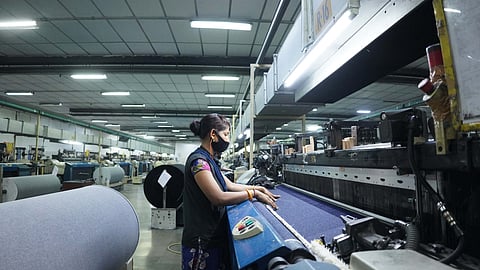
RSWML weaves a new growth phase
RSWM Ltd (formerly Rajasthan Spinning and Weaving Mills Ltd) has initiated a major transformation exercise. Called RSWM 2.0, the strategic initiative is aimed at uplifting the over six-decade-old organisation into a new growth orbit. It is a transformative plan to reshape the company’s culture and goals, with a focus on areas such as renewable energy, improved operational efficiency through Industry 4.0 technologies, and expanding its market and product reach, including denim and speciality yarns. RSWM 2.0 has been launched with a new management team under the vision Reflect. Reshape. Restore. All this follows as the flagship company of the LNJ Bhilwara Group is now consciously looking to realign its business with the fast-evolving consumer landscape.
“We have set foot on a new journey – RSWM 2.0 – since the beginning of 2025. This represents not just a transformation plan; it signifies a cultural shift across the organisation. We have adopted a new mindset that is grounded in agility, cost-effectiveness, intelligent manufacturing or product development, enhanced execution, and prompt responses to the needs of our customers. Enhancing profitability is our ultimate goal,” says Rajeev Gupta, 55, Joint Managing Director, RSWM Ltd.
“Our teams across various verticals are evaluating and analysing every process through a profitability sieve and adopting solutions that optimise costs and improve our margins. Sustainability efforts are being enhanced by adopting eco-friendly practices. We are refining our product range, reducing waste, and ensuring that every investment leads to meaningful results. We are working deliberately and diligently to create a future-ready organisation,” adds Gupta, who joined the company as its CEO in December 2024 and was later, in March 2025, elevated to the current position.
Fostering sustainable growth
Under the current initiative, the company aims to adapt to market changes and achieve sustainable growth by focusing on key pillars: technology, innovation, and sustainability. RSWM is integrating Industry 4.0 technologies, such as AI-driven price forecasting and machine learning for demand planning, to improve efficiency and cost management. The company is investing aggressively in sustainability by reducing its carbon footprint. RSWM is all set to increase the share of renewable energy in its total energy requirement to around 70 per cent from the present 33 per cent. The company has recently signed an agreement with Adani Energy Solutions Ltd for the supply of 60 MW of renewable energy.

As part of market expansion, RSWM is looking to broaden its product portfolio and market reach. This includes expanding its denim and knitting divisions and exploring entry into the garment segment. On the operational efficiency front, the company is planning to leverage its scale and streamline its operations to reduce per-unit costs and strengthen supplier relationships.
“It is an action-packed journey where speed and agility will reign supreme. New-age digital solutions will form the backbone of our business analysis and decision-making. Our ongoing leadership development programmes and cross-functional collaborations are already equipping our teams with the skills needed to succeed in this digital age. We set foot on this journey at the start of calendar 2025. I am particularly pleased that our financial performance in recent quarters reflects our sharp focus on execution, a diversified business portfolio, and the initial results of our transformative journey initiated under RSWM 2.0. In fact, it’s a commitment to agility, innovation, and sustainable growth. As we embrace a future of opportunity, our mantra is clear: Act. Act. Act,” states Riju Jhunjhunwala, 46, Chairman & Managing Director and CEO, RSWM.
Jhunjhunwala has played a key role in expanding the company’s business in the last decade or so. He is the grandson of LN Jhunjhunwala, who started the LNJ Bhilwara Group as a small textile unit in Bhilwara, Rajasthan, which over the decades has turned into a diversified business conglomerate with interests in multiple sectors.
After completing his graduation from the University of Bradford in the United Kingdom with a degree in Business Management Studies, he joined RSWM. He has been the managing director of the company since 2003 and also became its chairman in 2020 when his father, Ravi Jhunjhunwala, 70, decided to focus on the group’s graphite electrodes business. His father (now chairman & MD of HEG Ltd and director, RSWM) became chairman of RSWM in 1996 when his grandfather, LNJ (chairman 1960-1996), decided to pass on the mantle to his son. LNJ, now 97, is the chairman emeritus and remains the guiding force behind the LNJ Bhilwara Group.
RSWM’s recent initiatives have started bearing positive results, as the company reported a net profit in the first quarter of the current fiscal year after a gap of almost six to eight quarters. The company recorded a net profit of Rs7.00 crore, a reversal from the net loss of Rs13.7 crore in the previous year, though revenue at Rs1,169 crore in Q1 FY26 saw a marginal year-on-year decline. Other positive developments included a significant increase in EBITDA, which reached Rs81 crore: a robust 50.6 per cent year-on-year growth. The EBITDA margin during Q1 FY26 expanded to 6.9 per cent, up 243 bps YoY and 63 bps QoQ.
In fact, despite a muted external scenario, the company sustained its profitability in Q2 FY26 as well. The PAT during the quarter stood at Rs6.3 crore as against a loss of around Rs21 crore in Q2 FY25. In the first half of the current year, the company clocked a PAT of Rs13.2 crore on sales revenue of Rs2,319 crore. RSWM’s FY25 results showed a significant 18.9 per cent year-on-year revenue increase to Rs4,825 crore, even as the company reported a net loss of Rs41 crore due to higher finance and depreciation costs, primarily from increased working capital and investments. As of FY25, RSWM’s total debt stands at around Rs1,600 crore.
“Despite the challenging situation, RSWM, backed by its 2.0 initiative, is turning around. We are growing profitably and looking to continue this momentum with our commitment to responsible manufacturing, aligning with the sustainability goals of our global customers. As we move into the second half of the financial year, we expect a gradual recovery in exports and greater policy clarity. While short-term challenges may persist, the medium-term outlook remains positive. Our focus continues to be on innovation, agility, and creating lasting value for all stakeholders,” states Gupta.
Mitigating headwinds
On being asked how the company is dealing with the recent 50 per cent tariff imposed by the US on Indian textiles and apparel, Gupta says that RSWM is comparatively less impacted because it does not directly export to the US. All its businesses (yarn, knitted and denim fabrics) are B2B in nature, and hence it is affected only indirectly.
“Besides, our product basket is also quite diversified, and that de-risks the business to a great extent. Most importantly, 60 per cent of our revenue comes from domestic sales. The recently signed India-UK FTA and the upcoming India-EU trade pact are expected to be important milestones for the sector. These agreements will help reduce tariff barriers and enhance access to major international markets. RSWM is well prepared to take advantage of these developments through continuous product innovation, stronger compliance systems, and improved supply chain efficiency,” adds the company’s JMD, who has been brought in with a clear mandate to restore the company’s image in terms of product and financial performance in a fast-evolving trade order.
With over 30 years of extensive experience across the textile, home textile, and pulp & paper industries, Gupta, an MBA and a Certified Cost and Management Accountant, is renowned for his strategic vision, operational expertise, and ability to drive transformative business growth. In his current role, he leads RSWM’s strategic initiatives, focusing on innovation, operational excellence, and sustainability. He is spearheading efforts to adopt advanced technologies, enhance efficiencies, and strengthen the company’s competitive position in both domestic and international markets.
The Noida-headquartered company has come a long way since it was established in 1960 as a small textile unit in Bhilwara, Rajasthan. RSWM is today one of the largest manufacturers and exporters of synthetic, cotton and blended yarns, mélange yarns, knitted fabric, and denim in India. It exports a wide range of fabrics and yarns to over 70 countries across the globe. Today, the company has 12 manufacturing plants at multiple locations and employs around 17,000 people.
The company has 6.27 lakh spindles, 172 looms, and 95 circular and flat knitting machines across its manufacturing facilities located in Bhilwara, Banswara, Sikar in Rajasthan, and Mathura in Uttar Pradesh. It annually produces 24,000 tonnes of mélange yarn, 110,973 tonnes of synthetic yarn, 32,262 tonnes of cotton yarn, 32.4 million metres of denim fabric, 9,360 tonnes of knitted fabric, and 43,000 tonnes of green polyester fibre. The company’s clientele includes marquee names such as H&M, Tesco, Gap, Carrefour, JCPenney, Inditex, Walmart, C&A, Levi’s, and Tommy Hilfiger.
Capacity building
RSWM has invested over Rs1,200 crore between FY21 and FY25 to facilitate business growth. In addition to the modernisation of existing equipment and capacity expansion across all business verticals, the company has also established a greenfield PET bottle recycling facility and acquired the facilities of Ginni Filaments Ltd at Chhata in Mathura. Furthermore, it has channelled capital into renewable energy assets to enhance its ESG credentials.
While the company formally started its RSWM 2.0 journey recently, it has been laying the groundwork for this initiative for some time now. From being a pure-play yarn business, RSWM has, over the years, diversified into denim and, more recently, into knitted fabrics. The company is also looking to further integrate into garment manufacturing. Within spinning, which today accounts for around 74 per cent of its total revenue of Rs4,826 crore in FY25, the company has diversified into a wide range of value-added yarns. In other words, value-added yarn and fabrics make a significant contribution to its portfolio today.
As part of its diversification, the company set up its knitted fabric division – LNJ Knits – in 2023 and has been ramping up its capacity both organically and inorganically. It has recently announced a strategic investment of Rs92 crore in the modernisation and expansion of printing facilities for knitted fabric production and operations. The investment involves the acquisition of advanced machinery worth Rs54 crore from Birla Advanced Knits Pvt Ltd. This will strengthen RSWM’s knitted fabric capacity at its units located in Mordi, Rajasthan, and Chhata, Mathura, Uttar Pradesh.
The Chhata unit came into the company’s fold when it acquired Ginni Filaments’ knitting, processing, and spinning facility in 2024 for an enterprise value of Rs160 crore. Ginni Filaments divested the unit to improve its financial position and focus strategically on the technical textiles segment, where it holds a leadership position in products for hygiene, medical, and cosmetic applications.
The acquisition of advanced machinery from Birla Advanced Knits includes the purchase of European-made dyeing, processing, and knitting machinery, along with accessories and spares, to be installed for the modernisation of the company’s operations in Mordi, Banswara, and Chhata. The expansion will enhance RSWM’s total knitting capacity by 20 per cent: from 750 tonnes to 900 tonnes per month, over the next six to nine months. The upgrade adds a printed knits product line, allowing RSWM to cater to the 30-35 per cent fashion knitted market and offer a more diversified, value-added range to domestic and international garment manufacturers.
“The knitting business has shown consistent growth since inception, and this investment reflects our confidence in its long-term potential. The expansion aligns with RSWM’s broader strategy of building a future-ready textile enterprise through modernisation, diversification, and value creation. By strengthening our capabilities in Mordi and Chhata, we are enhancing our competitiveness and supporting India’s vision of textile leadership on the global stage,” says Jhunjhunwala.
The company’s knitted fabric portfolio ranges from single jersey and interlock to textured structures, enabling applications across apparel categories. The company is ramping up its knitted fabric division, which is expected to increase its contribution from the current 6.10 per cent to overall revenue, as the product mix has been completely shifted towards trending and value-added products (printed fabrics), resulting in higher order inflow.
LNJ Denim, a denim manufacturing facility established in 2007 under RSWM, has a production capacity of 34.2 million metres (over 3,000 variants) annually. Today, LNJ Denim, which contributes around 19 per cent to the company’s overall revenue, is globally acknowledged for its exceptional quality, setting a high standard in the industry for top-notch service, continuous innovation, and trendsetting practices. The company has also entered the casual shirting fabric segment, a new product vertical catering to large buyers in key domestic hubs.
RSWM is primarily known for its yarn business (capacity: 170,000 tonnes per annum; 6.27 lakh spindles), where the synthetic yarn division continues to deliver advanced yarn solutions for fashion, performance, and industrial applications. A leader in the business, the synthetic yarn division contributes more than 45 per cent to the company’s revenue, positioning itself as a strategic growth engine and an integral part of the company’s long-term vision. Its sustained leadership in domestic and international markets underscores a legacy built on agility, customer-centricity, and scalable excellence.
Diversified portfolio
Over the years, the portfolio of synthetic yarn has expanded to include a wide range of value-added products: linen and linen-look blends; Ecotherm and CICLO-based yarns; slub yarns in open-end spinning; blends with cotton, Modal, Lyocell, and bamboo (viscose); acrylic and nylon blends; sustainable yarns (recycled polyester, recycled viscose, etc); and yarns for home textiles, industrial applications, and technical textiles. In fact, speciality yarns now account for nearly 25 per cent of production, with significant growth expected as market demand for sustainable, functional, and value-added yarns increases.
A trailblazer in man-made yarns and speciality blends, RSWM has also strategically diversified into cotton yarns (contribution: around 16 per cent), establishing itself as a holistic yarn supplier catering to the full spectrum of customer requirements. Operating a robust fleet of 1,35,456 spindles and 1,720 rotors across two state-of-the-art facilities, the company produces around 116 tonnes of cotton yarn daily.
Kapaas by RSWM is a brand of 100 per cent cotton combed compact yarn known for its exceptional softness, lightness, and breathability. Introduced in 2023, this sustainable yarn is made from meticulously refined pure cotton and is used for creating products such as innerwear, shirting, bedsheets, and loungewear. The Kapaas brand represents RSWM’s commitment to combining textile craftsmanship with innovation.
Mélange yarns combine coloured fibres to create diverse visual effects in woven and knitted fabrics, ranging from subtle textures to bold patterns. With extensive expertise in producing premium mélange yarns, RSWM has established itself as a leader in this value-added segment. Marketed under the Melantra brand, RSWM’s mélange yarns are widely recognised by leading global brands in India. These yarns cater to a broad spectrum of applications, from undergarments and business suits to casual wear and home furnishings. Their rich texture and depth make them the preferred choice of fashion designers and manufacturers seeking distinctive, high-quality textile solutions.
“The success of RSWM’s mélange yarn division (contributing over 13 per cent to revenue) lies in its expertise in blending fibres of various colours to produce visually striking, multi-tonal effects. This adaptability and commitment to innovation position RSWM as a trusted partner in the global textile industry. We have added several global and domestic brands to our customer base. Overall, RSWM is aggressively strengthening its global footprint with a focus on value-added products and customers. These efforts should increase order inflow, thereby improving the capacity utilisation of our facilities,” avers the company’s JMD.
RSWM has also launched the Panchtatva Initiative – a sustainable textile innovation programme inspired by the five elements of nature. This initiative reflects RSWM’s commitment to merging ancient Indian wisdom with contemporary technology, thereby significantly contributing to the national agenda of Mission LiFE, which emphasises sustainable living and environmental responsibility. The initiative was prominently featured at Bharat Tex 2025, India’s largest textile event, held at the Bharat Mandapam in New Delhi. It garnered strong appreciation from industry leaders and received acknowledgement from the Union Minister of Textiles.
RSWM has entered into a strategic Joint Development Agreement with Birla Cellulose (a division of Grasim Industries) and TACC Ltd to develop graphene-enhanced functional textiles. This collaboration aims to leverage the unique properties of graphene, including its exceptional strength, conductivity, and lightweight nature, to create next-generation textile products. The graphene market, a derivative of graphite, is experiencing exponential growth, with industry reports highlighting major projections that reinforce the material’s increasing significance across sectors.
While carrying out all these initiatives, sustainability remains a central part of RSWM’s long-term strategy. This commitment is demonstrated through the company’s sustained efforts to reduce its carbon footprint via responsible product stewardship, optimised resource utilisation, increased reliance on renewable energy, minimised waste generation, biodiversity initiatives, and a circular economy approach. RSWM has deployed robust systems and protocols to support responsible manufacturing practices, effective resource management, and compliance with applicable environmental regulations. Its systematic approach towards reducing its carbon footprint and positively impacting the environment includes improving energy efficiency, increasing the share of renewables in the energy mix, moderating water use, and minimising waste generation.
Green energy
RSWM recently signed an agreement with Adani Energy Solutions Ltd (AESL) for the supply of 60 MW of renewable energy, marking a key milestone in its sustainability journey. Under the agreement, AESL will manage the entire green power value chain for RSWM’s additional power requirements. The company has invested Rs60 crore under the Group Captive Scheme with a renewable generation company for the supply of 31.53 crore units of green power per annum to its manufacturing facilities across Rajasthan. With this addition, the contribution of renewable energy to RSWM’s total energy requirement will rise from the current 33 per cent to 70 per cent in the near future.
Recognising the challenges posed by the rapidly increasing plastic waste, the company has established a PET bottle recycling facility. Operational since FY2015, the unit processes about 6.5 million PET bottles daily, converting them into polyester fibre. Recycled polyester now constitutes 50 per cent of total polyester production, up from less than 10 per cent initially.
“At RSWM, we see sustainability as both a responsibility and an opportunity to drive purposeful growth. Guided by Panchtatva, we are reimagining our industry by turning challenges into opportunities through sustainable innovation and nature-conscious initiatives. Our philosophy is simple – we only take what we can give back,” says Jhunjhunwala.
With all these developments in place, RSWM is ramping up its efforts to create a more robust and sustainable business model that will help it move into the next growth phase. It is building a more diversified portfolio with a focus on value-added products. Backed by RSWM 2.0 and other initiatives, the company is ready to reinvent itself as it commences a new growth journey in a fast-evolving marketplace where customers are more discerning than ever before. However, it remains to be seen how effectively it implements these initiatives to not only sustain its leadership position but also expand its footprint in this highly competitive marketplace.
Box
The LNJ legend
LNJ Bhilwara Group is one of the country’s diverse business conglomerates, with its roots dating back to 1960. The journey of the group started in a small city of Bhilwara in Rajasthan, when the legendary LN Jhunjhunwala (popularly known as LNJ; currently 97 – a guiding force behind the group), established a textile mill there, laying the foundation of what would in due course become one of India’s leading textile companies – RSWM Ltd. The sheer determination and vision of LNJ has led that one textile mill to grow into 17 companies with its 21 manufacturing units and 9 marketing offices across sectors like textiles, graphite electrode, power, energy storage solutions and IT services. The group today stands proud as a multi-product and services conglomerate with an annual turnover in excess of Rs10,900 crore. The group’s five companies are listed on stock exchanges.
The listed companies of the LNJ Bhilwara Group are RSWM (one of India’s leading textile companies, producing yarn and fabrics; revenue: Rs4,825 crore); HEG Ltd (manufactures and exports graphite electrodes; revenue: Rs2,153 crore), BSL Ltd (manufactures woollen/worsted yarns, synthetic yarns, blended viscose fabrics as also furnishing and fashion fabrics; revenue: Rs668 crore), Maral Overseas Ltd (makes garments including activewear, casual wear and sleepwear for men and women; revenue: Rs1,257 crore), and Bhilwara Technical Textiles Ltd (involved in the technical textiles sector; revenue: Rs8.20 crore).
LNJ’s parents were small-time jute brokers in Calcutta with very modest means. He entered business in 1947 as an exporter of jute goods from Calcutta, and within a short span of time, by 1951, he was one of India’s top ten exporters of jute goods. After this, he diversified into exports of iron ore. As the State Trading Corporation was keen to break the cartel of Japanese steel mills for the purchase of iron ore, LNJ established Belgo Indian Mineral Corporation in Antwerp and sold iron ore for the first time in Italy. He was appointed as the sole selling agent of the State Trading Corporation for Western Europe.
Against all odds, he established his first plant of 12,000 spindles at Bhilwara in 1960. The group now controls more than 6.5 lakh spindles spread over Rajasthan, Madhya Pradesh, Karnataka, Tamil Nadu and Uttar Pradesh.
A decade of relentless efforts by LNJ resulted in the establishment of the graphite electrodes business. Graphite electrodes are a high technology product with its technology held by only a handful of companies in the US, Europe and Japan. After two years of persistent efforts, he was able to edge out the Modis, Tatas and Birlas to get the industrial licence and then get a large French conglomerate, Pachiney, an $8 billion company in mid-1970s not only to give technology but also to become a financial partner in India.