
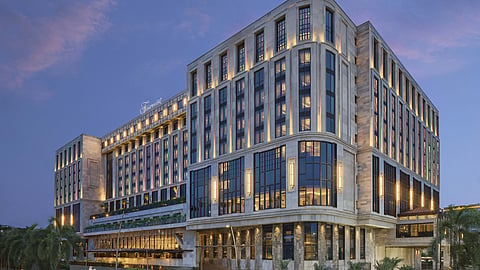
Roswyn redefines Mumbai's luxury hospitality with a unique lifestyle approach
Mumbai’s most successful hotels understand one thing: the city itself is the destination. Roswyn’s location is convenient for international travellers, but its ambitions extend well beyond serving passengers with early-morning flights. Opened in May 2026, Roswyn marked Ennismore’s entry into India and the debut of Morgans Originals in the country, a significant development for both the Shrem Group and Accor.
Mumbai has no shortage of luxury hotels, but its hospitality market increasingly demands something more nuanced: places that function as hotels, restaurants, meeting venues and social addresses, while offering an occasional escape from the city’s relentless pace. Roswyn brings these elements together under one roof. Its concept revolves around the rhythms of urban life – meetings, dinners, work, networking and short stays that turn into longer ones – as well as the simple need for somewhere to gather.
The story goes back to Sharan Pasricha, Ennismore’s founder. In 2021, Ennismore formed a joint venture with Accor to develop its lifestyle brands, giving Pasricha’s brand-building approach access to a much larger international platform. Accor is the international hospitality group and a major shareholder in Ennismore. Morgans Originals is a collection of individual hotels with distinctive cultural and design identities. Its properties include Sanderson and St Martin’s Lane in London, as well as Roswyn in Mumbai and Luura in Paros.
Asset-light arrangements
The commercial model combines management and brand agreements, brand development and hospitality operations, with the potential for residential extensions. Under asset-light arrangements, ownership of the hotel real estate may be separate from the brand and its operator. Returns depend on property-level performance after capital expenditure, debt servicing and management or brand fees.

Morgans Originals is built around originality, community and meaningful experiences. Ennismore positions lifestyle hospitality as an approach that creates culturally relevant destinations integrated into a city’s everyday life. Roswyn is therefore being positioned not simply as an international hotel brand arriving in India, but as an Indian property within an international lifestyle portfolio.
The Shrem Group owns Roswyn and has partnered with Ennismore and Accor to bring the property into the Morgans Originals collection. Shrem Airport Hotels Pvt Ltd is associated with its development and ownership, while Accor provides access to its distribution network. Roswyn’s suites and facilities cater to travellers seeking more space and independence than a conventional hotel room offers. Its design concept evokes the home of a well-travelled, design-conscious friend.
The group also owns Fairmont Mumbai, which opened in 2025. With 446 rooms and suites, extensive event spaces and multiple dining options, the hotel combines the elegance of 1920s Art Deco with contemporary luxury. If Fairmont represents Chhatwal’s approach to grand, polished hospitality rooted in the traditions of a five-star hotel, Roswyn is its more intimate, residential and deliberately informal counterpart. Together, the properties demonstrate how the same owner can approach hospitality through two distinct concepts.
Roswyn also reflects Chhatwal’s view of how luxury hospitality is evolving. “The project was driven by the changing Indian consumer preferences and the growing appetite for luxury experiences. Also, the fact that affluent Indian consumers increasingly want high-quality experiences at home rather than having to travel abroad for them,” he says.
More broadly, Roswyn represents another chapter in the hospitality journey of Chhatwal, chairman and managing director of the Shrem Group. The Mumbai-based family business has diversified interests spanning infrastructure, real estate, hospitality, healthcare and financial services. Its hospitality portfolio began with Novotel in 2012, followed by Grand Mercure in 2013, before expanding to Mumbai. This progression has given the group exposure to different hotel formats and price points.
From capital allocation to hospitality
Chhatwal’s move from manufacturing into infrastructure and hospitality reflects a broader strategy of long-term asset ownership and capital allocation. The privately owned Shrem Group also has interests in mining, manufacturing, logistics, electronics, events and exhibition spaces.
Its infrastructure arm, Shrem Infra Invest Private Limited, has a substantial portfolio of national and state highway projects, including toll-annuity assets. The group’s infrastructure investments also include the acquisition of 24 build-operate-transfer (BOT) road assets from Dilip Buildcon, involving an investment of more than $250 million.
Shrem InvIT, a SEBI-registered infrastructure investment trust established in 2021 and sponsored by Shrem Infra Invest Pvt Ltd, focuses on road infrastructure assets. Its returns depend on concession-linked revenue, debt servicing, maintenance costs and distributions. Key performance indicators include portfolio size, remaining concession periods, debt levels, revenue mix, refinancing and further asset acquisitions.
Chhatwal’s business philosophy has been shaped by more than three decades of entrepreneurship. In the mid-1980s, he co-founded Viraj Profiles, a manufacturing business that grew into a billion-dollar enterprise and one of the world’s largest manufacturers of stainless-steel long products, exporting to more than 90 countries. After exiting the business in 2010, he focused on building a diversified family office and established the Shrem Group in 2011.
The transition from stainless steel to hotels may seem dramatic, but Chhatwal sees a common thread: creating long-term value. He describes the lessons of his manufacturing years in three words: “precision, process, and patience”. These principles continue to inform his investment approach: identify an opportunity, understand its fundamentals, invest with conviction and build something that can endure.
This perspective helps explain his hospitality strategy. Rather than treating hotels merely as lifestyle businesses, Chhatwal approaches them as long-term investments. Hotels are capital-intensive assets in which land, construction, design, branding, operating expertise and market positioning must work together. A beautifully designed hotel can still fail commercially, while an efficient property may generate strong returns without becoming culturally relevant. The challenge is to create an asset that achieves both.
Chhatwal’s journey from stainless-steel manufacturing to infrastructure and hospitality illustrates an investment philosophy focused on long-term opportunities rather than passing trends. His early experience in manufacturing provided a foundation in process and scale, while his subsequent family-office approach broadened his interests across sectors. His hospitality investments, including Roswyn and Fairmont Mumbai, reflect that approach. Their proximity also creates an interesting cluster of properties under the same ownership, allowing the group to serve different segments of Mumbai’s luxury hospitality market.
Roswyn has just 109 suites, starting at 80 sq m. Unlike conventional hotel rooms, typically arranged around a bed, desk and bathroom for short stays, these are designed as living spaces, with a lounge, kitchenette, home bar, bedroom and dedicated study. This configuration reflects the changing needs of travellers, particularly in Mumbai, where the boundaries between work, leisure and socialising are increasingly fluid.
A business traveller might meet someone over breakfast, work from the suite, have lunch with a client, return to answer emails, dine downstairs and finish the evening at a listening bar. Roswyn has been designed around this flexibility. Its positioning is not about separating guests from Mumbai’s energy, but about offering a destination within it.
As Chhatwal puts it, “Mumbai moves quickly.” Yet, he argues, people still seek places where they can slow down, meet and spend time together. Roswyn does not attempt to persuade Mumbai to slow down; instead, it creates spaces within the city’s constant movement where people can choose to pause.
This approach reflects Chhatwal’s broader business philosophy. He combines mathematical rigour with entrepreneurial instinct and thinks in decades rather than years. His stated objective is sustainable value creation: identifying sectors with enduring potential, investing responsibly and building for the future.
Roswyn fits that philosophy. It is not designed to compete with every luxury hotel in Mumbai or overwhelm guests with scale. Instead, it offers a more intimate, residential experience. For the Shrem Group, the proposition rests on creating a distinctive hospitality asset that can deliver long-term value while meeting the changing expectations of luxury travellers.
The Morgans Originals connection: Roswyn is significant for its international partnership, marking the first Morgans Originals hotel in India and the first Ennismore property in the country. The hotel is a natural fit for Mumbai, a city that resists generic luxury. Impatient, cosmopolitan, entrepreneurial and constantly reinventing itself, Mumbai has a distinct personality. Roswyn draws on this character without turning it into a caricature.
Paris-based designer Daphné Desjeux approached the interiors as a home shaped by Mumbai rather than by obvious local clichés. The details are deliberately subtle: embroidered portraits, ceramic plates marked ‘Bombay’ and a photographic study of the shoreline. The design reveals itself gradually. The lobby immediately establishes the hotel’s character, resembling an elaborate living room rather than a conventional reception area. Comfortable seating, paintings, mirrors, a dramatic fireplace and carefully considered lighting create a sophisticated but welcoming space that avoids the stiffness traditionally associated with luxury hotels.
Roswyn’s identity as a modern lifestyle hotel rests on its dining and social offerings as much as its suites. Filia serves Italian cuisine, while Lacquer is a Japanese listening bar built around vinyl. The Third Room, meanwhile, occupies a space between a boardroom, a club and a living room. Designed as a social workspace, it allows hotel guests, business travellers and local professionals to meet, work, exchange ideas or simply have a drink.
This is central to Roswyn’s business proposition. The hotel offers multiple reasons to visit beyond accommodation: residents may come for dinner, business leaders for meetings and guests for wellness experiences. Its suites are another attraction. By combining these different uses, Roswyn functions less like a conventional hotel and more like a small ecosystem built around hospitality, work and community.
Wellness and longevity
At the heart of Fairmont Spa & Longevity is Blu Xone, described as India’s first longevity destination within a luxury hotel. It brings together advanced wellness technologies, medical guidance and personalised therapies. Each treatment serves a distinct purpose, from supporting circulation, oxygenation and physical recovery to promoting cellular health, metabolic resilience and skin health.
General manager Rajiv Kapoor brings more than 25 years of luxury hospitality experience to his role, including overseas operations, commercial performance and team development. Overseeing both Fairmont Mumbai and Roswyn presents a particular challenge because the properties require different operating philosophies.
Fairmont represents grand luxury rooted in the heritage of an established international brand. Roswyn, by contrast, offers contemporary, intimate and deliberately unconventional lifestyle luxury. Kapoor’s view captures this distinction: “Mumbai doesn’t need more overt luxury. It needs places that understand how people actually want to experience the city and respond to that without getting in the way.”
This is a departure from the traditional association of luxury with abundance – more marble, chandeliers, staff and visible service. The emphasis now is on removing friction and anticipating guests’ needs without making that anticipation intrusive. In a city such as Mumbai, where time is a precious commodity, this approach can be more valuable than ceremony. Kapoor’s challenge is to make Roswyn’s different components feel like a coherent experience rather than a collection of separate businesses.
The contrast between the two properties also reflects Chhatwal’s investment philosophy. With 446 rooms and suites, extensive event spaces, dining facilities and a strong architectural identity, Fairmont is designed to operate as a major luxury hotel in one of the world’s leading business cities. Roswyn is smaller and more specialised, with a focus on design, dining, wellness, social spaces and a residential experience.
Both properties illustrate how the Shrem Group can address different segments of the hospitality market without relying on a single definition of luxury. Traditional luxury hotels continue to serve business travellers, weddings, conferences and high-end leisure. At the same time, a new generation of travellers is seeking design, food, culture, wellness and community alongside accommodation. Guests are increasingly looking for an experience, not simply a room.
Fairmont and Roswyn’s proximity makes the contrast particularly compelling. Fairmont represents the established luxury hotel model, built around scale, service, events, dining and an internationally recognised brand. Roswyn offers a different proposition: fewer rooms, larger suites, distinctive design, destination restaurants, wellness and a more residential atmosphere. Neither makes the other redundant. Instead, they broaden Chhatwal’s exposure to the hospitality market, allowing the group to serve different consumer preferences through two distinct assets.
Chhatwal’s stated ambition is to build institutions that endure across generations rather than businesses focused on quarterly results. This philosophy is particularly relevant to hospitality, where buildings may last for decades, but their commercial and cultural relevance must continually be renewed.
A hotel’s long-term success depends on more than its investment thesis, brand or architecture. The properties that endure are those that evolve without losing their identity. Roswyn’s proposition is built around this flexibility, but its ultimate test will be whether it becomes a Mumbai destination in its own right rather than simply a hotel near the airport. The answer will shape its commercial and cultural success.
The Shrem Group is also preparing to enter the senior living segment through ShremMoha, co-founded by Chhatwal and Soumyajit Roy, CEO of Emoha Elder Care. Established in July 2026, Emoha is a premium senior independent-living platform. The strategic alliance combines the Shrem Group’s hospitality and real estate expertise with Emoha’s elder-care experience. The partners aim to create India’s premium senior-living communities, developing integrated longevity ecosystems where growing older means living magnificently.
The group also plans to invest around Rs1,000 crore in two additional hotel properties in Goa and Pune. Chhatwal says his succession plans include his son, Aaryaman, who has been involved in the business for the past five years and has already played a role in building Fairmont and Roswyn.
BOX
Doing something different
Business India asked Chhatwal about the Shrem Group’s investment in Roswyn, its partnership with Ennismore and the business strategy behind the hotel
Asked how the group identifies and acquires land, particularly in established urban markets, Chhatwal explains: “We had the opportunity to lease land near the airport because hospitality infrastructure was needed.” Securing a hotel site in an urban market is difficult, given the constraints of land availability and development. Asked whether the group invests its own capital or primarily raises external funding, he says: “We invest our own capital, and we fully own Roswyn, while the management contract is with Accor/Ennismore.”
On the choice of Accor and Ennismore, Chhatwal points to shared strategic interests: the Shrem Group brought a locally developed property, while Ennismore gained an entry point into India for its lifestyle hospitality portfolio. Asked about the financial and legal advisers involved in the arrangement, he says: “We have an internal team for financial advice; for legal advice, we have Advocate Mukesh Jain, who has been advising our group for 30-plus years.”
The discussion then turns to ownership, returns and the hotel’s operating model. Asked whether Shrem Airport Hotels holds the freehold or leasehold interest in the property, and what its beneficial shareholding is, Chhatwal replies: “It is leasehold land; Shrem owns 100 per cent.” The group plans to hold its hospitality assets for the long term, targeting mid-teens returns over that period.
Roswyn operates under a management agreement rather than a franchise or brand licence. Asked about the expected stabilised occupancy, average daily rate (ADR), revenue per available room (RevPAR) and cash-on-cash return, Chhatwal says: “Overall, with Fairmont and Roswyn, we plan to have more than 75 per cent occupancy in the third year and an average ADR above 20,000.”
Asked why the group chose Morgans Originals over other Accor brands or competing luxury offerings, and whether it was the right fit for Roswyn, Chhatwal responds good-humouredly: “We wanted to do something different, and it is, after all, the first lifestyle property in India.”