
Juniper Green: Entering the big league?
The winter chill has just begun making an impression, especially in the northern part of the country. But, at Mumbai’s Dalal Street, the torrential downpour of IPOs (in terms of volume of new issues, 2025 may conclude with ‘the best year’ tag) has not signalled any sign of abatement as yet. December, the concluding month of the year, is traditionally considered to be slow for investments and other funding activities. But, this time, it seems to be business as usual and one of the clear manifestations of it is in the form of new IPOs being floated. Meesho, Park Medi, ICICI Prudential AMC and Neptune Logitech are the prominent offerings leading the IPO rally in the concluding month of the year.
In a year when power sector (especially renewable energy-linked) companies have fared well in the IPO litmus test, Gurgaon-based Juniper Green Energy could be another addition to this list soon. The company had earlier received SEBI’s nod to raise Rs3,000 crore and in all likelihood, it may take the plunge in the next few weeks. Meanwhile, earlier this year, companies in the renewable space, such as Vikram Solar and Saatvik, had met with enthusiastic response from investors and it is generally believed that the new offerings from the power sector companies are being looked at favourably in Dalal Street, considering the massive leap the country has taken to ensure that the economic engines are up and running. And, when judged through this prism and the recent examples of successful enlisting by power companies, Juniper too is likely to follow the suit.
The second coming
Point it out to Ankush Malik, the young CEO of the company, that the environment is favourable for the power companies for an IPO and he quickly responds, defining the differentials. “Most of the renewable power companies, which have done well this year, have primarily been in module manufacturing,” he asserts. “But we have nothing to do with module manufacturing. We are primarily an IPP (independent power producer) rooted in renewables and determined to make a mark in the segments which go beyond plain, vanilla renewable production or generation.” An alumnus of IIM-Lucknow, Malik has spent a large part of his career for over a decade with AT Capital, which is behind Juniper. “Another major feature of our IPO is: there is no OFS (offer for sale) element involved,” he affirms. “The fund generated would be used for debt repayment and expanding our operations.”

If you put together the above-mentioned quotes, the imports are clear. Firstly, Juniper Green is positioning itself in the larger ecosystem of private power generation dominated by dedicated (renewables) or integrated players like ReNew, Adani Power, Tata Power, Greenko, etc. And, secondly, there is a subtle indication that, in this high-capex game, Juniper is on a sound financial base.
The latter is the critical strength for Juniper. Owned and controlled by Singapore-headquartered AT Capital Group, the company is spearheaded by the seasoned entrepreneur and investor Arvind Tiku. And, according to the DRHP filing of the company, AT Holdings owns 75.01 per cent equity in it, with the remaining 24.99 per cent left with Rosco SA, a subsidiary of leading global energy trader Vitol.
For AT Capital, known for luxury real estate assets under the Experion brand, which has developed upscale residential projects at multiple locations in northern India, Juniper’s arrival can be considered a second coming in the clean energy business. In 2013, it had stepped into the Indian renewable space with brand Orange, which was sold to Greenko in 2018, in a nearly $1 billion deal, which had elevated buying firm’s portfolio capacity by over 1GW across solar and wind capabilities. (Greenko, a leading player in the domestic renewable business, is estimated to have developed an over 10 GW functional portfolio.) AT Capital later swung into action again in the renewable space with the formation of Juniper. According to Malik, the company has made swift moves after the initial years of forming a solid operational base and achieved commendable success. “Today, we are among the 10 largest renewable independent power producers in the country,” he informs.
Driving factors
As a new entity on the block, Juniper had made its first decisive mark in March 2020, with the commissioning of a 100 MW solar project. And, since then, it has stretched its wings at a regular pace in a growing market, where payments to IPPs have become more secure with the implementation of supportive measures. According to the SEBI filing, Juniper had a portfolio of 48 projects as on 31 March, which included 17 operational projects, 18 under-construction contracted projects and 13 under-construction awarded projects. Its operational projects’ combined capacity stood at 954 MW (885 solar and 69 wind energy) and the projected capacity of under-construction contracted projects and under-construction awarded projects stood at 3,153 MW and 3,790 MW, respectively. Maharashtra, Gujarat, Rajasthan and Madhya Pradesh are the states where Juniper has made its presence felt, creating a diverse base of off-takers comprising Central government entities like SECI, SJVN, NHPC and NTPC, and state government entities, such as GUVNL and MSEDCL. Private entities like Tata Power are also signing up for their projects as off-takers. Nearly 97 per cent of its total capacity is backed by long-term PPAs, which are typically for 25 years.
According to a CRISIL report, the SEBI filing also underlines that Juniper has the shortest receivable days for each of the nine months period ended 31 December 2024, as also 2023-24, 2022-23 and 2021-22, when compared to other listed industry peers. Another critical feature is Juniper’s ability to execute projects on time or even ahead of schedule in some cases.
The world of renewable production is under a serious churning where plain, vanilla production model (solar and wind energy, as stand-alone projects) is losing its grip and relevance. “‘Firm and Dispatchable RE (FDRE) and Wind Solar Hybrid (WSH) projects are gaining in prominence as, when combined with battery storage, it becomes possible to supply power when customer demands,” observes Vinay Rustagi, a leading renewable energy expert. “Though costlier, it is the need of the hour and an intelligent solution, which has been adopted on a large scale in China, Europe and the Middle-east. In India too, the leading IPPs are opting for it by improving their capability. It is the future.” FDRE is considered to be a major transformative factor, as it facilitates integration of renewable power plants with back-up storage facilities (battery energy storage systems and other technologies). This gives them the leeway to distribute when the customer demands. It offers many benefits including grid stability and a better demand-supply equilibrium between the producer and the end users.
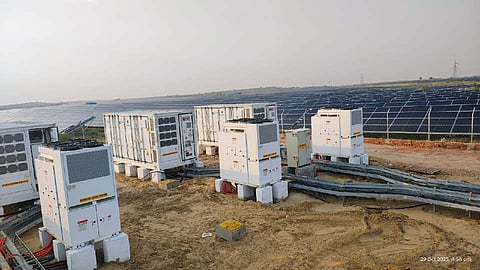
And this is what Juniper has shown a strong intent to do, despite being a relatively new player. A visit to its Bikaner district site (over 300 acres in Nokha Daiya village, which is part of a major solar hub in the state), where it is executing a 100 MW project, reflects the manifestation of this intent. Here, you will find a dedicated large-scale storage section. “We are ranked as the second largest bidder in terms of total capacity won in WSH and FDRE tenders concluded between April 2021 to December 2024,” says Malik enthusiastically. In fact, much of the projected capacity strength of the company is rooted in contracts won in both these segments. According to a company filing, its total capacity in WSH (being executed under contracted or awarded mode) had stood at 3,927 MWp (‘p’ stands for potential peak); under similar parameters, it was 4,409 MWp for FDRE at around May end.
Tailwinds for growth
Juniper, in recent times, seems to have been quite busy adding more projects to its portfolio. Similarly, there has been a spurt in the commissioning action in recent months. In October, it commissioned about 64 MWp of new renewable energy capacity across two key projects in Gujarat and Maharashtra. The projects included the commissioning of a wind power project and the solar component of its hybrid power project in these respective states. It actually meant commissioning of 28 MW of wind power capacity from its 70 MW wind power project in Dwarka, Gujarat, about four months ahead of its scheduled commercial operation date. The power purchase agreement for this project was signed in February 2024. The new opening in Maharashtra comprised commissioning of a 36 MWp solar component of its 133 MWp hybrid power project in Nanded. The plant has been commissioned 13 months ahead of schedule. “The dual commissioning across Gujarat and Maharashtra, completed months ahead of schedule, is a testament to our execution capabilities and commitment to speedy delivery,” Malik comments.
In the same month, Juniper signed a Power Purchase Agreement with Tata Power for a capacity of 70 MW firm and dispatchable renewable energy (FDRE) power project. The PPA has been signed for a period of 25 years. Under this PPA, Juniper Green Energy will develop a renewable energy power project in Maharashtra, which will be a mix of solar, wind and battery energy storage system (BESS). The project will have a renewable energy capacity of around 180 MWp and BESS of about 280 MWh. The supply is scheduled to commence from September 2027. Under the FDRE category, Juniper Green Energy had previously signed a PPA with NHPC in June 2025 for a 250 MW FDRE project to supply power to the state of Haryana. And, in November, the company inked a PPA deal with Gujarat Urja Vikas Nigam Limited (GUVNL) for a 50 MW wind project. It will be commissioned by November 2027 and has been signed for 25 years.
The point is: Juniper is fast turning into a stage of intensifying action and that is a testament of the market acceptance of its claim that it has expertise spanning the entire project lifecycle – from initial concept to construction and development – across the country. And it seems to be positioning itself well to reap dividends of a scenario when the contribution of the renewable sector would further improve, both in terms of linkage to the grid (a recent report by JMK Research has maintained that ‘about 50 GW of RE capacity is stranded across India’ due to infrastructure inadequacies) and share to the total production kitty (already crossed 50 per cent of the total national production). Interestingly, the World Economic Forum (WEF) has just come out with a report projecting India to lead the global drive for consistent surge in renewable production between 2024 to 2030. According to the report, India’s renewable electricity capacity is likely to post an annual growth trajectory of 16 per cent, as against a more than 15 per cent annual average of China. The report also says that India’s policy intervention to develop domestic capabilities in solar modules and advanced batteries with schemes like production-linked incentive will go a long way.
There are a host of such reports which are pointing in the direction of a major quantitative and qualitative uptick in the renewables and aligned businesses, so, there would be opportunities galore for companies like Juniper. But there would be challenges on some critical fronts too. “No doubt, FDRE is the future but production plus storage combo is a costly affair at this stage,” says Rustagi. “The costs will ultimately come down in a medium run scenario but, till then, all the players in the ring will have to manage this prudently.” Adds a senior official of an equity research firm: “Juniper may be new and small vis-à-vis the leaders of the IPP pack but, within a short period, it has shown top-class execution abilities and aggression in expanding its portfolio through bidding. These are the signs of an efficient management which market may seriously look at. Plus, it has pedigree”. If his words are to be taken at its face value, Juniper, with its IPO, may be set to make a statement of its arrival on the big stage.