
Jai Raj Ispat's boutique bet
When Jai Raj Ispat decided to become a primary steel producer, it walked into a market with no obvious room for it. Above sat five integrated giants: Tata Steel, JSW, JSPL, SAIL and AM/NS India, all with the scale, brands and balance sheets built over decades. The company’s answer was not to match them on size, but to beat them on quality while pricing at or below their levels. “We asked ourselves how we could compete with the big boys,” says director Rajshree Jain. “The answer was to make a better product and offer it at the same price, or even less, because we produce at a lower cost than they do.” That is the logic of India’s sixth primary steel producer and of the first plant in Asia to run the technology behind it.
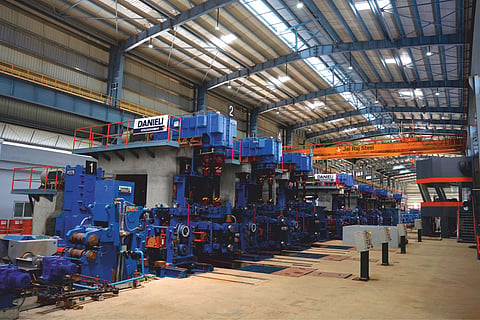
At the heart of the integrated plant at Kurnool, built for over R2,100 crore, is an endless casting-and-rolling line supplied by Italy’s Danieli, a technology that rewrites the economics of TMT making. The site itself was a deliberate choice. “Steel needs a large, contiguous parcel, and such land was not readily available in Telangana,” says executive director Siddharth Jain. “Kurnool gave us room to build an integrated facility across roughly 430 acres, with close to 1,000 acres secured for expansion, and it is strategically placed, with good connectivity and easy access from Hyderabad.” The facility already employs close to 1,500 people.
Advanced technology
Conventional TMT making is a stop-start affair: steel is cast into billets, cooled, cut, then reheated and rolled. The Danieli line removes the interruption: liquid steel runs continuously from casting to finished bar, with no cutting, cooling or reheating in between. Fewer thermal cycles mean a stronger, more consistent product, sold as Jai Raj ATOOT Fe 550D; skipping the reheat strips out energy and cost. It also sets Jai Raj apart from the crowded base of the market. Below the five majors sits a long tail of regional secondary producers – hundreds of scrap- and sponge-based re-rolling mills that together account for close to half of India’s steel, competing on price, none of them running endless rolling. The clearest sign the bet was right is that Tata Steel has now ordered the same technology for a plant in Punjab, though its edge will not remain exclusive.

Behind the technology is a family firm that has learned to move fast. Founded by SK Goenka in 1983 with a small furnace unit in Hyderabad, the company keeps its decision-making close. “We sit on the same floor,” Rajshree Jain says. “Whatever issue comes up during the day, we discuss it and decide. No board, no layers of approval.” Her father, the founder, remains the most active of them all, still pushing for more sales. For him, the point was never scale. “True success,” Goenka says, “is not measured only by scale, but by the legacy of excellence, reliability and trust we leave for future generations.”
The runway is national. India is targeting 300 million tonnes of steel by 2030 and is roughly halfway there, leaving room for a producer that competes on capability rather than size. “That gap is the opportunity,” Jain says. The plan is to grow Kurnool towards 1.5 million tonnes within 4 years and to five million tonnes over the decade, adding a coke oven and captive power first, for around R600 crore, then a further rolling mill for R400 crore, all funded through internal accruals, with no near-term plans for an IPO. Growth, in other words, on the company’s own terms.
Jain is one of relatively few women running a steel plant in India, and she is unsentimental about it. “People underestimate you, and you can take advantage of that,” she says. “I’ve always felt being a woman in manufacturing is an advantage.” It is of a piece with the way she runs the business: quietly confident and content to stay smaller than the giants as long as the steel is better. In an industry where the furnace itself has barely changed in a century, that is the wager: that the edge lies not in how much you make, but in how well, and in being first to change how it is made.