
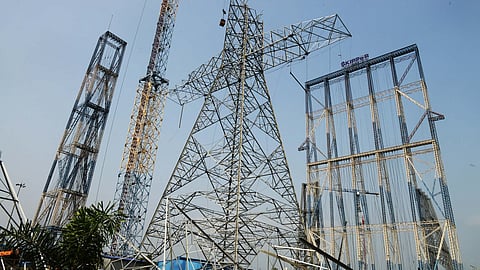
How Skipper maintains its leadership position in the industry
When the going is good, the wise seek to secure their future in business. Skipper Ltd, one of India’s largest infrastructure companies, has consistently adapted to changing market conditions and invested in capacity expansion and value addition. Intensive research and innovation have begun to pay rich dividends. Skipper Chairman & Managing Director Sajan Kumar Bansal believes that market stability is an illusion. He explains: “Businesses must continuously evolve to survive, which is why Skipper consistently prioritises forward-thinking adaptation.”
Today, this Kolkata-based listed company has three business verticals: the manufacture of Transmission and Distribution (T&D) structures, EPC services (infrastructure), and polymer solutions. It has grown steadily and presents a creditable report card. Skipper is India’s largest integrated T&D tower structures manufacturer (and among the world’s top 10), with a total manufacturing capacity of 375,000 mtpa, which is currently being expanded. KEC International and Kalpataru Projects International are the second and third largest players in the country, but their manufacturing capacities are far behind Skipper’s. The segment accounts for almost 80 per cent of Skipper’s total revenue of Rs5,553 crore in FY26. Over the past 5 years, the company has achieved a CAGR of more than 34 per cent.
The transmission and distribution (T&D) sector continues to benefit from strong structural tailwinds. Large-scale investments in grid infrastructure, renewable energy integration and High-Voltage Direct Current (HVDC) projects in India, together with robust global demand driven by the energy transition and electrification, are creating a sustained demand-supply gap that is benefiting industry players. As the company’s capacity utilisation has exceeded 90 per cent, expansion is underway at its existing plant in Uluberia, West Bengal, increasing manufacturing capacity to 450,000 mtpa by the end of July this year through the addition of 75,000 mtpa at an investment of Rs250 crore. “We are well positioned to capitalise on these opportunities in the segment and drive the next phase of growth,” says Director Sharan Bansal.
The board has also approved a Rs500 crore expansion to add another 1.5 lakh mtpa in two phases and build a new manufacturing facility at Khalna, West Bengal. Both phases are scheduled for completion by 2030. “This will be funded largely through internal accruals alongside term loans. This addition will take the company’s total capacity to 600,000 mtpa.” Director Devesh Bansal says: “This additional capacity will provide us with a competitive edge once completed.”

Skipper Ltd began its journey in 1981 under founder Sajan Kumar Bansal, who established a small manufacturing unit for Hamilton telecom poles in Howrah. As the rise of mobile telephony transformed the telecom industry, Bansal strategically shifted operations in 2006 to the manufacture of power transmission and distribution (T&D) structures. Over time, his three sons – Sharan (46), Devesh (43) and Siddharth (38) – joined the company, learning the business from the ground up before eventually joining the board of directors. Today, while 68-year-old Sajan Kumar Bansal oversees macro-level corporate strategy, his sons, along with a team of professional executives, are actively driving the company’s growth.
Over the past few years, the Bansals have driven Skipper’s rapid expansion and diversified product portfolio. The company has strengthened its position through backward integration, making Skipper both a cost leader and a preferred supplier.
Among its three business verticals, Engineering (tower and structures manufacturing) is the principal revenue earner, contributing 79 per cent. Infrastructure (EPC business) contributes 3 per cent, while the polymer segment (PVC pipes, water tanks, etc) accounts for the remaining 18 per cent.
The company ranks among the world’s ten largest manufacturers of T&D structures. It serves clients in more than 50 countries and focuses on technological innovation, international expansion and sustainable business practices. It also possesses one of the industry’s most modern testing stations.
Skipper has four T&D manufacturing facilities, all located in eastern India: two at Jangalpur, one at Uluberia in Howrah, and another polymer pipes and fittings facility at Palashbari in Assam. In the T&D segment, it offers end-to-end solutions, from tower design to installation. Skipper’s transmission line and tower testing and R&D facilities are located near its manufacturing units at Bagnan in Howrah district. The company’s testing expertise spans guyed towers, lattice towers, distribution poles, high-mast poles, solar structures and wind towers.
Advanced technology
All the company’s manufacturing facilities are equipped with advanced technology. It produces a wide range of power transmission towers, power distribution poles and transmission-line monopoles, telecom towers, railway electrification structures and high-mast poles. It also manufactures fasteners, bolts, nuts and other accessories. T&D structure manufacturing is labour-intensive. Each structure can comprise up to 800 unique parts, all produced using precision engineering.
Uluberia is the company’s mother plant and an integrated facility. It comprises a rolling mill, pole division, tower manufacturing and accessories unit, galvanising unit, and a polymer pipes and fittings manufacturing facility serving the plumbing and agricultural sectors.
“We have the most modern manufacturing production lines and testing equipment in our plants, sourced from reputed global suppliers. Our in-house engineering and design teams have developed innovative and cost-effective designs to meet clients’ requirements,” says Devesh. Skipper was one of the first companies in the power T&D segment to undertake backward integration by setting up steel angle rolling mills. “From raw material production through fabrication, galvanising, testing and installation, our integrated operations make us one of the industry’s cost leaders,” he adds.
The company’s strategically located plants in eastern India ensure easy access to steel plants, proximity to Haldia and Kolkata ports, and cost-effective labour, giving it a competitive advantage.
The company has an order book worth Rs8,502 crore, comprising 77 per cent domestic power T&D projects, 13 per cent non-T&D segments (telecom, railways, solar, Water EPC and steel structures), and 10 per cent T&D exports. This is supported by a strong bidding pipeline exceeding Rs33,000 crore, providing excellent multi-year revenue visibility. Looking ahead, Sharan notes: “A strong sectoral outlook, a robust order backlog, expanding capacities and improving profitability give us confidence in delivering another year of record performance and sustained value creation.”
Skipper has successfully implemented major domestic infrastructure projects, including the Gurgaon-Palwal Transmission Project (GPTL), featuring 143 km of four 400 kV double-circuit lines and India’s first footprint-reducing vertical GIS substations at Prithla, Kadarpur and Sohna Road, as well as high-voltage double-circuit and multi-circuit monopoles for the Samruddhi Expressway, the Kharghar-Vikhroli Project and the Pune Metro. Internationally, its completed portfolio includes high-voltage projects such as the 500 kV Mantaro-Montalvo project in Peru, Project EnergyConnect (PEC) in Australia, the Obras Nuevas STT transmission lines in Chile, and the Colectora Substation and associated transmission lines in Colombia.
“Skipper is the country’s largest and most reliable T&D manufacturer,” says Santimoy Chattopadhyay, Senior Vice-President, G R Infraprojects. “We have partnered with them since 2022, shortly after entering the transmission sector as a developer. Skipper currently supplies towers for our EPC projects, and we may look at joint bidding for future TBCB projects.”
Setting new benchmarks
Skipper’s two fully independent transmission tower test beds at a single location in Bagnan, Howrah, make it the only company in the world with dual test-bed facilities, along with a first-of-its-kind integrated tower testing set-up for lattice towers and monopoles, the management claims. Spread across 15.8 acres, the fully automated facility features a remotely controlled loading system to eliminate manual errors. Monitoring is carried out through four PTZ cameras and one drone camera. It offers one of the fastest turnaround times in the industry, with the capability to conduct up to 12 tests a month. The station not only tests the company’s own products but also serves a diverse clientele in India and overseas. “We have set a new industry benchmark by prototyping and testing the world’s heaviest transmission tower, weighing 320 tonnes, for the Saudi Electricity Company,” says Sharan.
“Skipper’s computerised tower testing facility is the most modern in the industry. We test our towers at its facility to ensure error-free assessment, faster project turnaround and greater reliability,” says Ranganathan Balaji, Head of Design & Engineering, Adani Transmission Ltd.
Exports contribute 16 per cent of Skipper’s revenue, and the company has a presence in more than 50 countries across Africa, South America, North America, Oceania, Europe, South and South-East Asia, and the Middle East. “We see a strong opportunity in international markets as utilities move away from Chinese suppliers. That gives Indian suppliers a significant advantage,” explains Sharan.
In the EPC segment, Skipper currently executes approximately 5,000 circuit km of EHV and HVDC transmission line projects and has entered the substation EPC segment, complementing its core transmission line expertise. “We principally bid for EPC projects where we are required to supply 75-80 per cent of our own manufactured towers or poles. By doing so, we ensure the quality of the project,” says CFO Shiv Shankar Gupta. “We are among only six or seven companies qualified to execute EPC projects at the highest voltage levels. Considering the enormous demand in transmission today, there is a shortage of adequate execution capability,” he adds.
According to a research report by SKP Securities, Skipper has reported healthy top-line growth over the past few years, driven by order inflows from Power Grid and export markets. However, the report cautions that any slowdown in transmission capex or lower-than-expected execution in export markets could adversely affect future order inflows.
Responding to concerns over the company’s dependence on Power Grid, which accounts for around 70 per cent of its order book in the T&D segment, Sharan clarifies: “It is simply because Power Grid is the largest utility in the country. Naturally, it is our largest customer by volume. However, we work with everyone in the sector, including large private players such as Adani and Sterlite.”
Transmission remains the backbone of the energy transition. India’s power system is undergoing a once-in-a-generation expansion driven by the shift towards cleaner energy. Non-fossil fuel capacity is expected to reach 786 GW by 2035-36, compared with around 275 GW currently. Renewable energy (solar and wind) alone is projected to account for 664 GW, while peak power demand is expected to rise to 459 GW, implying sustained infrastructure investment.
Multi-year order pipeline
The transmission and distribution ecosystem enjoys the unprecedented visibility of a multi-year order pipeline. Transmission infrastructure is being planned to integrate 900 GW of generation capacity by 2035-36. The total investment opportunity is estimated at around Rs7.9 lakh crore. Infrastructure development includes approximately 1,37,500 circuit kilometres of transmission lines and 8,27,600 MVA of substation capacity.
Power Grid Corporation of India Ltd has increased its capital expenditure guidance to Rs45,000 crore for FY28, compared with Rs35,000 crore in FY26, reinforcing the sector’s growth outlook and improving order-flow visibility.
In 2009, Skipper entered the polymer business, marking its first diversification into non-steel products. Today, it has two manufacturing facilities, located at Uluberia in West Bengal and in Assam, with a combined production capacity of 62,000 mtpa. The company offers a diverse range of CPVC, UPVC and HDPE pipes, agricultural pipes, fittings, storage tanks, borewell pipes and fittings used in plumbing, sewage, agriculture and borewell applications. The products are marketed under the Skipper brand.
The company has a presence in more than 30,000 retail outlets across India and reported revenue of Rs506 crore in FY26. The growing demand for CPVC pipes in irrigation, building and construction is a major growth driver for the business. The market has steadily shifted from metal to polymer pipes. The segment is projected to expand from around Rs35,000 crore to Rs55,000 crore over the next 3 years. “There have been headwinds in the polymer sector over the past 3-4 years because commodity prices have been highly volatile. Even in these challenging conditions, however, our volumes have continued to grow. We have a strong presence in West Bengal,” says Director Siddharth Bansal. He has set a goal of making Skipper one of the country’s top five brands. The company appointed MS Dhoni as its brand ambassador 3 years ago and is also planning a new manufacturing facility in northern India.
“Skipper remains well positioned to benefit from the structural growth in power transmission and distribution infrastructure, supported by India’s grid expansion, renewable energy investments and rising global demand for T&D equipment,” says Vaibhav Pachisia, Executive Director, SKP Securities. “A strong order book, planned capacity expansion and improving margins provide confidence in sustained growth. Key monitorables include the turnaround of the polymer business, export recovery amid geopolitical uncertainties, working-capital intensity and any execution delays.”
The company has successfully implemented SAP S/4HANA RISE across key business functions, marking a major milestone in its digital transformation journey. “The implementation is expected to streamline end-to-end operations, enhance process standardisation, improve data accuracy and enable real-time visibility across business functions, thereby supporting faster and more informed decision-making, stronger controls and scalable growth,” explains COO Jalaj Malpani.
Among its many initiatives, the company is also evaluating the introduction of an induction furnace for tower bending to replace the existing gas- and fuel-based furnaces as part of its sustainability programme.
Skipper has maintained a healthy balance sheet. The promoters hold 66.50 per cent of the company, foreign portfolio investors own 6.07 per cent, while the remaining 27.43 per cent is held by others. The company reported consolidated revenue of Rs5,552.80 crore in FY26, compared with Rs4,624.50 crore in FY25. Net profit increased to Rs213 crore in FY26 from Rs149 crore in FY25. The debt-equity ratio stood at 0.62, compared with 0.59 in the previous year. The stock is trading at around Rs575 on the NSE, giving the company a market capitalisation of around Rs6,490 crore.
“We have been growing faster than the industry,” says Gupta. “Over the past 5 years, our CAGR has exceeded 34 per cent. That has not gone unnoticed, and the market is viewing us positively. Despite our capacity expansion, we have maintained the debt-equity ratio below one.”
According to Sharan, the company will also explore mergers and acquisitions to leverage the power sector’s massive expansion plans. He has set a target of doubling revenue over the next 4-5 years.
With established markets, expanding global opportunities, management stability and considerable scope for future growth, Skipper appears well positioned to strengthen its leadership in the industry.