
How Priya Living curated the third-stage pitch
You may not have probably forgotten this. In the immensely popular Bollywood flick Lage Raho Munnabhai (released in 2006 and a sequel to Munnabhai MBBS, released three years earlier), the central tension in the storyline was to save the ‘second innings house’ (an old age home) from a real estate shark making predatory moves. It was an effective emotive term, which strongly underlined that elders are fully entitled to live with dignity and enjoy the rest of their lives to the fullest extent possible. This assumption or belief probably also finds reflection in what Priya Living, helmed by Arun Paul, a San Francisco-based hospitality entrepreneur, is now trying to achieve.
With templates in the US, the company is making its mark in India, which is well visible if you visit its unit in Delhi/NCR. The Central Park (Flower Valley), Sohna Road, is clearly a defining real estate project in many ways – located close to the Aravali range, the massive 500 acres plus project has diverse components of luxury living. And, recently, one more feather has been added to its cap, with a section of one of the imposing structures now being occupied by Priya Living.
As you walk through this section, you will come across aesthetically done rooms that can compete with their counterparts in the best high-end luxury hotel rooms. And, behind this kind of set-up, the management premise, as Paul stresses, is quite different from what top-notch branded hospitality offers. The driving strategic rule is to create an ideal ecosystem for luxury community living.

So, unlike hotels, Priya Living can have guests living for many months or even years (suitable for senior citizens with deep pockets). However, it has also opened its doors for a relatively younger generation of NRIs, who would like to experience high-end community living now and then, particularly when they are on the move. “The philosophic premise that the process of ageing should not be classified as a compulsory declining phase is the core of our operational designs,” explains Paul. “Our facilities and services have been crafted in such a way that they convey the third stage as actually the peak of life. The entire ambience is such that our guests spend quality time with other occupants and often develop strong community bonding. This has also begun to draw the younger population (from NRI quarters, who typically belong to ‘nuclear family, global existence’ club), who are using our units in the US and India.” Paul had begun this venture 13 years ago in San Francisco and now has arrived in India with big-ticket ambitions.
Creating the differential
Paul’s idea to create a hospitality-linked product with a different orientation owes to his stint as an investment banker in the early part of his career, which exposed him to the top-tier hospitality business. After graduating from Stanford University, he began his career in investment banking (in the mid-1990s) and soon transitioned fully into hospitality after working with Irvine, one of the largest developers in the US by asset value. “In the early part of my career, I was involved in designing some units of iconic Aman Resorts and other large-scale projects like Solage Resort,” says Paul. “Those experiences taught me a lot to plan and execute defining projects”.
A natural predilection for high-end hospitality led Paul to plan Priya Living venture after 2010, when his parents had to shift from Los Angeles to San Francisco (they had migrated to the US in the 1960s). And his vision veered towards setting up a larger unit, which can have more members of the same age bracket. The words soon spread, and there were enquiries from the Indian community there. And this resulted in the formation of the debut unit in 2013 (San Francisco, Fremont). With enquiries increasing, another unit was set up four years later (San Francisco, Santa Clara). “The second unit happened as we noticed an abundance of enquiries from a relatively younger generation of Indians there,” Paul recalls. “Typically living in nuclear family set-ups, they liked this idea of community living, whenever possible, and we opened the gates for them. This broadened the scope of Priya Living and sowed the seeds of multi-generational community units in my mind.”
With Priya Living primarily catering to Indian customers (old and young), the idea of branching out in India was propelled by enquiries from some of the clients, who wanted to avail similar services at key locations during their trips to India. And that led to the opening of the debut property at Sohna Road (early last year) and a much bigger unit in Hyderabad in the current year.
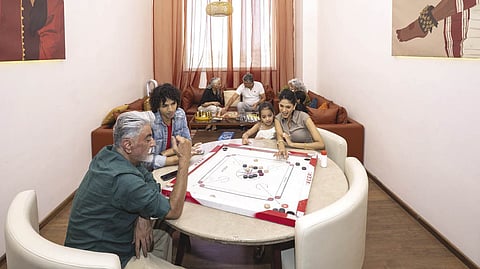
Paul and other key officials strongly emphasise that the USP of Priya Living is the service standards, which are tailored to the third stage of life. “Our endeavour actually is to create luxury in human connection,” says Radhika Tata, who, after spending over two decades with leading hospitality brands, has recently joined as general manager, Priya Living, Hyderabad. “From daily housekeeping and maintenance to concierge support and thoughtfully prepared meals, our services are designed to elevate everyday living,” Tata explains. “Everything from chai chats and rooftop yoga to workshops on entrepreneurship, philanthropy, storytelling and culture, we are encouraging community bonding. We host artist residencies, musical performances, film screenings, tech demos, and, sometimes, even spontaneous dance parties.” Adds Paul: “We have even developed Entrepreneurship programmes with the former dean of ISB alongside leadership and philanthropy that encourage residents to start ventures or NGOs. That is our way of telling them that there is so much left in them to do in life.”
The main turf
With four existing units under its belt (two in San Francisco and one each in Delhi/NCR and Hyderabad), Paul says that Priya Living is commanding an average room rate of Rs6,000-8.000 daily. However, as he emphasises, it comes down modestly for those who are committed to staying for a long time. Priya Living offers options to the customers on a typically per-room basis in a hotel-like set-up or as accommodation in a luxury flat. And some customers endorse that the company is delivering on its promises. “We have just come back from Africa and were looking at a comfortable place to stay for a couple of weeks in Hyderabad,” comments Rajni Nair, who recently enjoyed the hospitality after coming back from Africa. “We particularly wanted a pet-friendly accommodation. And, on a friend’s recommendation, we opted for Priya Living. Though the prices were a little higher, we found their customer service quite impeccable. The environment was quite homely, which you usually don’t find in a branded hotel”.
Asset light model
According to Paul, Priya Living has been a multi-million-dollar investment project (though he does not disclose the figure), and its two units in the US have already surpassed the break-even point. It typically operates in an asset-light model, where the units are set on leased properties. In terms of segment-wise occupant ratio, customers over 50 years of age are driving the show, accounting for 60-70 per cent of occupancy, with the rest shared by relatively younger customers. He emphasises that his debut units in India have done well – Delhi/NCR with 35 rooms and the much larger Hyderabad unit (127 rooms) – and this has set the ball rolling to make India the main turf for Priya Living.
“In terms of size, Hyderabad is our biggest unit, and it has become our flagship product now,” Paul informs. “But, before the end of this year, we will have an expanded portfolio. Our units in other cities are getting ready to reach the operational stage in the next few months.” In the current calendar year, Priya Living units in Ahmedabad (50 rooms in a 3 BHK set-up) and Baroda (98 rooms, again in a 3 BHK set-up) will join the existing units. And, in 2027, the company will be unveiling properties in Goa, Pune, Chandigarh, Mumbai and Varanasi. “We are targeting to be present in nine cities before the end of next year,” he says.
The company is also looking at international expansion to locations other than the US, where two more units are coming up (in New York and New Jersey). The international locations identified – London, Singapore, Dubai and Torrento – are particularly those which have a significant Indian population or Indian connect. “But our main priority right now is to expand our ambit in India and make our differentials clear to a larger customer base. While our current USP – providing comfortable living in the third stage – will be consolidated, our multi-generational character will also be further refined. And that is
why there is no plan to take the franchise route. Being in control of our services is the most critical part,” Paul sums up his broader strategy for the medium run.