
Ghodawat enters the big league
Ghodawat Consumer Ltd (GCL), the flagship company of the R3,500-crore Kolhapur-headquartered Sanjay Ghodawat Group (SGG), is betting big on the growing consumer products space. GCL, which commenced its journey in 2003, has chalked out an ambitious plan to grow five times to around Rs6,000 crore in the next 5 years, from around Rs1,200 crore at present. Over the years, the company, led by its umbrella brand ‘Star’ (staples and everyday essentials), has expanded its portfolio in a big way. The company, primarily present in rural and semi-urban areas of Maharashtra and Karnataka, is now looking to expand its footprint in states like Gujarat, MP, AP, Telangana and Goa in the coming years.
Led by its founder and chairman, Sanjay Ghodawat, SGG is a diversified group with a presence in consumer goods, education, energy, aviation, real estate, and textiles. Having started its journey in 1992 from Jaysingpur, Kolhapur in Maharashtra, the group, backed by a team of over 11,000 employees, has emerged as a formidable force, focusing on quality, affordability, innovation, and sustainable growth.
GCL, which started with the manufacturing of soyabean oil, today boasts a well-diversified portfolio across edible oils (soyabean, sunflower, cottonseed, palmolein and rice bran oils), rice, atta, pulses, salt, snacks and beverages (packaged drinking water, carbonated drinks, ready-to-serve fruit drinks and non-alcoholic beverages). The company, which has five modern manufacturing facilities (capacity of 150,000 TPA), also has a presence in the home care and personal care categories.
With over 900 employees, GCL has positioned itself quite uniquely as it targets the aspirational demand in India’s growing semi-urban and rural FMCG market through a dedicated distribution strategy. In fact, the company has built its reputation on providing high-quality daily consumable essentials at affordable prices, primarily under its flagship ‘Star’ brand.
Premium foray
Though primarily positioned in the affordable segment (mass to mass-premium range), the company has also forayed into the premium segment. GCL has recently acquired two leading premium brands. In 2022, it acquired non-alcoholic beer brand Coolberg, and in 2023, TBH (To Be Honest), a healthy snack brand known for its 100 per cent real fruit and vegetable chips.

Mumbai-based Coolberg, founded in 2016 by husband-wife duo Pankaj Aswani and Yashika Keswani, offers malt-based flavoured non-alcoholic beverages (currently available in six unique flavours). The start-up was backed by investors including India Quotient and Singapore-based family office RB Investments. On the other hand, Delhi-based TBH, founded in 2017 by IIT and IIM graduates Mayank Gupta, Ritika Agrawal and Anuj Ghanghoria, focuses on vegetable- and fruit-based healthy snacks.
Going forward, GCL, which has a well-carved-out growth plan in place, is looking at more acquisitions to ramp up its overall portfolio, with plans to add more premium and healthier products for its customers.
“We have ambitious plans to grow GCL into a big-league player. We are ramping up our portfolio in a major way, wherein both organic and inorganic efforts will play their role. While expanding our portfolio, we will also focus on adding premium and value-added products across our existing categories. We are excited to lead the charge in promoting healthier choices while meeting the evolving preferences of consumers. Our customer-focused strategy has been crucial in adapting to shifting consumer preferences and needs,” says Salloni Ghodawat, 38, Chief Executive Officer (CEO), Ghodawat Consumer Ltd.
“As we expand our offerings, we are also planning to increase our footprint in other geographies, even as we deepen our presence in our traditional markets. Going ahead, we are putting in place an asset-light business model to achieve our set goals. Channels like modern trade, e-commerce, and quick commerce will help us expand our base nationally and internationally,” adds Ghodawat, who has played a major role in GCL’s 2.0 journey, as the company undertakes its transformation phase.
Daughter-in-law of Sanjay Ghodawat and the wife of the founder’s son, Shrenik Ghodawat, the managing director of the group, she joined the business more than a decade ago. At the heart of GCL’s success is her unwavering commitment to product innovation and quality excellence. Working closely with business units and product development teams, she has championed a consumer-centric approach that anticipates market trends and delivers superior offerings. As a Chartered Financial Analyst (CFA) from the USA, with a degree in Finance and Global Commerce from the University of Western Ontario, Canada, she brings a sophisticated understanding of financial management, investment analysis, and risk assessment to GCL’s operations.
Salloni has played a crucial role in the acquisition of Coolberg and TBH, which are expected to not only help GCL diversify its portfolio but also expand its geographical presence significantly. Both these brands have an international presence. Today, GCL’s offerings are available across 250,000 outlets (1,200 distributors) in over 120 cities in India and are also exported to more than 25 countries. GCL products are widely available across multi-channel platforms, including quick commerce and e-commerce (Blinkit, Zepto, Swiggy Instamart, Amazon, Flipkart) and physical modern trade stores (Reliance Smart, D Mart, 24Seven, Booker, More, Udaan and Jumbotail).
A strategic move
Experts view the acquisition of these brands as highly strategic. It will help GCL move beyond regional boundaries to quickly become a national player, while also strengthening its presence in export markets. Coolberg has a presence across over 150 cities, 700+ distributors and 20,000+ retail points, while TBH is available across India in over 30 cities and 13+ countries. Moreover, experts believe that the inclusion of these brands will help GCL foray into two fast-growing categories. Coolberg has enabled the company to enter the non-alcoholic lifestyle beverage segment, complementing its existing beverage portfolio that includes Fizzinga (carbonated drinks), Frustar (fruit drinks) and Rider (energy drink).
On the other hand, TBH has given the company entry into the health-conscious snacking segment, which is gaining momentum, driven by rising demand for healthy products among consumers. In 2024, India’s healthy snacks market was valued at $2.67 billion and is expected to reach $4.95 billion by FY32, according to a report by Markets & Data.
Driven by health trends, rising incomes and urbanisation, India’s non-alcoholic beverage market is also booming. Led by major players such as Coca-Cola, PepsiCo, Parle Agro and Dabur, the domestic non-alcoholic beverage market is projected to cross $64 billion by 2033, up from around $35 billion at present.
GCL also operates a retail chain called Star Localmart, focused on bringing modern retail, quality essentials, fresh produce, and national and local brands to semi-rural and rural areas in Maharashtra and Karnataka at fair prices. The aim is to transform local shopping experiences by blending local understanding with modern retail. The chain, which operates 170 stores across Maharashtra and Karnataka, acquired Bengaluru-based hyperlocal grocery chain DusMinute (40 stores), operating in gated communities, in September 2025.
This acquisition has helped the company expand its retail network from 130 stores earlier to the current count. The company plans to scale up Star Localmart’s operations in a big way, while also planning to foray into states such as Goa, Andhra Pradesh and Telangana.
The company, which generates around 60 per cent of its revenue from the edible oil business (extraction and refining of soyabean, sunflower, cottonseed and palmolein oils), has recently named Bollywood actress Raveena Tandon as Brand Ambassador for its ‘Star’ brand refined oil. In fact, staples account for over 90 per cent of its overall business.
As the company pursues its growth plans, it is ramping up its portfolio. GCL has decided to adopt an asset-light model to strengthen its manufacturing strategy. Over the next 4-5 years, the company plans to outsource over 60 per cent of its manufacturing across various categories. At present, barring a very small portion, the company manufactures and processes most of its products in-house. Its facilities for staples, pulses and beverages are located across multiple locations in Maharashtra and MP. In addition, the company has salt manufacturing units in Gujarat and TN.
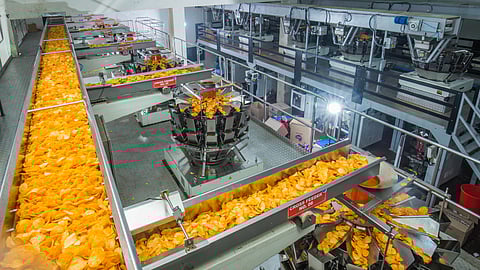
In Maharashtra, GCL has modern oil extraction and refining facilities at Chipri, Kolhapur. The facility has a solvent extraction capacity of 330 MT per day, a refinery capacity of 100 MT per day, and 200 MT per day across soyabean, sunflower, cottonseed, palmolein and rice bran oils. At Chipri, the company also has a snacks unit with an output capacity of 300 kg per hour of chips; 300 kg per hour of extruded fried snacks; 300 kg per hour of extruded baked snacks; 600 kg per hour of namkeens; and 1 MT per day of vacuum-fried snacks.
Moreover, the company also has a beverages unit in Chipri, Kolhapur. It manufactures packaged drinking water (120 bottles per minute), carbonated drinks (330 BPM), ready-to-serve fruit drinks (90 BPM), and non-alcoholic beverages (120 BPM). GCL has a state-of-the-art rice milling unit (Bühler equipment, colour sorter and paddy storage silo) in Majale, Kolhapur. The facility (ISO 9001:2015 certified, FSSC v 5.1 2000 certified, and BRCGS v 9 certified) is engaged in the processing of rice varieties such as Sona Masoori, RNR, Sriram Sona, Indrayani and Basmati, with a total capacity of 6,600 MT per month. Besides, the company has an atta unit (whole wheat atta; capacity: 45 MT per day) in Indore, MP.
Sophisticated equipment
“Our manufacturing techniques prioritise quality and food safety, following industry standards and utilising cutting-edge equipment. For instance, in our oil division, we use Alfa Laval equipment, while Germany’s Bühler equipment is employed in rice processing. In addition to our regular unit quality assurance laboratories, we have built the Ghodawat Analytical and Research Centre, which is committed to supporting and validating the quality of our units. Our central lab is equipped with advanced testing equipment such as gas chromatography with FID and ECD detectors, ensuring rigorous product and packaging testing while maintaining our dedication to excellence,” says a company official.
To ensure safety and hygiene in its manufacturing processes, the company adheres to stringent procedures and follows Good Manufacturing Practices (GMPs), Operational Prerequisite Programmes (OPRPs) and Critical Control Points (CCPs). The processes are carefully designed to prioritise product hygiene, using controls such as micron filters and metal detectors. These efforts are part of the company’s commitment to providing consumers with the highest quality and safest products possible.
“The company strives towards quality, driven by automation and digitalisation across all processes. Its fully automated, high-tech plants are compliant with industry standards, ensuring zero human touch in critical operations. GCL integrates pioneering technologies into its procurement processes, ensuring agility, sustainability and operational excellence. Its processes deploy an AI-powered digital platform and a supplier management programme designed to nurture collaboration and innovation,” says the GCL CEO.
With all these developments in place, GCL is aggressively pursuing its next phase of growth, aiming to scale up its business significantly over the next few years. Having proved its mettle in the rural and semi-urban areas of Maharashtra and Karnataka, the company is now foraying into additional states to replicate its successful model. GCL is actively consolidating its pricing optimisation efforts to encourage consumers to shift from local products. This strategy has played an indispensable role in enhancing its consumer base.
While expanding its footprint, the company has consciously adopted an asset-light model, reducing its dependency on asset-heavy manufacturing by outsourcing a larger portion of production. In addition, the company is aggressively expanding its presence in modern trade, e-commerce and quick commerce. This will help GCL scale up its business with reduced pressure on its resources. In a strategic move, GCL is also pursuing premiumisation by adding premium and value-added products to its portfolio.