
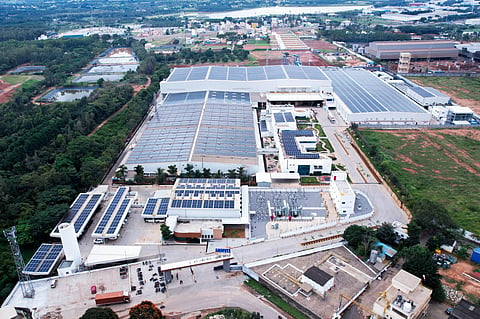
From morning baths to Gigawatts: Emmvee's solar journey
D V Manjunatha’s solar story began with a problem considerably smaller than a gigawatt. It was the need to take a hot water bath in the morning while navigating the inconveniences of unreliable electricity. “We love our early morning bath here in the south, and you can imagine how cold mornings used to be in Bengaluru back then,” recalled the founder, explaining how that experience led him into solar water heating.
In 1992, when he entered the sector, solar offered an answer to an everyday household need. Did he think about building a large photovoltaic manufacturing business? That was still a distant prospect.
Now, more than three decades later, the business he chairs is preparing to spend about Rs5,500 crore on an integrated cell and module expansion at Devanahalli, Bengaluru.
Changing scale
Emmvee Photovoltaic Power has 10.3 GW of installed module capacity and 2.94 GW of cell capacity. Its order book stood at 10.4 GW at the end of September 2026. The scale has changed dramatically. However, the question running through the company’s history remains: how much manufacturing capability should be built before the market fully catches up?
That question now carries the expectations of public shareholders. Listed in November 2025, Emmvee reported revenue of Rs3,131.9 crore for the first half of FY27, up 45.1 per cent. EBITDA rose 47.4 per cent to Rs1,105 crore and profit after tax increased 79.1 per cent to Rs762.3 crore. The figures provide a strong opening to its life as a listed manufacturer. They also raise the standard against which the next investment cycle will be assessed.

The early chronology is worth preserving. Manjunatha dates his entry into solar to 1992 and the establishment of Emmvee Solar Systems to 1996. The photovoltaic business followed in 2007 with 15 MW of capacity. These were successive stages in a manufacturing journey, rather than a single company emerging at its present scale. Water heating introduced him to a practical application of solar energy; photovoltaics opened a much larger market in electricity generation.
Together, these milestones describe an entrepreneur willing to take risks as he looked overseas for both technology and customers. With a limited domestic photovoltaic market, Emmvee developed its business in Germany. Its archives record the opening of an international sales office there in 2008. The company account also describes the installation and commissioning of 14 MW of projects in northern Germany. For a manufacturer starting with a small production base, that exposure offered experience of customers whose expectations extended beyond the initial purchase price. An early interest in automating cell interconnection is also a feature of the founder’s account.
Manjunatha travelled to identify alternatives to a labour-intensive production process. That instinct to invest in the way a factory works still shapes the company’s decisions. In the earnings call, he described the scale of the market he believes Indian cell makers will need to serve: “We need about 80 to 100 gigawatts of capacity, at a minimum.” He was referring to usable capacity to meet expected demand, not simply the sum of factory announcements.
By 2010, module capacity had reached 135 MW, rising to 560 MW in 2017, alongside a 40 MW solar project in Karnataka. The intervening years matter because they temper the impression that today’s growth arrived suddenly. Emmvee accumulated experience through several stages of the industry’s development before its recent, much larger capacity additions. A manufacturing organisation has to carry what it learns from one stage into the next.
Its working relationship with Germany subsequently acquired a different dimension. In 2022, Emmvee entered into a research and development agreement with Fraunhofer ISE. The collaboration supported its move into TOPCon cells and has since extended to laser-enhanced contact optimisation and newer cell architectures. An overseas connection that had helped the company find a market was now helping it develop the technical capability needed to compete in a changing one.
It may surprise many that all this was achieved by a young man from Chintamani, in Karnataka’s Kolar district, who studied for a BCom degree at an evening college. The truth is that Bengaluru’s entrepreneurial community was not always about start-up heroes built on PE-VC funds. The city has long been home to builders who pursued their convictions over decades, often in industries where progress is measured in factories and capabilities rather than funding rounds.
The distinction between adopting a technology and operating it well is central to Emmvee’s current position. TOPCon may provide the technological foundation, but widespread adoption makes the label alone less distinctive. The useful questions concern material consumption, yield, throughput and consistency. Emmvee’s early commitment gave it time to work through those questions. Maintaining an advantage will require continuing improvements as competitors commission their own lines and acquire operating experience.
Increased automation
Chief executive Suhas Donthi now explains much of this operating argument to investors. The founder remains chairman and managing director, while the next generation articulates how equipment choices and process improvements translate into commercial results. In the Q2 earnings call, Suhas linked the design of the new plant to experience gained from existing TOPCon production. He discussed increased automation and lower silver consumption as elements of the project, rather than presenting expansion simply as a purchase of more machines.
But as questions about emerging pricing pressures continued to come in, Manjunatha explained how Emmvee would respond: “We used to use 220 milligrams of silver; today we are using around 60 to 65 milligrams.” He was referring to silver consumption in cells since the company began supplying NTPC orders last year. The change represents a reduction of roughly 70-73 per cent in silver use.
Manjunatha links the material saving with the shift from M10R to G12R cells, which, he says, “were producing about 9.5 W on average against 8 W in the earlier single-cell format”. He then gave the commercial logic plainly: “With the value addition and other things, prices will be a little lower, but margins can be maintained.” He connected that outcome to manufacturing efficiency and the cost advantage it can pass on to customers.
The Q2 results suggest that several operating levers are working together. Revenue rose 39.4 per cent to R1,576.4 crore, while EBITDA reached R556.9 crore, with a margin of 35.3 per cent. Cell production increased to 513 MW from 319 MW a year earlier. Effective cell utilisation reached 89 per cent. Those measures show the existing production base contributing more fully just as management prepares to add a much larger one.
The module business presents a different operating picture. Production was 952 MW in Q2, against 682 MW a year earlier, but effective utilisation was 44 per cent. Suhas explains that module capacity provides flexibility to select markets and decide between captive use of cells and external cell sales. He indicated a broad module-utilisation range of 45-60 per cent.
The distinction has commercial consequences. Emmvee targets roughly 25-30 per cent external cell sales as a broad operating approach. Selling cells to other manufacturers creates a separate customer base and gives the company another outlet for production.
Retaining cells for modules captures a different part of the value chain. The balance is likely to depend on order schedules and the relative economics of each business, making integration an exercise in choice as well as ownership.
Demand is also more varied than a list of large utility contracts might suggest. Management described about a quarter of module sales as coming from retail and KUSUM-related markets, with the balance from institutional customers, including commercial and industrial buyers and utilities. Smaller, recurring purchases do not always appear in a long-duration order book. This gives the sales organisation a role in replenishing demand even while the factories execute larger commitments already on hand.
At Devanahalli, the plan is to add 6 GW each of cells and modules. Management expects the module line to be commissioned by December 2026 and the first cell from the new cell line in March 2027. Utilisation is expected to increase progressively thereafter, taking the company’s planned capacity to approximately 16.3 GW of modules and 8.94 GW of cells by early FY28. First production and full commercial output are separate milestones.
The Rs5,500-crore project estimate includes about R4,600 crore of hard costs. On the earnings call, management put the cell portion of those hard costs at approximately Rs4,000 crore and modules at R500-600 crore. The remaining overall project cost includes items such as interest during construction, contingencies and margin money for working capital.
The funding story has also moved on since the IPO. Emmvee’s Rs2,900-crore offering included both fresh shares and an offer for sale; the entire issue value was therefore not money available to the company. Debt repayment using company proceeds helped lower finance costs. By September 2026, however, investment in the new project was drawing borrowing back onto the balance sheet. Net debt to equity stood at 0.12 times, according to the Q2 disclosure.
Lower reported interest expense requires similar care in interpretation. The finance team told investors that interest on new expansion borrowing was being capitalised during construction. It would enter reported finance costs progressively after commissioning. The current profit growth consequently reflects both stronger operations and a favourable financing comparison. Assessing the new plant’s contribution will require watching the increase in production alongside the depreciation and financing charges that accompany its entry into service.
Disciplined growth
Working capital will be another test. Operating cash flow in H1 FY27 was Rs409.9 crore, substantially above Rs120.7 crore a year earlier, but below reported profit after tax. Management put inventory at around Rs1,884 crore, including approximately Rs860 crore of finished goods. Large production programmes and delivery schedules can absorb cash before sales are completed. The founder’s emphasis on disciplined growth will be measured partly by how efficiently those balances turn into collections.
Reliability provides a longer perspective on those quarterly measures. Emmvee’s independent product testing and warranty claims are below 0.016 per cent of revenue. Such disclosures support the company’s quality proposition, although a low historical claims rate cannot establish how every module will perform throughout its operating life. For customers committing capital to generating assets, the manufacturer’s ability to deliver consistently and remain accountable matters well beyond the date on which a shipment leaves the factory.
The next proposed step is further upstream: 9 GW of ingot and wafer manufacturing, phased as 5 GW in FY29 and 4 GW in FY30. The indicated investment is Rs5,000-5,500 crore, separate from Devanahalli’s cell and module project. Manjunatha expects substantial funding from internal accruals, subject to policy clarity and market conditions. This would broaden Emmvee’s manufacturing responsibilities again, requiring another body of operating knowledge as well as another allocation of capital.
For Manjunatha, the attraction is consistent with the journey from water heating to modules and then cells. Each move has enlarged the part of the product that Emmvee can make and control. Yet the commercial discipline becomes more demanding as those investments grow. A company can be right about India’s long-term energy needs and still need to adjust the timing of its factories, the mix of its products and the pace at which it commits cash.
Manjunatha’s earlier decisions have brought Emmvee to a position from which it can attempt that expansion. Whether the long bet keeps paying will depend on the same practical question that shaped its beginnings: can the company turn a clearly understood need into a product it can manufacture reliably and sell profitably?