
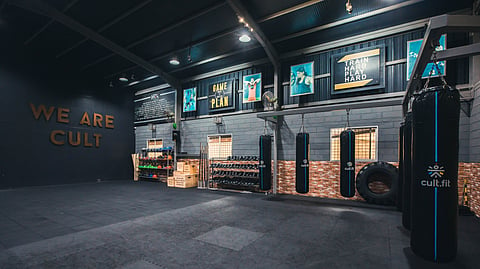
Cult.fit expands beyond traditional workouts
India’s fitness market is moving beyond the traditional gym. Consumers are increasingly looking at fitness as part of a broader active lifestyle, spanning structured workouts, sports, at-home exercise, recovery and products that support everyday activity. For Cult.fit, this shift has shaped the evolution of its business over the past decade and is now informing the company’s next phase of growth.
Cult.fit has built its proposition around bringing different aspects of fitness onto a single platform. Its fitness services offering today spans trainer-led group classes, gyms, at-home workouts, sports facilities and full-service luxury fitness centres. Complementing this is its fitness products business, which includes fitness equipment and accessories, apparel and footwear. These offerings are brought together through the Cult.fit app, website and a network of physical centres and retail touchpoints. As of 31 March 2026, the company had 708 fitness centres across 77 cities in India, up from 588 centres in 2024. The scale of the platform has grown alongside its member base. Paid memberships increased from 690,657 at the end of FY24 to 833,032 in FY25 and 987,020 in FY26. Revenue from fitness services increased from R669.89 crore in FY24 to Rs888.09 crore in FY25 and Rs1,197.83 crore in FY26.
The next chapter for Cult.fit is therefore not simply about adding more gyms. It is about taking the platform into more markets, reaching different consumer segments, expanding the product proposition and using technology and community to make the relationship with consumers broader than a gym membership.

“Over the last decade, our focus has been on making fitness more accessible and engaging across different formats. Technology and community have been integral to how we have built Cult.fit, enabling us to connect with members both within and beyond our centres. As we look ahead, our focus is on building on these strengths across fitness services and products to create a more integrated experience and make fitness a natural part of everyday life,” says Naresh Krishnaswamy, CEO, Cult.fit.
An integrated fitness platform
Cult.fit’s fitness services business has evolved into a multi-format model designed to address different consumer preferences and price points. Cult Elite centres offer equipment-based workouts alongside trainer-led group classes across formats such as strength, yoga, dance and boxing. Cult Neo, meanwhile, is positioned in the mass segment, with standardised layouts, an in-house-designed equipment kit and a consistent operating proposition. The company also operates luxury formats through Fitness First, Gold’s Gym and Pilates Circle by Cult, while Cult Play provides access to sports including swimming and badminton.
The company’s membership proposition similarly spans multiple formats. CultPass enables access across offerings including Home, Pro, Elite and Play, while CultPass Corp provides access for employees of enterprise customers across specified formats and cities.
This multi-format approach allows Cult.fit to address consumers at different stages of their fitness journeys. It also gives the company multiple avenues through which consumers can interact with the platform, whether through a physical centre, a digital workout, a sports facility or a product purchase.
That breadth is central to how Cult.fit sees its position in the market. The company describes itself as an integrated fitness and active lifestyle platform, with technology serving as the common layer across its physical and digital offerings.
Beyond the metros
Geographic expansion is one of the clearest components of Cult.fit’s next phase. The company plans to deepen its presence across the top 100 cities in India, using a data-driven approach to determine where different fitness formats can be introduced. Its proprietary AI-based technology stack evaluates markers including population demographics, retail presence and adoption of fitness as a lifestyle to identify potential locations and formats.
The opportunity lies particularly beyond the four markets that currently account for most of the company’s fitness-services revenue. Delhi-NCR, Mumbai Metropolitan Region, Bengaluru and Hyderabad account for 40-42 per cent of India’s fitness services market, according to the Redseer Report. At the same time, 58-60 per cent of the market lies beyond these four cities. Cult.fit’s four largest markets contributed 90.44 per cent of its fitness services revenue in FY26.
The expansion strategy combines entry into new micro-markets with greater depth in markets where Cult.fit already operates. The company plans to tailor formats, membership types and go-to-market strategies to local demand rather than following a single format across every market.
Cult Neo is particularly important to this strategy. The company identifies the mass segment as the largest and fastest-growing segment of India’s fitness services market, accounting for approximately 41 per cent of the market by value. Its Neo format is designed around standardisation and affordability, with the company planning to add more Neo gyms in existing markets, peripheral locations and new cities.
“As fitness adoption expands across India, we see an opportunity to serve consumers across a wider set of cities and price points. Our approach is to understand local demand and bring the right format and membership proposition to each market, rather than applying a one-size-fits-all model,” adds Krishnaswamy.
The expansion is also supported by an asset-light model. Of the 708 fitness centres in the network as of 31 March 2026, 288 were franchise-owned and 202 were marketplace gyms. Franchise and marketplace centres together accounted for 69.21 per cent of the network.
Building a second engine
The other major part of Cult.fit’s strategy is its fitness products business. The company’s portfolio covers fitness equipment like treadmills, walkpads, stationary bikes, recovery products, accessories, apparel and footwear. These products are sold through the Cult.fit app, CultStore, exclusive brand outlets, e-commerce and quick-commerce platforms, retail partners and other offline and B2B channels.
Products have become an increasingly important part of the platform. Revenue from products rose from R256.78 crore in FY24 to R326.45 crore in FY25 and R522.77 crore in FY26, with the segment accounting for 30.38 per cent of total revenue from operations in FY26. The number of products sold also increased from 19.04 lakh units in FY24 to 30.39 lakh units in FY25 and 42.39 lakh units in FY26.
The company sees a natural connection between its services and products businesses. Consumers using Cult.fit’s fitness services can become customers for apparel, footwear, equipment and recovery products, while product consumers can discover the broader Cult ecosystem.
This cross-sell is already visible in the business. Sales of fitness products to existing and past members of Cult.fit’s fitness services through its D2C channels and EBOs contributed 31.75 per cent of revenue from operations from products in FY26, compared with 29.07 per cent in FY24.
Cult.fit now plans to expand this opportunity through a broader omnichannel footprint. As of 31 March 2026, its products were available through 29 EBOs across four cities. The company intends to add more EBOs in metropolitan as well as high-potential Tier II and Tier III cities, using online demand signals and consumption patterns from both its services and products businesses to inform location selection.
Its first-party digital channels are another focus. The company plans to improve user experience, search and recommendation engines and personalised merchandising based on member behaviour and fitness data. It also intends to deepen its presence across e-commerce and quick-commerce platforms.
Innovation built around the consumer
For Cult.fit, technology is a part of the consumer proposition rather than simply an operating tool. The company plans to continue investing in AI and data-driven capabilities across its services and products businesses. Within its fitness centres, its AI control tower currently monitors operational metrics including safety, service standards and ambience. The company also uses its in-house systems to track equipment utilisation, maintenance and servicing across centres.
On the consumer side, Cult.fit’s Smart Workout Plan is designed as an AI-powered personalised and adaptive workout programme based on a user’s goals, fitness levels and progress. The company uses onboarding flows, health-data integrations and activity tracking to refine these plans.
The same technology infrastructure is being applied to expansion. By combining demographic and market information with demand indicators, Cult.fit intends to use its technology stack to determine which formats and membership propositions are suited to individual markets.
The Cult proposition is also being built around the idea that fitness is not only an individual activity but a social experience. Community initiatives are already an important part of the company’s engagement strategy. Cult Unbound, Cult Fitness Carnival, Yogathon, Cult Run, Cult Dance Fitness Party and Cult Cyclothon bring members together across multiple cities. The company plans to increase the frequency, geographic reach and thematic diversity of these events.
Within the platform, programmes such as Cult Ninja, Cult Champions and Squads are designed to encourage participation, recognition and peer interaction. Cult.fit plans to build additional community features and integrate these experiences more closely across its app, centres and events.
The objective is to create a connected ecosystem where content, community, services and products reinforce one another. This engagement is already reflected in the relationship members have with the platform. In FY26, 50.88 per cent of existing members renewed their memberships. In FY26, 38.68 per cent of all members were introduced to the Cult platform or brand by friends, family or colleagues. Since inception, the Cult.fit app had recorded more than 38.60 million installs and the company had more than 4.70 million social media followers as of 5 July 2026.
Investing in the Cult brand
The company’s next phase also calls for continued investment in brand building. Cult.fit plans to use integrated digital and offline campaigns to build awareness of its ecosystem across the 100 cities where it intends to deepen its presence. Its stated marketing approach includes targeted social and digital campaigns, city-level marketing, partnerships with communities and corporates, influencer-led initiatives and selected athlete and celebrity endorsements.
The brand is already a significant part of the company’s consumer proposition. Cult.fit has built its brand around a combination of fitness, community and an aspirational yet accessible approach. It also reported the highest search interest among leading fitness service providers in India over the 5 years to 1 April 2026, based on Google Trends data in the Redseer Report.
Marketing expenditure has also become more measured over time. Marketing, branding and related professional costs were R170.57 crore in FY26, representing 9.91 per cent of revenue from operations, compared with 12.27 per cent in FY25 and 20.34 per cent in FY24.
The evolution of Cult.fit points towards a business that increasingly sees fitness as an ecosystem rather than a single service. The company’s roadmap brings together several strands: expanding the fitness-centre network across the top 100 cities; using Cult Elite and Cult Neo to address different consumer segments; increasing the role of franchise and marketplace models; broadening the fitness products portfolio; expanding physical and digital distribution; using AI and member data to personalise experiences and improve operations; and investing in community and brand-building.
The underlying proposition remains straightforward: make fitness more accessible, more varied and more integrated into everyday life.
For Cult.fit, the opportunity over the next decade lies in connecting these different pieces. A member may discover the brand through a gym, continue through an app-based workout, participate in a community event, purchase fitness equipment or activewear and engage with personalised recommendations along the way. The company’s strategy is to make each of these interactions part of the same platform.
That is the direction in which Cult.fit is preparing for its next decade – not simply as a network of gyms, but as an integrated fitness and active lifestyle platform spanning services, products, technology, community and consumer engagement.