
A building, a product: Interarch's art of construction
“Imagine 10,000 parts where every nut and bolt has to match perfectly,” says Arvind Nanda, MD, Interarch Building Solutions. “Even if you are out by 0.1mm, the building simply will not assemble.”
For Nanda, that commitment to precision captures the reality behind modern pre-engineered steel construction – a business where engineering tolerances, manufacturing accuracy, logistics coordination and on-site execution must function as one integrated system.
As India’s industrial and infrastructure landscape becomes larger, faster and increasingly sophisticated, the complexity behind seemingly simple structures has increased dramatically. Internally, Interarch often describes its operating philosophy through a deceptively simple phrase: ‘One Building, One Date’. Over time, the idea evolved into more than a delivery commitment. In an industry where delays are often normalised and timelines routinely shift across contractors and agencies, the insistence on predictability became one of the company’s defining disciplines.
“In the early and mid-1980s, India was a very different country,” recalls Nanda. “Imports were nearly impossible, foreign exchange was scarce, and quality standards were largely domestic. But we were adamant that whatever was the best available in the world should also be available to clients in India.”
Founded in 1983 by Nanda and his childhood friend Gautam Suri, an IIT-Delhi graduate, Interarch Building Solutions began operations at a time when steel-based architectural systems and pre-engineered construction technologies were still relatively uncommon in India. The company’s early years were shaped by precision manufacturing, disciplined execution and a focus on introducing internationally benchmarked architectural products into a market still dependent largely on conventional construction systems. Even the company’s name – derived from ‘International Architecture’ – reflected the founders’ ambition to bring global-quality building products and engineering standards into India’s evolving construction ecosystem.

What began with suspended metal ceiling systems and architectural products gradually evolved into a much larger industrial opportunity. As India’s economy liberalised through the 1990s and industrial activity expanded beyond traditional clusters, demand began rising for faster, more scalable and more efficient construction systems. Manufacturing facilities became larger and technologically more sophisticated, logistics infrastructure deepened, and developers increasingly sought integrated execution capabilities capable of reducing project timelines and improving cost certainty.
Interarch responded by moving beyond product manufacturing into integrated pre-engineered building solutions, bringing design, structural engineering, fabrication, logistics and on-site execution under one operational framework. “The customer orders a building from us almost as a product,” says Nanda. “From engineering to manufacturing to site execution, everything is coordinated by one company. That ensures reliability, quality, timelines and accountability.”
Over time, that integrated model became one of the company’s defining differentiators. Unlike fragmented construction ecosystems where design consultants, fabricators and erection contractors often operate independently, Interarch positioned itself as a single-point execution partner capable of taking responsibility across the project lifecycle. As projects became larger and more schedule-sensitive, the ability to deliver predictability emerged as a competitive advantage.
As execution capabilities deepened, Interarch increasingly participated in projects that tested both engineering depth and delivery discipline at national scale. One of the company’s defining milestones was its role in delivering the pre-engineered steel construction package for Terminal 3 at Indira Gandhi International Airport, New Delhi, among the country’s largest and most time-sensitive infrastructure developments at the time. The project demanded coordination across multiple stakeholders, adherence to global execution standards and strict delivery schedules, reinforcing Interarch’s reputation for precision-led execution.
Anand Rathi, in a sector report, has cited projects such as IGI Terminal 3 as examples of Interarch’s capability to execute complex, large-scale assignments across industrial and infrastructure segments. Projects such as the Rudraksha Convention Centre in Varanasi reflected a different dimension of capability, where modern steel engineering had to align with architectural symbolism and cultural design intent. Together, these assignments marked Interarch’s gradual transition from a product-focused business into an integrated engineering and execution player operating across industrial, institutional and infrastructure segments.
The importance of integrated execution increased alongside India’s own industrial transformation. As manufacturing investments accelerated and infrastructure development gathered pace, developers increasingly began to view delays not merely as construction issues but as business disruptions.
Economic value
Factories commissioned late could affect production schedules; logistics parks delivered behind schedule could impact inventory movement and supply-chain efficiency. In sectors operating within compressed commissioning cycles, predictability acquired economic value.
That evolution fundamentally changed the nature of modern industrial construction itself. “We are not really a building company but a capital goods company,” says Suri, Whole-time Director at Interarch. “Today’s manufacturing buildings, logistics centres and warehouses are highly sophisticated structures where most of the processes happen within the building itself.”
Industrial structures today are no longer simple sheds designed merely to house operations. Semiconductor plants, EV battery facilities, automated warehouses, renewable energy infrastructure and advanced food-processing units function as highly engineered operating ecosystems where structural tolerances, environmental controls and equipment integration directly influence productivity and operational efficiency.
One of the biggest shifts shaping the industry is the growing convergence between construction and manufacturing. Historically, industrial buildings in India were often viewed as relatively straightforward civil structures designed primarily for utility. Today, however, the building itself has become part of the manufacturing ecosystem. Structural grids, loading capacities, thermal performance, vibration tolerances, automation systems and future scalability increasingly influence how industrial facilities are designed and executed.
This transformation is especially visible across sectors such as semiconductors, electric vehicles, battery manufacturing, food processing and advanced warehousing, where the structure must integrate seamlessly with highly specialised machinery and automated systems. In many cases, production processes begin influencing building design long before fabrication starts.
“If you go to an Asian Paints plant or a Birla Opus facility, these are extremely complex buildings,” says Suri. “There are hardly any people there. Everything is done by machines.”
That increasing sophistication has reshaped execution dynamics across the industry. Scale alone no longer defines complexity. The real challenge frequently lies in context, sequencing and coordination.
A greenfield manufacturing facility rising on open land presents a very different operational challenge from a brownfield expansion embedded within a functioning industrial plant. In the first, timelines are unforgiving because production schedules often begin counting from the date of handover. In the second, precision becomes critical because construction activity must proceed without disrupting operations, compromising safety or affecting existing manufacturing systems.
Logistics and warehousing projects introduce another set of pressures altogether. These structures are typically large, repetitive and intensely schedule-driven, shaped less by architectural ambition than by supply-chain efficiency. Delays ripple rapidly into inventory cycles, distribution schedules and operational costs, leaving little tolerance for rework or sequencing errors.
Institutional and public infrastructure projects add another layer of complexity. Coordination with consultants, regulators, contractors and site stakeholders frequently becomes as important as engineering precision itself. Each interface introduces risk, and managing those interfaces often proves harder than erecting the structure.
Location compounds the challenge further. Remote industrial belts test logistics planning, manpower mobilisation and material sequencing, while dense urban sites impose constraints around access, safety, traffic movement and regulatory approvals. Weather cycles, particularly monsoons, compress execution windows and amplify the cost of missteps.
Unseen operational layer
Across these varied contexts, construction outcomes are ultimately shaped less by materials than by orchestration. Anticipating constraints, sequencing work correctly and resolving execution risks before they escalate into delays is often what separates predictable delivery from reactive project management.
This unseen operational layer – the ‘work behind the work’ – is where execution capability is truly tested. What appears externally as a relatively straightforward steel structure often begins as a highly complex engineering exercise. Every pre-engineered building starts with understanding the customer’s operational requirements: from process flows and crane loads to clear heights, utility integration and future expansion plans. These are translated into customised structural designs through detailed load calculations, wind and seismic analysis, and steel optimisation models. Every beam, plate, weld and bolt connection is subsequently mapped through precision shop drawings that become the blueprint for manufacturing and site execution.
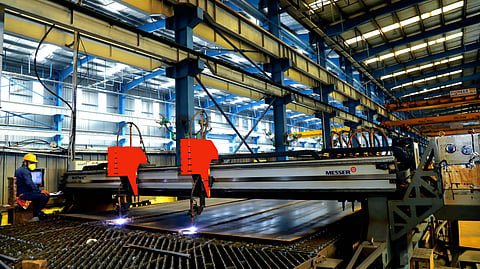
Unlike conventional construction, a significant portion of the building is engineered and manufactured off-site under controlled factory conditions. Thousands of customised components are fabricated using automated systems, quality-tested, tagged and digitally tracked before being dispatched to project sites in carefully sequenced batches. Since each component is engineered for a specific position within the structure, even minor deviations can affect final assembly, demanding millimetre-level precision across engineering, manufacturing and logistics.
At site, the structure is assembled almost like an industrial-scale system using cranes, specialised erection teams and synchronised installation schedules. Columns, rafters, bracings, roofing and wall systems are erected in a calibrated sequence, gradually transforming thousands of individual steel components into a fully integrated industrial facility. The completed structure then undergoes alignment, stability and safety checks before handover.
“In a fully integrated PEB project, engineering, manufacturing, logistics and site execution have to move almost simultaneously,” says Navaz Cheriya Malikakkal, COO. “The challenge is not just building the structure, but synchronising thousands of activities without losing precision.”
As project complexity increased, Interarch steadily expanded its manufacturing footprint to improve execution responsiveness and reduce logistics dependencies. Facilities in Uttarakhand and Tamil Nadu strengthened servicing capabilities across northern and southern markets, while the commissioning of a fifth fully integrated manufacturing facility at Athivaram in Andhra Pradesh significantly enhanced production capacity across southern and eastern India. Additional expansion plans in Gujarat and capacity augmentation at existing plants reflect management’s expectation that India’s infrastructure and industrial investment cycle still has considerable room to grow.
The expansion pipeline now includes a dedicated heavy structures facility in Andhra Pradesh and a new manufacturing plant in Gujarat, together representing planned capital expenditure of roughly Rs170 crore over the next 8-10 months. According to Nanda, the Andhra facility is being positioned to address demand for larger and more complex heavy steel structures linked to industrial and infrastructure projects.
Systematix has also highlighted Interarch’s expansion into heavy structures through dedicated capacity additions adjacent to its Andhra Pradesh facility, reflecting growing demand for larger and more engineering-intensive steel structures linked to India’s industrial expansion.
Analysts tracking the sector estimate that the Indian pre-engineered steel buildings market could expand from approximately Rs19,500 crore in FY24 to nearly Rs33,000-34,000 crore by FY29, supported by investments across manufacturing, warehousing, infrastructure, logistics and commercial construction. Research reports by Anand Rathi and Systematix note that demand is increasingly shifting towards larger-span and more engineering-intensive structures linked to sectors such as semiconductors, batteries, electric vehicles, renewables and data centres.
“What we are seeing now is not a short-term construction cycle but a structural expansion across manufacturing, logistics, renewables and industrial infrastructure,” says Manish Garg, CEO, who has led the company since 2021. “The scale and sophistication of projects coming into the market today are very different from what the industry handled even 5 or 7 years ago.”
Research reports by Systematix point to a broad-based greenfield investment cycle emerging across sectors such as paints, automobiles, logistics, renewable energy, semiconductors, batteries, electric vehicles and data centres. Many of these sectors require increasingly sophisticated industrial infrastructure featuring larger spans, higher load capacities and tighter engineering tolerances: areas where integrated steel construction systems are gaining relevance. This transition is also being reinforced by larger macroeconomic trends. India’s infrastructure and industrial investment cycle has accelerated sharply over the past decade, supported by sustained public capital expenditure and increasing private-sector investment across manufacturing, logistics and energy infrastructure. Government initiatives linked to industrial corridors, multimodal logistics networks, renewable energy and domestic manufacturing have expanded the addressable market for steel-intensive construction systems.
Opportunities galore
The opportunity extends well beyond traditional industrial hubs. Manufacturing expansion is increasingly spreading into Tier-II and Tier-III locations, where industrial parks, warehousing clusters and integrated logistics facilities are creating fresh demand for scalable construction systems. These emerging geographies often present additional operational complexities around logistics access, vendor ecosystems, skilled manpower availability and project coordination.
According to a recent Systematix research report, India’s relatively low penetration of pre-engineered steel buildings remains less a demand constraint than a supply-side limitation, with organised manufacturing capacity and integrated execution ecosystems still evolving. As industrial construction becomes increasingly time-sensitive and engineering-intensive, analysts expect adoption of pre-engineered systems to rise structurally over the coming years.
Interarch executed the structural steel works for the Campa Cola bottling plant, including detailed engineering, fabrication, supply and erection. “Interarch adopted a structured and disciplined approach in executing our bottling plant project,” says Divye Ratan Dixit, MD, Bharatiyam Beverages Pvt Ltd. “From design coordination and material planning to site erection, the execution process was managed efficiently and with strong attention to detail.”
For Systematic Conscom Ltd, Interarch executed the structural steel building works for an industrial facility, covering engineering, fabrication, supply and on-site erection of the steel structure. “The team demonstrated strong engineering capability, disciplined execution and a well-coordinated project management approach,” says Vinay Arora, CEO, Systematic Conscom Ltd. “Their responsiveness and structured operating approach made them a dependable partner for complex steel construction projects.”
Brokerage reports tracking the sector have highlighted integrated execution capabilities, spanning design, engineering, manufacturing and on-site erection, as an increasingly important differentiator within the PEB industry. Analysts also point to strong order inflows, rising execution efficiency and ongoing capacity expansion as factors supporting long-term visibility for organised players.
“The visibility pipeline today is significantly stronger because clients are investing ahead of capacity creation,” says Garg. “Faster execution, integrated capabilities and reliability are becoming critical differentiators in this business.”
Interarch’s project portfolio increasingly reflects the changing nature of industrial infrastructure in India. The company is currently executing projects across manufacturing, logistics, food processing, renewables and emerging technology sectors for clients that include Tata Group companies, Reliance, HUL, PepsiCo, Vikram Solar, Exide, Amara Raja, Asian Paints and Birla Opus.
Several of these assignments involve highly specialised engineering requirements. “We recently built a food processing plant for HUL that required a 70-metre-high structure – almost the height of a 20-storey building – with machines operating at every level,” says Suri.
In another project in Gujarat, the company executed a structure featuring a 125-metre clear span without intermediate columns. “These are the kinds of engineering complexities steel allows you to solve,” he says.
Interarch’s ‘One Building, One Date’ philosophy has evolved alongside this larger transformation. What began as an internal execution discipline gradually became embedded across engineering systems, manufacturing protocols and project management frameworks. The company institutionalised digital engineering tools, standardised quality systems and integrated planning processes designed to improve predictability across complex projects, explains Nanda. As scale increased, so did the need for organisational discipline. Management focused on training project managers to anticipate execution risks rather than react to them, while suppliers and site operations were integrated into tighter delivery frameworks. Over time, this predictability became one of the company’s strongest differentiators, particularly among repeat industrial clients operating within compressed commissioning schedules.
Operational discipline
“Our approach to growth has remained closely aligned with operational discipline,” says Pushpendra Kumar Bansal, CFO at Interarch. Even while expanding manufacturing capacity and project volumes, the company maintained a debt-free balance sheet and funded growth largely through internal accruals.
Management views that financial discipline as essential in a business where execution reliability and operational continuity matter more than aggressive expansion.
Interarch’s evolution into a publicly listed company marked another milestone in its growth journey. In August 2024, the company made a strong debut on the stock exchanges, with its shares listing at a premium of over 44 per cent on the NSE. The listing reflected investor confidence in both the company’s integrated execution model and the broader long-term opportunity emerging within India’s pre-engineered steel buildings sector. Since listing, the stock has continued to attract market attention amid growing investor interest in India’s infrastructure and manufacturing-led growth story.
Sustainability has also become increasingly central to the company’s long-term positioning. Steel’s recyclability, combined with reduced construction waste and energy-efficient building systems, aligns naturally with evolving environmental priorities across industrial infrastructure. Interarch’s involvement in renewable energy projects and climate-resilient infrastructure reflects a broader shift towards more sustainable construction systems.
Over four decades after its founding, Interarch’s evolution mirrors India’s own industrial transformation. What began as an effort to introduce modern architectural systems into a relatively closed economy has evolved into an integrated engineering and manufacturing business operating at the centre of India’s infrastructure and industrial expansion.
As India enters an increasingly execution-intensive phase of growth, the ability to deliver certainty at scale may prove as important as construction capacity itself.
For Interarch, ‘One Building, One Date’ reflects less a slogan than a discipline built over four decades of engineering, manufacturing and execution
Box 1
Think Big, Build Bigger
India’s infrastructure story is entering a new phase — one defined not merely by scale, but by sustained execution, integrated planning and long-term economic ambition. Across highways, industrial corridors, airports, logistics parks, ports and metro systems, the country is steadily reshaping its economic landscape through one of the largest public investment programmes in recent decades.
In the Union Budget for 2025-26, Finance Minister Nirmala Sitharaman reaffirmed infrastructure as a central pillar of India’s growth strategy, announcing a capital expenditure outlay of Rs11.21 lakh crore, equivalent to just over 3.1 per cent of GDP. Post-Budget analyses by firms such as EY have described the allocation as a continuation of the government’s sustained infrastructure-led growth model, reinforcing the role of public investment in stimulating economic activity, crowding in private capital and strengthening long-term competitiveness.
The scale of this transformation is increasingly visible on the ground. India’s national highway network has expanded from roughly 91,000 km in 2014 to more than 1,46,000 km today, while expressway length has increased sharply over the past decade. Union Minister Nitin Gadkari has repeatedly described roads and highways as economic multipliers capable of accelerating industrial growth, reducing logistics costs and improving national competitiveness. His ministry is currently overseeing large-scale investments across greenfield expressways, economic corridors and multimodal logistics connectivity projects involving investments worth several lakh crore rupees.
The broader philosophy underpinning this investment cycle is equally significant: infrastructure is no longer viewed merely as support infrastructure for growth, but as the growth engine itself. Roads, freight corridors, ports, airports, industrial parks and digital infrastructure are increasingly being positioned as productivity multipliers capable of improving supply-chain efficiency, expanding market access and accelerating industrialisation.
Prime Minister Narendra Modi has consistently framed infrastructure as an instrument of economic transformation and national integration. Under initiatives such as PM Gati Shakti, the government has sought to move away from siloed project execution toward integrated planning across ministries and states through a unified digital platform designed to synchronise transport, logistics, industrial and urban infrastructure. The objective is to accelerate project execution while reducing duplication and inefficiencies.
Industrial infrastructure is evolving in parallel. Government and industry estimates indicate that India now has more than 4,500 industrial parks and manufacturing clusters spread across millions of hectares. Industrial corridors such as the Delhi-Mumbai Industrial Corridor are intended to combine transport infrastructure with smart cities, manufacturing zones and logistics ecosystems, effectively compressing distances between production centres and markets. Analysts increasingly view these investments as structural rather than cyclical, with long-term implications for exports, manufacturing growth and employment generation.
Urban infrastructure is also undergoing rapid expansion. India’s operational metro rail network now exceeds 1,000 km across multiple cities, making it one of the world’s fastest-growing urban transit systems. Simultaneously, investments in airports, renewable energy, semiconductors, electric vehicles and data centres are creating demand for increasingly sophisticated industrial ecosystems and large-scale engineering-intensive facilities.
The macroeconomic indicators reinforce this momentum. Reuters, citing official data, has reported sustained growth in India’s infrastructure output index, supported by rising cement and steel production: key indicators of construction and industrial activity. Morgan Stanley has projected that India’s infrastructure investment could rise from approximately 5.3 per cent of GDP in FY24 to nearly 6.5 per cent by FY29, reflecting expectations of continued public investment alongside rising private-sector participation.
These developments are creating significant opportunities for companies operating across industrial and infrastructure ecosystems. As manufacturing investments scale up and industrial facilities become more technologically sophisticated, demand is rising for faster, more integrated and execution-intensive construction solutions.
For companies such as Interarch Building Solutions, the opportunity lies not merely in rising construction volumes, but in the increasing complexity of what India is building. Industrial facilities today require larger spans, tighter engineering tolerances, faster execution cycles and greater integration between structural systems and manufacturing processes.
“What India is building today is very different from what the country was building even a decade ago,” says Arvind Nanda, Managing Director, Interarch Building Solutions. “Industrial facilities are becoming larger, more sophisticated and far more execution-sensitive. For companies with integrated engineering, manufacturing and project execution capabilities, this creates a significant long-term opportunity.”
Nanda believes the shift extends well beyond infrastructure creation alone. “As supply chains modernise and manufacturing expands across sectors, clients are increasingly looking for reliability, speed and certainty of delivery,” he says. “That is where integrated pre-engineered building solutions become increasingly relevant.”
As India’s infrastructure and industrial investment cycle gathers momentum, companies capable of combining engineering precision, manufacturing scale and execution predictability are likely to play an increasingly important role in shaping the country’s next phase of growth.
Box 2
From War to Warehouses
How pre-engineered buildings transformed industrial construction
The origins of modern pre-engineered buildings can be traced back not to architecture, but to crisis. In the aftermath of the Second World War, much of Europe and parts of Asia faced the enormous challenge of rebuilding cities, factories, warehouses and industrial infrastructure at unprecedented speed. Traditional steel construction methods – heavily dependent on labour-intensive fabrication at site – proved too slow for the scale of reconstruction required.
“There was a huge demand for new industries, warehouses, factories and cities after the war,” recalls Arvind Nanda, Managing Director, Interarch Building Solutions. “But manpower was scarce. Millions of people had died in the war, and traditional construction simply could not respond fast enough.”
American companies responded by developing what eventually became known as the pre-engineered building, or PEB, model – an integrated system where design, engineering, fabrication and execution were coordinated by a single company. Instead of fabricating steel structures entirely at site, buildings were increasingly manufactured within controlled factory environments and assembled rapidly on location using far smaller teams.