
Towards indigenous identity
With Droupadi Murmu becoming the first tribal indigenous (Santhal) President of India in 2022, the nation is witnessing a remarkable cultural transformation. Nearly 105 million people identify themselves as adivasis (indigenous), ascribed in our Constitution, formulated by B.R. Ambedkar (hailing from the ‘untouchable’ Mahar community) as Scheduled Castes/Scheduled Tribes in India, according to the last census. These ethnic minorities are the original peoples of the vast and diverse sub-continent. As part of a growing initiative by the Ministry for Tribal Affairs to honour tribal heroes and celebrate their socio-cultural continuum, in November 2025, Prime Minister Narendra Modi inaugurated the R50 crore Shaheed Veer Narayan Singh Memorial & Tribal Freedom Fighters Museum in Nava Raipur, Chhattisgarh. This repository of material culture, living traditions and digital archives is one of the 10 planned and recently dedicated museums.
The other nine out of the 10 museums planned are under construction – in Rajpipla in Gujarat, Lambasingi in Andhra Pradesh, Raipur in Chhattisgarh, Kozhikode in Kerala, Chhindwara in Madhya Pradesh, Hyderabad in Telangana, Tamenglong in Manipur, Kelsih in Mizoram and Ponda in Goa. India does not have treaties signed with the indigenous communities, unlike the US, Canada, Australia and New Zealand, given the differences in circumstances and contextual realities. Nor does India’s museum policy make specific provisions towards the protection and repatriation of cultural and traditional appropriations or the inclusion of Adivasi awareness content in educational curricula. Article 366 (25) of the Indian Constitution defined scheduled tribes as such: “tribes or tribal communities or parts of or groups within such tribes or tribal communities, as are deemed under Article 342 to be Scheduled Tribes for the purposes of this Constitution”. But, due to the political leverage associated with tribal peoples in the Constitution of India, the term adivasi serves as a unifying umbrella for a diverse spectrum of the indigenous, both politically and socio-culturally, maintaining its influence in public discourse as a status quo, challenging the legally designated, state-specific administrative term ‘Scheduled Tribe’.

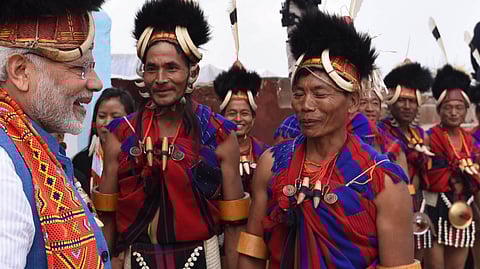
Pushed to the hills, deep forests and harsher terrains by invaders in the north, the adivasis share their common respect and symbiotic harmony with nature. Their populations are scattered across at least 26 states and Union Territories, with significant numbers in central and northeastern regions. Some of the better-known communities in western India include Koli, Warli, Kanjar, Meena, Garacias, Damor, Saharia, Gadia Lohar, Kathodi, Siddi, Kolga, Mavchi, Rathawa, Naika, Halpati, Dhodiya, Kachchi and many others. While the eastern sub-continent is home to Khasi, Jaintia, Bodo, Adi, Naga, Karbi, Deori, Apatani, Monpa, Mishmi, Nishi, Angami, Ao, Konyak and Mizo, North is known for the Bakkerwal, Gaddi, Bhotia, Jaunsari, Raji, Kanet, Tharu, Nuxa, Balti, Beda, Drokpa, Garra, Purikpa, Bhoksa, Kuki, Garo and others.
While tribal arts started gaining traction during the festivals of India and international cultural outreach, they caught the attention of the media when the National Crafts Museum and Hastkala Academy were first established in 1956
Central India is home predominantly to Bhil, Gond, Munda, Santhal, Oraon, Kondh, Bonda, Paraja, Gadaba, Kurukh, Koya, Bhumia, Birhor, Lanjia Soura, Banjara, Bathudi, Dongria and Khond, while the South is populated with Kodava, Yerava, Gowdaa, Kuruba, Chenchu, Yerukula, Savara, Yanadi, Lambada Sugali, Paniyan, Kattunayakan, Mudugar, Paliyar, Kadar, Irular, Muthuvan, Adiyan, et al.
Perhaps the oldest, most enigmatic, vulnerable and protected indigenous negrito-tribes are the Jarawa, Onge, Shompen and Sentinelese in the Andamans, dating back some 60,000 years, from the Upper Palaeolithic period. Wearing ancestor jaw-bones, staining their teeth red, believing in spirits, they remained largely undiscovered and isolated till the 1790s. With dwindling numbers of under 500 Jarawas and 100 Onge, they are the rarest of surviving hunter-gatherers in the world, teetering on the brink of extinction.
The sheer diversity and rich socio-cultural traditions of indigenous tribes are so vast and varied that their stories, artefacts and intangible heritage, as also cuisine, beliefs, music and attire, would be impossible to capture in the confines of any western museum construct. Many museum professionals acknowledge that the Te Papa museum in New Zealand comes close to curating the manna or soul of indigenous Maori culture. It would take hundreds of such institutions to chronicle, curate and display the countless indigenous cultures of the Indian sub-continent with 22 official and over 1,600 recognised languages and dialects. At the same time, it presents a unique opportunity to explore non-Western ways of telling their stories that adapt better to the indigenous way – be it through talking trees, mesmerising masks, whispering winds, waterfalls, flora, fauna and natural phenomena intertwined with religion, mythology, ceremonies and rituals.
While tribal arts started gaining traction during the festivals of India and international cultural outreach, they caught the attention of the media when the National Crafts Museum and Hastkala Academy were first established in 1956. The five-acre crafts village complex showcases over 35,000 artefacts and a much larger archive of collections, ranging from textiles, pottery, figurines, toys, works of art, musical instruments, and tribal jewellery. Its library of over 10,000 books, manuscripts and video recordings of intangible heritage, music and folklore holds the key to indigenous wisdom and living traditions.
The technology of spatial configurations, field research, immersive and interactive exhibit platforms and AI-driven curation has opened the door for creating incredible and memorable experiences. Its leverage depends on our ability to listen to the winds – as it carries the sensibilities and songs of our ancestors.