
Time to tread carefully
Europe’s increasing rift from the US at the influential Munich Security Conference (MSC) this month has begun sounding the death knell of the so far mostly unchallenged dominance of Washington’s influence over world affairs. Whether this will benefit or destabilise global geopolitics will become clear only in the coming months. But President Donald Trump has opened a Pandora’s box by his selfish stewardship of the post-World War II transatlantic alliance that empowered Washington and successive American presidents to rule the world.
For India, the potential for chaos will raise unprecedented challenges, as the post-1945 rules-based global order unravels and ‘might is right’ geopolitics set hurdles to its developmental ‘Make in India’ and ‘Make with India’ efforts to rise as a prominent world power. The MSC is still underway at the time of my writing this article, but key European leaders have already torn down the veils of hypocrisy that have characterised trans-Atlantic amity. They illustrate the near panic in Washington’s long subservient facilitators in both NATO, the most fearsome military alliance the world has ever seen, and the European Union, the most awesome commercial hammer the world has ever seen. US presidents have used both for half a century to batter weaker countries in the global south to obtain acquiescence to their policies.
India’s extraordinary trade deal with the European Union (EU) after years of struggle could turn out to be less remarkable than expected, since Europe’s governments will themselves be struggling to stay afloat. They have lost the ability to stand on their own legs, having long used to being sheltered under financial and security umbrellas provided by the country that started as their colony and was populated by the ‘poor and huddled masses’ of their emigrants.
More importantly, Indian security may be harder to stabilise in the face of a hubristic China, which will surely welcome the trans-Atlantic rift and the consequent erosion of trust in Japan, South Korea and Taiwan of Washington’s security guarantees. If ‘kith and kin’ Europeans can no longer rely on America, what chance do those alien Far Eastern civilisations have with Washington? They have to be mindful of some 100,000 US soldiers stationed on their territories, buttressed by US naval fleets, warplanes and cyber surveillance.
This is a good time to pose the question of who and what Delhi can trust for the security, safety and the painfully earned prosperity of its people. Schadenfreude over China’s current economic problems, including possible stagflation, should not distract us from the probability that can no longer be ruled out. All of us might have to live under the opaque hegemony of China and its likely vassal, Russia. Can we coexist under the influence of a civilisation that hardly anyone outside China, or even within China, understands?
Perhaps, some brilliant Indian minds will find ways to hold up bridges between the US, the EU, the Middle East and India without permitting the West to weaken Russia or stop China from raising its people to equivalence with America and the EU.
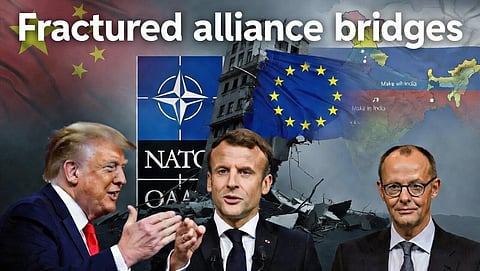
Meanwhile, the rift between the US and key EU powers like France and Germany is widening to a chasm. Friedrich Merz, chancellor, Germany, which has long been a pleasant Washington lapdog with about 60,000 US soldiers still on its territory, was uncharacteristically blunt. Alluding to the Munich Security Report 2026 entitled, ‘Under Destruction’ with reference to the multilateral rules-based order, he declared, “I’m afraid we have to put it in even harsher terms – this order, as flawed as it has been even in its heyday, no longer exists”.
“The world has entered a period of wrecking-ball politics,” the report, authored by prominent European experts, insists. “Sweeping destruction – rather than careful reforms and policy corrections – is the order of the day. The most prominent of those who promise to free their country from the existing order’s constraints and rebuild a stronger, more prosperous nation is the current US administration. As a result, more than 80 years after construction began, the US-led post-1945 international order is now under destruction.”
“This is the right time for audacity,” exhorted Emmanuel Macron, President of loyal US ally France. “This is the right time for a strong Europe. Europe has to learn to become a geopolitical power… Europeans must start this work with their own thinking and their own interests”.
The effects of this shift are being felt worldwide, but much more in Europe. It has long relied on the US for security, but now experiences its relations as shifting between ‘reassurance, conditionality and coercion’.