
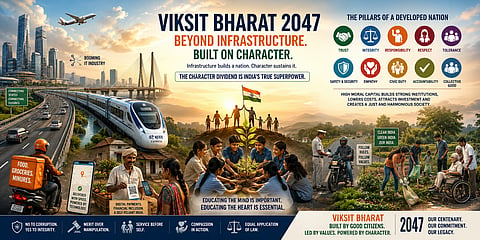
The road to Viksit Bharat 2047
A magnificent expressway weaving across states, a sleek Vande Bharat train cutting through the landscape, a booming IT industry, app riders delivering food and groceries within minutes and a local vendor accepting digital payments in a remote village – these are the visible markers of a rising India. The vision articulated by our prime minister is bold, inspiring and historic: India must become a Viksit Bharat by 2047, the centenary of our independence.
Yet, beneath the excitement of economic growth lies a deeper question: Can a nation become truly developed if its character fails to keep pace with its infrastructure? Is development merely a larger GDP, more airports, faster trains, greater military strength or superior technology? History suggests otherwise. Economic strength and technological advancement may be the visible hardware of a nation, but the invisible software that determines whether that hardware delivers lasting prosperity is the collective character of its citizens. If that software is compromised, even the most sophisticated hardware eventually malfunctions. The real infrastructure of a developed nation is not steel, cement or silicon. It is trust, integrity and responsibility.
The character dividend: Economists often speak of demographic, digital and innovation dividends. However, there is another dividend that receives far less attention: the character dividend – a society where people honour commitments, obey laws, reject corruption, respect women and care for their safety and security, practice tolerance, accept diversity and uphold civic responsibility by placing collective good above personal convenience. It generates extraordinary economic value.
Every act of integrity reduces friction. Every act of responsibility reduces supervision. Every act of trust lowers transaction costs. Character is not merely a moral virtue. It is a national economic asset.
The world’s most successful societies did not become ethical after becoming prosperous. They became prosperous because they built cultures of trust, accountability, and civic responsibility. Countries such as Singapore, Denmark, Finland, and Sweden consistently rank among the world’s most prosperous and well-governed nations. While their economic models differ, they share a common characteristic: high levels of institutional trust, civic discipline and public accountability. Citizens generally expect rules to be followed, public systems to function fairly, and wrongdoing to lead to consequences. That trust becomes an invisible force multiplier for economic growth. That is the character dividend in action.
Moral capital – the nation’s most undervalued asset: We often speak about economic, financial, physical and human capital. Yet, the most undervalued asset of any nation is moral capital – the collective stock of trust, integrity, responsibility, empathy and civic consciousness embedded within its people and institutions.
High moral capital strengthens institutions, attracts investment and fosters social cohesion. Nations with high moral capital require less policing, fewer controls and lower transaction costs. Also, they enjoy stronger social cohesion. Investors feel more confident. Institutions function more effectively. Citizens co-operate more willingly. Character, therefore, is not merely a social virtue. It is a strategic national asset. But the uncomfortable truth is that, while India is rapidly building physical capital, we have not devoted equal attention to building moral capital.
The cost of character deficit: India’s challenge is not a lack of talent, ambition or opportunity. It is the growing gap between our aspirations and our civic culture. Consider our educational ecosystem – repeated examination paper leaks have disrupted the futures of millions of students; also, recruitment examinations for teachers, police and public servants have frequently been delayed or cancelled. The message unintentionally conveyed to young citizens is deeply damaging: merit can be defeated by manipulation.
But the consequences of a character deficit extend far beyond examination halls.
They appear in the pothole that re-emerges on a newly built road after every monsoon, despite repeated expenditure. They appear in bridges and public infrastructure that fail years before their intended lifespan. They appear in adulterated food products, counterfeit medicines, synthetic milk, and substandard construction materials that quietly compromise public health and safety. They appear in classrooms where teacher absenteeism deprives children of opportunity, in hospitals where negligence can cost lives, and in government offices where citizens often spend more time navigating processes than receiving services.
Corruption is not merely the theft of money; it is the theft of opportunity, trust, safety and hope. The consequences are not abstract. They are encountered daily by ordinary citizens. In India, traffic rules are ignored with alarming regularity. Public property is damaged without hesitation. Littering is treated as someone else’s problem. Compliance is often viewed not as a duty but as an obstacle to be bypassed. But perhaps the most troubling manifestation of this decline is our growing indifference to the suffering of others. When accidents occur, too many bystanders record videos, rather than offer help. Convenience increasingly triumphs over conscience. These may appear to be isolated incidents. They are not. They are symptoms of a deeper deficit in character where conscience is ignored and neglected.
When shortcuts become normal, excellence becomes difficult. When accountability weakens, institutions crumble. When trust erodes, development slows. No nation can sustainably become developed, while simultaneously normalising dishonesty, indiscipline and disregard for the public good.
Why enforcement alone cannot solve it: The natural response is to demand stricter laws and harsher punishments and more aggressive enforcement. While enforcement is essential, history shows that fear alone cannot transform a society. It can temporarily suppress undesirable behaviour, but it rarely changes underlying values. A nation cannot police its way into character.
Character must be cultivated. Just as literacy requires education, ethical citizenship requires systematic learning, reinforcement and practice. If India wishes to become a developed nation by 2047, it must invest in character with the same seriousness with which it invests in infrastructure, technology and economic growth.
Building the foundations of Viksit Bharat: The road to Viksit Bharat cannot be built on economic metrics alone. It must also be built on moral foundations. This is precisely the challenge that the Institute of Goodness seeks to address through Personal Social Responsibility (PSR) learning frameworks designed for integration from kindergarten through graduation.
Our objective is not moral preaching. The objective is nation-building. Imagine a generation entering hospitals as doctors, public offices as administrators, courts as judges, classrooms as teachers, and boardrooms as corporate leaders after years of structured exposure to empathy, responsibility, civic duty, integrity and ethical decision-making. The long-term impact would be transformative. If introduced today and scaled nationally, such efforts can help create a generation of citizens equipped not only with professional competence but also with character. By 2047, they would form a significant part of India’s workforce, institutions, and leadership, helping India realise the full benefits of its character dividend.
Character is the foundation of a nation. Without it, prosperity becomes fragile, development becomes uneven, institutions lose trust and social cohesion and societal well-being gradually erode. Alongside educational reform, every institution – political, corporate, judicial, administrative or social – must remain subject to transparent accountability and equal application of the law. Because trust cannot flourish where accountability is absent.
The India we must build: When historians look back at India’s journey to 2047, they will not judge us solely by the size of our economy or the number of airports we built, or the sophistication of our technology. They will ask a far more important question: did we build a society defined by integrity, responsibility, empathy, trust and respect for the common good? Because nations ultimately become what their citizens become. Viksit Bharat is not a destination that can be built with concrete alone. It must be built with character.
GDP may determine the size of a nation, but character determines its soul. The true measure of Viksit Bharat will not be how wealthy India becomes, but what kind of Indians we have become. The road to Viksit Bharat runs through the character dividend we choose to build today. If India wishes to lead the world in the 21st century, it must first lead in the values that make civilisations endure.
The author is Founder & Chairman - Institute of Goodness