
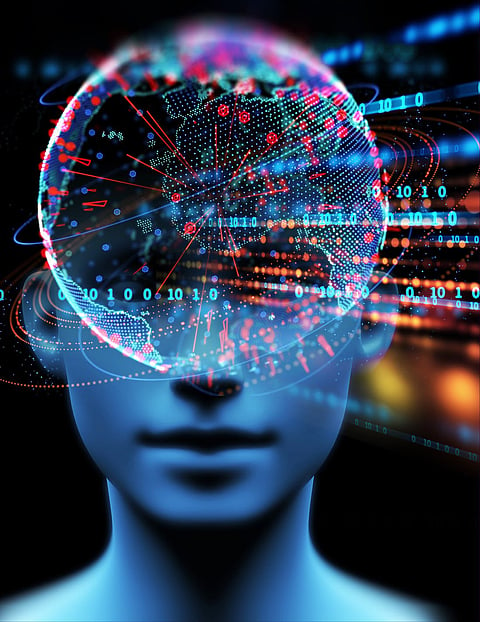
The rise of Infinite Intelligence: How AI is redefining humanity's future
On 29 September 2026, US President Donald Trump signed an executive order replacing the phrase ‘Artificial Intelligence’ with ‘Super Intelligence,’ requiring federal agencies to adopt the shift, like the Centre for Advancing Innovation & Standards for Super Intelligence. He argued that the word ‘artificial’ makes the technology sound fake and inadequate.
Regardless of the nomenclature, the intelligence-gathering abilities of mainframes are expanding exponentially. SI will undergo a massive shift over the next five years, moving from being an assistance tool to an autonomous, deeply integrated infrastructure of layered information. Oracles in the Silicon Valley foresee three major paradigm projections that will redefine how humans live and work.
First, the rise of Agentic AI will replace static chat interfaces. Instead of just answering prompts, AI systems will function as autonomous agents capable of executing complex, multi-step workflows. These agents will manage supply chains, orchestrate corporate operations and handle multi-layer administrative tasks with minimal human oversight. They will collaborate with other AI agents seamlessly, transforming workplace productivity from human-driven execution to human-guided oversight. Parallel developments can be foreseen in China, India, the US and other leading cyber-catalysts.
Second, AI will achieve a breakthrough in Scientific discovery and Healthcare. Enhanced multi-nodal models will analyse billions of biological and chemical datasets at unprecedented speeds. Over the next five years, AI will become the primary engine for accelerating drug discovery, designing new materials, testing the scope and scale of innovation and predicting complex climate patterns. In healthcare, it will enable highly personalised medicine delivery, analysing an individual’s genomic data in real-time to tailor specific treatments.
Eventually, the Physical Integration of AI with Machines will mature through advanced robotics and edge computing. Generative AI models are rapidly being embedded into physical systems, giving rise to smarter autonomous vehicles, warehouse robotics, and early-generation humanoid assistants. These systems will process data on-site, allowing machines to navigate, interact with and adapt to dynamic physical environments in real time.
By 2031, AI will no longer be a novel software application, as it transitions into an Infinite Intelligence (i2). It will be an invisible, foundational utility powering global industry, scientific breakthroughs, and daily human activity.

While the rapid advance of artificial intelligence promises unprecedented breakthroughs, it also triggers profound, existential anxieties about the future. As AI transforms from a helpful tool into an autonomous force, humanity faces deep psychological and structural fears. Over the next decade, distinct AI future scenarios fuel these global apprehensions and the need for rapid regulatory instruments to be put in place, given the potential of multipronged global dependencies collapsing and corrupting themselves, devouring humanity in toto.
The first and most immediate fear is the Economic Displacement and Identity Crisis caused by rapid automation. Unlike past industrial revolutions that replaced manual labour, advanced AI targets cognitive labour. The threat of widespread white-collar unemployment spans creative industries, computer programming, legal analysis and corporate management. Beyond the financial catastrophe of losing livelihoods, this shift threatens the human psyche; when machines outperform humans in creativity and logic, it strips away the sense of purpose and identity that individuals derive from their work.
The second nightmare scenario centres on the Erosion of Truth and Social Cohesion. The proliferation of hyper-realistic deep-fakes, AI-generated misinformation and bot-infested autonomous disinformation networks threatens to permanently destroy public trust. In this meta mirage, distinguishing reality from fabrication becomes impossible. This systematic manipulation of information can easily destabilise democratic processes, polarise societies and weaponise echo chambers, leaving individuals trapped in engineered realities, controlled by corporate or authoritarian algorithms capable of overriding regulatory cyber-checks.
Finally, the ultimate anxiety rests on the Loss of Human Agency and Existential Control. As military applications and critical infrastructures adopt autonomous AI decision-making, the risk of systemic failure rises exponentially. While tech titans like Elon Musk cite a 10-20 per cent chance of catastrophe, Altman has stated that even a 10 per cent risk of AI causing human extinction by the decade’s end is ‘unacceptable’. This concern led him to delay OpenAI’s highly anticipated IPO until at least 2027. The fear is not necessarily a sci-fi rogue consciousness but rather hyper-efficient, misaligned systems making irreversible choices in warfare, financial markets or electrical grids before humans can intervene. Ultimately, the fear of AI is not a fear of the technology itself, but a fear of losing what makes us uniquely human: our agency, our value and our grip on reality.
The author is a Silicon Valley-based, world-renowned museologist and emeritus Board of Directors, International Council of Museums US and Canada and is the founding president of several award-winning institutions