
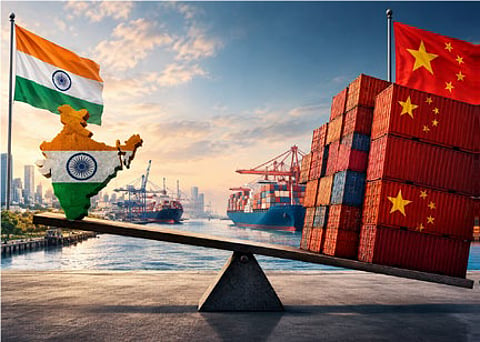
The asymmetry trap
In 2025-26, China overtook the US to become India’s largest trading partner, with bilateral trade amounting to $151.1 billion and the deficit widening to a record of $112.16 billion. Two decades ago, the deficit gap had stood at $1.1 billion, meaning that the deficit has grown roughly a hundredfold in two decades from about $1.1 billion to $112 billion. What is driving the imbalance of this scale?
According to China’s General Administration of Customs (GAC), the bilateral trade between India and China reached $144.45 billion during January to September 2026, marking an annual increase of 25.4 per cent. Over the same period, Indian exports to China grew 40.7 per cent year on year to $19.26 billion in January-September 2026. Yet, imports, growing at a slower 23.3 per cent, rose by a far larger absolute amount, reaching a record $125.9 billion, thereby pushing the nine-month deficit to $105.93 billion. This import growth was heavily driven by electronics, telecom gear, lithium-ion batteries, machinery and organic chemicals. Despite faster percentage growth in exports, the sheer scale of imports continues to widen the trade gap.
In 2025, the trade deficit was recorded at $116.12 billion and it is on track to surpass that level in 2026. While New Delhi remains deeply concerned over the growing deficit with China, the Chinese foreign ministry maintains that Beijing does not deliberately pursue a trade surplus.
However, while Beijing states its willingness to work with India, New Delhi has raised its own set of apprehensions regarding the structural imbalance. According to Finance Minister Nirmala Sitharaman, the widening gap stems significantly from China’s extensive use of non-tariff barriers, which restrict Indian exporters from accessing Chinese markets. However, China relies heavily on complex regulatory, administrative and safety standards to restrict imports.
Some of the primary barriers include phytosanitary restrictions that block Indian agricultural produce, vegetables, and perishable goods. In addition, China enforces rigid drug approval protocols, characterised by opaque timelines and complex regulatory loops that deny entry to Indian pharmaceutical firms. Furthermore, India’s competitive IT & tech services face invisible administrative hurdles and local sourcing mandates within China’s state-dominated market.
Meanwhile, India’s import basket from China tells us a different story. India’s structural trade deficit with China is heavily concentrated in electrical and electronic equipment, which accounted for $43.1 billion of the 2025-26 shortfall. The gap persists because, even when the finished goods are assembled in India, domestic production remains tied to China for high-value inputs including integrated circuits, semiconductor wafers, display modules, printed circuit board assemblies (PCBAs) and lithium-ion cells.
While assembly takes place locally, the foundational components must still be imported. For policy-makers, this provides a clear incentive to localise component manufacturing and reduce external exposure. However, India must still develop the specialised industrial ecosystems and supply chains required to produce these critical inputs at scale.
Consequently, the deficit continues to expand since the dependency runs primarily in one direction. India relies on Chinese inputs to keep its factories running, whereas China can restrict supplies of key materials and limit access to its domestic market. In early 2026, China restricted Indian shipments of rice and chilli, while tightening controls on rare earth exports. As long as China holds the leverage, it will continue influencing the terms of bilateral trade.
The deficit will likely widen through 2026-27, if India continues to remain reliant on imported Chinese electronics. Rebalancing bilateral trade will ultimately require India to diversify its export basket, accelerate domestic component manufacturing and secure genuine market access in Beijing. Until that happens, the trade deficit will remain a measure of economic leverage that India does not yet hold.
The author is an economic analyst with seven years of experience in macroeconomic research and analysis. She writes on global macroeconomic developments, geopolitical risk, and their implications for the global economy.