
Policing the politicking
The Election Commission of India’s (ECI) Special Intensive Revision (SIR), which began in Bihar in June 2025, otherwise a routine clean-up of the rolls, has struck more than 13 crore names off the draft voter rolls in the states and Union Territories, putting the Election Commission at the centre of scrutiny, casting a shadow on its impartiality, integrity and transparency, and sparking an endless debate over its role in deciding who gets to vote and who doesn’t. An investigation by the Indian Express, published in the form of a report on 23 September, revealed that two of the Election Commissioners, namely Sukhbir Sandhu and Vivek Joshi, have formally objected, on record at least fourteen times over the last ten months, four times on a single day, to decisions taken and orders issued, they say, without their knowledge. Their main concerns are that these steps on new voters are ‘unauthorised and illegal’ as well as the voter database access being ‘centralised’ in Delhi, bypassing state officials and concerns over the integrity of voter software. The ECI has rejected this report, claiming that all the decisions were unanimous.
The Commission is a constitutional body under Article 324; all three Election Commissioners are equal in rank, the CEC is first among equals but does not have the power to decide alone. Under the Chief Election Commissioner and Other Election Commissioners (Appointment, Conditions of Service and Term of Office) Act, 2023, all business of the Commission, as per Section 18, “shall, as far as possible, be transacted unanimously.” If the CEC and the Election Commissioners “differ in opinion on any matter”, the matter “shall be decided according to the opinion of the majority.” The same section allows the Commission to settle its own procedure and the division of its work, but only “by unanimous decision”.
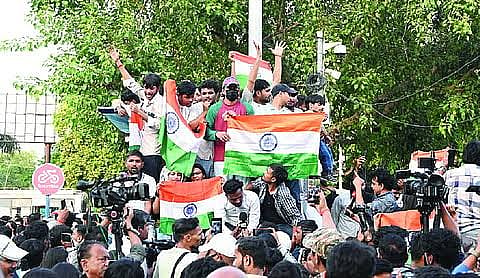
The protests began with some elements of the opposition on Delhi’s streets for three days from 6-9 October, demanding Chief Election Commissioner Gyanesh Kumar’s resignation, the repeal of a 2023 law (that gives the CEC and EC lifelong immunity) and an end to SIR and return to paper ballots. On 9 October, a Bench of Chief Justice Surya Kant with Justices Joymalya Bagchi and V. Mohana stated that the Delhi police’s order directing the closure of 57 Metro stations in Delhi before October 10 protests was “overreaching”. It distinguished “prohibition” from “regulation”. On 10 October, 45 Delhi Metro Stations remained shut, and the police detained opposition leaders, lawyers and protestors. On October 11, the Supreme Court assembled for a special Sunday hearing to hear a contempt petition alleging violation of the Court’s 9 October order and a habeas corpus petition seeking release of the detained protestors. A third petition also alleged physical handling, intimidation, arbitrary detention or coercive removal of female journalists while engaged in bona fide journalistic activity, breaching Articles 19(1)(a) and 21. The Court examined Sudhir Vasudeva v M. George Ravishekaran, where the Court confined contempt to the four corners of the order alleged to be breached, and the 9 October order left it to the authorities to make a prudent decision to run services in a regulated manner and the command was that there be “no outright prohibition on the movement of Metro trains”. The interim direction barred illegal detention following Article 21, wherein liberty may be taken away only through ‘procedure established by law’. Following Maneka Gandhi v. Union of India, the procedure itself must be ‘fair, just and reasonable’. In Rajender Singh Pathania v. State, preventive arrest was confined to cases where an offence cannot otherwise be prevented. The Bench, however, kept the legality of the detentions open for scrutiny.
Another point of contention was the standing order passed by the Delhi Police Commissioner de-notifying Jantar Mantar as a designated protest site in Delhi and naming alternatives. This standing order had gone ahead and decided a question that was already pending before the Supreme Court. In Mazdoor Kisan Shakti Sangathan v Union of India, the Court favoured regulation rather than a ban on Jantar Mantar and found the alternatives to be insufficient.
The legality of these protests is governed by the Indian Constitution, the BNSS and the Delhi Police Act, 1978. Article 19(1)(b) guarantees the right to assemble ‘peaceably without arms’, which is subject to reasonable restrictions with peaceful demonstrations being a fundamental right. Section 163 of the BNSS grants power to issue orders in urgent cases of nuisance or apprehended danger, which has been utilised by the authorities to impose prohibitory orders to prevent potential disturbances ahead of the protests in Delhi. However, the Supreme Court has repeatedly held that it is an exceptional preventive power and not a tool for routine administration. “In Babulal Parate v. State of Maharashtra, the court upheld the constitutional validity of the provision but stressed that it can be invoked only in an emergency to prevent specific threats to public order. It held that the power is conditioned by the circumstances set out in the statute and is not “unlimited or untrammelled”.
Further, the Delhi Police Act, through Sections 28(1)(p) and 30(3), empowers the Commissioner to regulate the conduct of assemblies and processions on streets and prohibit them for the preservation of public order for the necessary time. The same has to be exercised reasonably and not operate as a blanket ban.
Also, imperative is judicial safety. When the judges are independent and free from threats to life or property, they can deliver justice. Recently, a CJP Bail hearing was put off as the Judge who was supposed to hear the matter cited a threat to his life. The Delhi police stated that the Judge was pressured to release Saurav Das and Ashutosh Ranka without delay.
Whether these protests were within the limits of the law is a question that remains up for debate as the matter is sub judice. The refusal, on public order grounds, to hold the protests piques the curiosity to answer the question whether it is a reasonable restriction or not. Regulating protests is constitutionally permissible, but blanket measures that are disproportionate need to be scrutinised. Protesting peacefully is a constitutional right; the only question arises is whether it was truly peaceful; if not, the police taking measures seems appropriate, falling squarely within the reasonable restrictions in order to maintain public order.
All said and done, the law shall take its course and the Apex Court is very, very strong to tackle these minor anarchies masked in the form of the so-called legitimate protests. From the looks of it, these protests seem to be more inclined towards regime change rather than CEC change. Politicking is a given in a democracy – especially vibrant and large like ours – but not at the altar of constitutional bodies. Abraham Lincoln was right when he said, “The ballot is stronger than the bullet.”
The author is Managing Partner, S. Kothari & Co. and President, Council for Fair Business Practices