
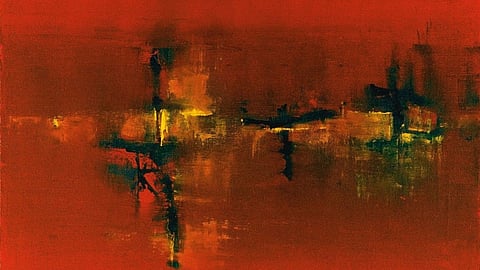
Mirage of the Masters
Art is rapidly becoming a commodity on the rise in the Indian market. Name recognition and bragging rights are flooding the field, as curated shows, auctions, art fairs, museums, galleries, private collectors and investors converge on this evolving theatre of paint and promise. The exponential jump in price tags, as recently demonstrated by billionaire industrialist Cyrus S. Poonawalla’s purchase of Raja Ravi Varma’s iconic 1890s painting, Yashoda and Krishna, for a record-breaking R167.2 crore ($17.9 million) at a Saffron Art auction in Mumbai, is a testament to this emerging intangible phenomenon. A layered class of collectors is shaping the composition of canvases that previously remained mute to the market, easily swayed by names and trends. A new breed of online auctioneers has also joined the fray tapping into a Tier II market fringe, where volume makes up for the gaps.
The usage of the term ‘Masters’ mirrors the Western art-historical tradition of ‘Old Masters’ or ‘Modern Masters’ that honours revolutionary artists, who transformed the global visual landscape between the late 19th and mid-20th centuries. Rejecting traditional academic realism, these pioneers embraced abstraction, raw emotion and structural freedom, fundamentally reshaping how humanity perceives reality, culture and individual identity. From Pablo Picasso, whose co-invention of Cubism shattered conventional perspective, to Henri Matisse, who championed the expressive power of pure colour in the Fauvist movement, these artists perfected technique and thought beyond the breathing brush.

The progressives like Husain, Raza, Souza, Abanindranath Tagore, Nandlal Bose, Tyeb, et al, were prolific and possessed an unprecedented urgency to pour their creative souls onto canvas in a provocative mix of story, substance and synergistic style. The term ‘Masters’ itself came into circulation with some art historians initiating adjective-induced frames of reference, with media, galleries and auctioneers layering upon its continued usage. As with ustaad in music, earning reverential status called for a discerning lens requiring thought, rigour and a deeper understanding of visual vocabulary, rendered on canvas that addressed technique, nuance and emotive flourish – how an artist learns to unlearn and strip down a painting until colour can hold an image; how not to choose abstraction in pursuit of pre-ordained styles; how to control light on canvas and bend it with illumination of thought; how to compose a painting that continues to speak when the subject stops breathing et al. Rebuilding and loosening structure with the rhythm of the brush is when material and what matters to a painting fuse in a masterful relationship. It is only then that a masterpiece is born and its DNA in a modernist Master, acclaimed.
Ultimately, the modern masters did not merely paint; they permanently altered human consciousness. They taught the world that art is not just a passive mirror to reflect the physical world, but a profound window into the human psyche. By breaking rigid academic rules, these visionaries laid the foundation for all contemporary art, proving that creative expression is entirely boundless.
Their works do not merely exist in an aesthetic vacuum; rather, it anchors a complex commercial ecosystem driven by media, demand, collector profiles and elaborate catalogues, ensuring their immortality. The commerce of art in India has evolved from modest, patron-driven origins into a sophisticated financial market, reflecting the nation’s broader economic liberalisation and global integration. As India’s wealth expands, a new class of corporate collectors and high-net-worth individuals look to art as both a status symbol and an investment buoyed by the arrival and birth of auction houses.
Despite this rapid growth, the commercialisation of Indian art faces significant structural challenges. The market remains highly speculative and top-heavy, while a disproportionate amount of capital flows toward a few deceased artists referred to in media as ‘modern masters’ or top-tier contemporary names, leaving mid-career and emerging artists economically vulnerable. The market leaves little room for recognising new Masters in the making – an area where public museums ought to step in for academic and artistic rigour. The loose application of the word ‘Masters’ often faces curatorial dissolve just as the museological grasp associated with ‘curation’ in the mainstream. As with any new trend, lack of strict regulation, proliferation of fakes and scarcity of independent authentication bodies can threaten market transparency.
The future of India’s art commerce is increasingly digital and decentralised. Online viewing rooms, digital auctions and social media platforms have democratised art buying, allowing a younger generation of tech-savvy collectors to bypass traditional gallery gatekeepers.
Ultimately, the commerce of art in India is no longer just about buying and selling beautiful objects. It has become a vital index of India’s cultural soft power and economic confidence. By transforming raw creative expression into structured financial wealth, this market ensures that the legacies of India’s contemporary masters are preserved, valued and projected onto the global stage.
Like with most sectors, there are those who collect, those who trade and those who commission and create. It can easily be forgotten that art at its expressive best is not made to please society. It is not a quest for a forced style for distinction to augment a critic’s narrative in the media. It is an emotive release of line, form or an abstraction that melds paint with passion. The Master is both a mercurial magician and a silent musician at once, whose brush yearns to dance without an audience and prance with paint in a fit of anarchic abandonment that defies the vocabulary of the vain.