
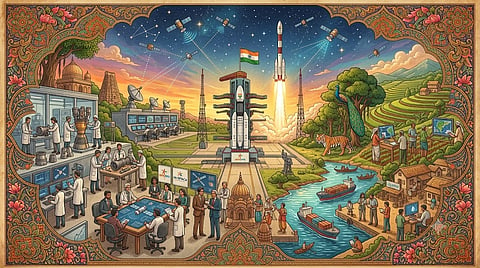
India's space economy takes off: From ISRO's legacy to private sector innovation
For decades, India's space programme was synonymous with the Indian Space Research Organisation (ISRO). From satellite launches and planetary exploration to landmark missions such as Chandrayaan III, ISRO had established India's reputation as a technologically capable and cost-efficient spacefaring nation. However, the next chapter of India's space journey is now being shaped by a new set of participants: private enterprises, technology start-ups, manufacturers and investors.
The transformation is significant. Space is no longer merely a domain of scientific exploration and national missions; it is evolving into a commercial ecosystem with applications across telecommunications, agriculture, logistics, financial services, climate monitoring and national security.
India's space economy, valued at about $8.4 billion in 2024, is projected to reach $44 billion by 2033. The opportunity is to move beyond being a successful space programme operator towards becoming a global supplier of space technologies, manufacturing capabilities and space-enabled services.
From government-led missions to private enterprise: The 2020 space-sector reforms and the Indian Space Policy 2023 have marked a structural shift in India's space ecosystem. The establishment of IN-SPACe (Indian National Space Promotion and Authorisation Centre) created an institutional mechanism to facilitate private participation, while NewSpace India Limited (NSIL) strengthened the commercialisation of space capabilities.
This transition has enabled private companies to participate across the space value chain, including satellite manufacturing, launch vehicles, propulsion systems, ground infrastructure and downstream applications. India now has more than 300 space-tech start-ups developing indigenous technologies and commercial solutions. And ISRO's evolving role as a technology developer, research institution and ecosystem enabler has created opportunities for private industry to participate in manufacturing, commercialisation and global supply chains.
Where will the next investment opportunities emerge? The space economy should be viewed as an interconnected value chain comprising upstream, midstream and downstream activities. Each segment presents distinct investment characteristics, capital requirements and opportunities for value creation.
Upstream, building indigenous technological capabilities: This segment includes satellite platforms, payloads, propulsion systems, launch vehicles, avionics and space-grade components. The adoption of small satellites, reusable launch technologies, modular architectures and advanced manufacturing is transforming the economics of space.
Indian companies developing launch systems, satellite subsystems, optical payloads, communication modules, sensors, advanced materials and propulsion technologies can become critical suppliers to domestic and international space programmes.
Midstream, enabling access and operations: Launch operations, mission control, telemetry, tracking, command systems and ground infrastructure connect space assets with terrestrial networks. As satellite constellations expand, demand for ground stations, antennas, tracking systems and mission-support infrastructure will increase.
Downstream, converting space data into economic value: The downstream segment represents one of the most significant commercial opportunities. Satellite communication, Earth Observation (EO), Positioning, Navigation and Timing (PNT), and geospatial analytics are increasingly becoming essential to non-space industries.
Applications span precision agriculture, maritime surveillance, insurance, infrastructure monitoring, disaster management, logistics and climate intelligence. The real commercial value lies not merely in collecting satellite imagery or positioning data, but in converting it into actionable intelligence.
Government as the first customer: One of the most important enablers of India's SpaceTech ecosystem will be the government's role as an early customer. SpaceTech start-ups face long development cycles, high upfront capital requirements and extensive technical qualification before reaching commercial scale. Even after demonstrating technological feasibility, securing the first large customer can remain a significant challenge.

ISRO, IN-SPACe, NSIL, the Ministry of Defence and other government agencies can help bridge this gap through procurement of indigenous satellite subsystems, propulsion systems, launch services, Earth Observation data and communication technologies. An initial government contract can validate technical performance, establish operational credibility, provide revenue visibility and help start-ups attract subsequent commercial customers and investors. Predictable procurement pipelines, milestone-based contracts and faster technology qualification can help start-ups transition from prototypes to repeatable manufacturing and commercial deployment.
Building a globally competitive space economy: Investing in SpaceTech requires a different approach from conventional technology investing. Long development cycles, capital-intensive infrastructure, technical qualification, regulatory requirements, and customer concentration can shape these businesses' commercial trajectories.
India's next phase of growth will depend on more than increasing the number of launches or satellites manufactured. It requires industrial depth, reliable domestic supply chains, widespread adoption of space-enabled services, and stronger global partnerships; space manufacturing clusters, Common Technical Facilities, technology transfer, and collaboration between start-ups, MSMEs, and established industrial companies can strengthen the ecosystem.
Ultimately, India's SpaceTech opportunity is not simply about reaching space; it is about creating economic value from it. ISRO demonstrated India's ability to achieve technological milestones. The next generation of private enterprises must demonstrate India's ability to build, own and export the technologies that power the global space economy.
The author is the Founder and Managing Partner Unicorn India Ventures