
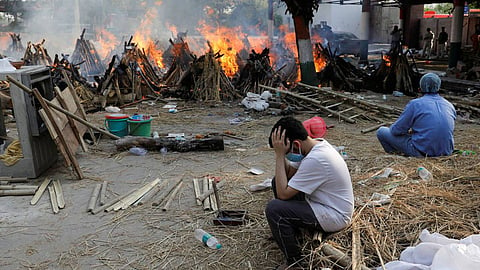
India's Covid crisis: A wake-up call for all
The Covid-19 disaster has damaged the political capital Prime Minister Narendra Modi had earned around the world for his administration, because of his personal charisma, since he came to power. Almost all the governments of the world are sympathetic but also shocked at the enormous and tragic hits taken by India’s people and its economy in just a few weeks. The emerging opinion overall is that Modi is a less efficient administrator and leader than many politicians and academics in the world’s leading countries had thought him to be.
That said, Modi can recover his reputation for leadership, if he handles the crisis aftermaths skilfully in coming months. There is growing fear outside India that the unimaginable human tragedy of India’s people will spill over into other countries, especially the poorer developing countries of Africa and badly administered nations of South America. That could also cause fourth and fifth waves of novel corona-virus infections in the richer countries, gravely imperilling their painstaking recent success in slowing down the pandemic.
The chaos in India, which was widely respected as a well-run democracy, is a wake-up call to all countries including the US and Europe that thought the pandemic was finally coming under control. New and more urgent efforts are now being made to help India directly through bilateral support and through the World Health Organisation (WHO). Director General Tedros Adhanom has launched a ‘Together for India’ appeal to raise funds to support work against the pandemic in India, including the purchase of oxygen, personal protective equipment and medicines.
Since the Covid-19 virus is still a mystery, the main focus remains on producing more vaccines as quickly as possible. High and upper-middle income countries represent 53 per cent of the world’s population but have received 83 per cent of the world’s vaccines. Low- and lower-middle income countries account for 47 per cent of the world’s population, but have received just 17 per cent of the world’s vaccines.
A strand of good news is that BioNTech’s CEO Ugur Sahin is convinced that his company and other vaccine developers will produce more than enough vaccines in the next 8-12 months to take care of all the world needs. “We have now scaled the manufacturing capacity up to 3 billion doses in 2021 and more than 40 per cent of these doses are expected to go to middle- and low-income countries,” he said. BioNTech and its US partner Pfizer have more than doubled production capacity for this year.
WHO has classified the corona-virus variant racing through India as a global ‘variant of concern’, because early studies suggest it may be more quickly transmissible than some other variants. This variant, known as B.1.617, is being investigated by scientists but has already spread to more than 30 countries, including the US, the UK, France and Japan. It is the fourth variant to be classified as of concern following the B.1.1.7 variant identified in England, the B.1.35 variant found in South Africa; and the P.1 variant found in Brazil.
So far, there are no findings to suggest that currently used vaccines are not effective against the Indian variant. “What we know now is that the vaccines work, the diagnostics work, the same treatment used for the regular virus work,” WHO’s chief scientist Soumya Swaminathan said. “There’s no need to change any of those and in fact people should go ahead and get whatever vaccine is available to them.”
Around the world, as in India, the realisation is being driven home that the novel corona-virus is a great social equaliser, because it attacks people across all social strata without discrimination. In response, many countries seem to be coming together to face it without trying to score points against one another.
Reportedly, Delhi will now invest $400 million in increasing production capacity for the Covishield vaccine made by the Serum Institute of India and $200 million in Covaxin made by Bharat Biotech. It is possible that vaccine supplies will start to stabilize after July and the pandemic’s rage may be damped down.
But international pressure will grow on Modi to deal with the aftermaths with less regard to domestic politics. Above all, India’s federal health system will have to be restructured to improve collaboration between the centre and individual states since they are responsible for health care. In particular, the system in Delhi will have to be improved because the Centre, the city’s government and several municipal corporations have diverse roles in the capital’s health care infrastructure. In general, health care budgets will have to be increased substantially at all levels.