
Beware of ‘super-intelligence’
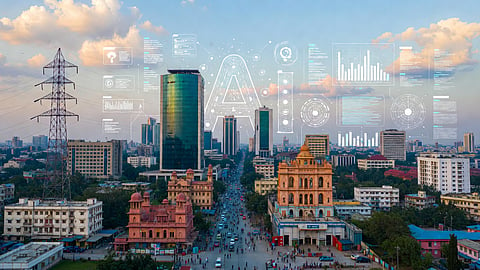
India stands on the edge of a nearly $5 trillion global market opportunity for artificial intelligence (AI), but profiting from it will take extraordinary foresight, planning and operational skills, because exceptional hype and investment fever are casting a dense fog on the paths forward. So far, power is concentrated in the hands of only about 100 mostly American and Chinese companies that are driving 40 per cent of the world’s private investment in AI research and development (R&D). About 118 developing countries are missing from global AI governance discussions altogether. To promote equity, the United Nations system, including UNCTAD, its trade and development agency, is emphasising the creation of a new global artificial intelligence framework and regulatory guardrails. For many specialists, that would simply thrust another layer of arthritic multilateral bureaucracy over a fast-moving domain, led almost entirely by dynamic young companies and risk-takers.
India, which is racing to become a leader in AI, is ranked 10th globally for private investment in AI, with $1.4 billion in 2023, according to UNCTAD. It is far behind China’s $7.8 billion, and both are light-years behind the US, with $67 billion invested. No developing countries are on the horizon.
The bright spot is that India ranks particularly high in AI research and development, with third place globally in scientific strength. It has also risen to 36th place out of 170 countries in 2024 from 48th in 2022 in the 'Readiness for Frontier Technologies' Index. Another positive feature is India’s vast talent pool of about 13 million software developers, which is the world’s second largest. But sharp challenges persist in key areas like digital infrastructure, where it is ranked 99th, and workforce skills development, where it is in 113th place.
The world’s most powerful countries are already struggling in a breakneck race for AI leadership while zealously protecting their intellectual property since AI, when used properly, can deliver spectacular productivity gains, generate new industries and deliver world-beating competitive advantage. Delhi understands these advantages and is investing persistently in reskilling, upskilling and workforce adaptation to ensure that AI creates employment opportunities and gives the lie to critics, who assert it will eliminate them. The leverage required to gain leadership instead of being left behind includes focus on infrastructure, data and skills. That means investing in fast, reliable Internet connections and the computing power needed to store and process vast amounts of information. It also means ensuring access to diverse, high-quality datasets to train AI systems in ways that are effective and fair. Above all, it requires building education systems that equip people with the digital and problem-solving skills needed to thrive in an AI-driven world.
India is well on the way to leadership among developing countries, some of which are already emulating its digital infrastructure and software solutions, including UPI, open APIs and other digital public goods. But gaps with China and the US continue to widen, despite the impressive investments from top-level global corporations that Prime Minister Narendra Modi’s policies have attracted in 2025.
The unveiling of OpenAI’s ChatGPT two years ago set off a gold rush for artificial intelligence, with billions of dollars pouring into AI-focused and AI-adjacent companies on the promise that the technology is going to impact most aspects of life across the planet with its ‘super-intelligent’ applications and infrastructure. Already, the valuations of Nvidia, Apple, Amazon, Meta, Alphabet and Microsoft have risen to $4 trillion apiece, pushed by their AI muscles. But an emerging body of sceptics has begun to warn of limits to expansion and upscaling, investment bubbles and unwise reliance on models that continue to throw more data and computing power at them, though almost no one fully understands how they work.
Indian companies may hit the wall more slowly because of our gigantic population and the digital data derived from it, but AI’s technical limits could remain. For example, to humanise AI machines, they must be trained on human-made data, which would be every piece of text or audio on the Internet, but once a model has gobbled up everything, there’s less ‘real’ stuff left to train it on.
The most formidable walls for India are AI’s enormous electric power and energy needs. Delhi is successfully enticing investors, but providing hundreds of megawatts in uninterrupted power for their giant installations may be impossible without thorough overhauls of the country’s power generation and transmission capabilities, including resort to untested innovations like smaller, widely distributed edge data centres built in local communities.