
An ‘existential’ scenario
Prime Minister Narendra Modi has said our current era is not one of warp; he repeated his message of Vasudhaiva Kutumbakam to ovation in the Israeli Knesset earlier this month, during the first-ever visit by an Indian prime minister to Israel’s Parliament. But India’s neighbourhood may be careening towards the worst regional war in centuries in the Middle East – between the US and its Israeli protégé against Iran, which has been beleaguered by US sanctions for almost all its 47 years as a revolutionary Shia theocracy.
India’s rise, as an Asian great power and likely to rank third within a decade, would be seriously hampered by US President Donald Trump’s dangerous brinkmanship that could inflame the region. Modi told the Knesset and Prime Minister Benyamin Netanyahu that negotiations are preferable to war with neighbours, but Israel is convinced that there is no better time to engineer the Tehran regime’s downfall.
Netanyahu thinks inciting an uprising in the Iranian streets could work, if catalysed by intense US and Israeli bombardment to destabilise the theocracy. Some analysts say Israel’s Mossad could successfully decapitate the regime by killing its top 200 clerics, including the supreme leader, within a few days. Trump seems to agree and is still riding high on what Netanyahu said, and he perceives it as a victory in the 12-day war in June 2025 that destroyed a great deal of Iran’s ability to launch missiles. Trump also insists that his warplanes obliterated its uranium enrichment capabilities to build nuclear warheads.
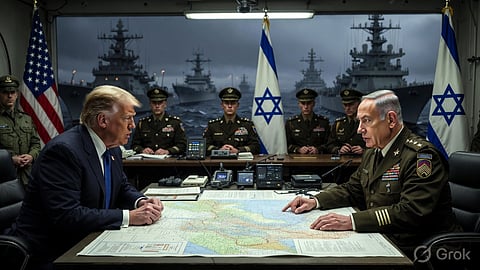
Top-level US and Iranian negotiators held two peace-making sessions in Geneva on 26 February and declared progress, although nothing was said, perhaps to preserve secrecy, about being any closer to a deal. Meanwhile, Trump has sent thousands of US troops to Iran’s vicinity and a naval ‘armada’, including two aircraft-carriers along with other warships, fighter jets and refuelling aircraft.
This much American fire has not been seen together anywhere in the world at one time, prompting most experts to predict imminent war. But US military supremo, Air Force General Dan Caine, has reportedly warned that strikes against Iran could be risky, potentially drawing the US into a prolonged conflict, although Trump insists that Caine believes the war would be ‘easily won’. The Middle-East region’s US military commander, Admiral Brad Cooper and Cain briefed Trump on 26 February after the Geneva talks; so, a war may be closer, awaiting only that all of America’s forces are deployed, which is just days away.
In turn, Iran is sabre-rattling loudly with threats to respond to any attack by striking American military bases in the Middle East. This might be credible since some reports say China is helping Tehran with modern radars and anti-ship missiles.
Many saw the Geneva meeting as a last chance for diplomacy before Trump decides whether to launch a war or not. Vice-President JD Vance has also sounded war trumpets recently. “I think most Americans understand that you can’t let the craziest and worst regime in the world have nuclear weapons,” he said.
In his 24 February State of the Union address to Congress, Trump branded Iran as a clear and present danger to the US. “They’ve already developed missiles that can threaten Europe and our bases overseas, and they’re working to build missiles that will soon reach the United States of America,” he said.
But an unclassified 2025 US Defence Intelligence Agency assessment said that Iran could take until 2035 to develop a ‘militarily viable’ inter-continental ballistic missile (ICBM) from its existing space-launch vehicles (SLVs). Apparently, potential military action aims to pressure Iran to make concessions in nuclear negotiations, but it’s unclear whether limited American airstrikes would work. If the goal is to remove Iran’s leaders, that would likely commit the US to a larger, longer military campaign.
From the Indian perspective, the potential for chaos in Iran, including civil war, is immense, including threats from Iranian Kurdish groups, who might exploit it to create their long-desired autonomous state linked to Kurds in Iraq, Turkey and Syria. That would throw the region into a long-term spiral of instability and violence. Some analysts predict oil prices exploding to beyond $150 a barrel – up from the current $70 a barrel.
For India, that would be a disaster, especially if Israel joins the US attacks on Iran and Modi’s bear-hugs to Netanyahu irritate Tehran enough to infiltrate Islamic terrorists into Kashmir or elsewhere through Pakistan. It has never done so; this time, the war would be existential for its clerical rulers.