
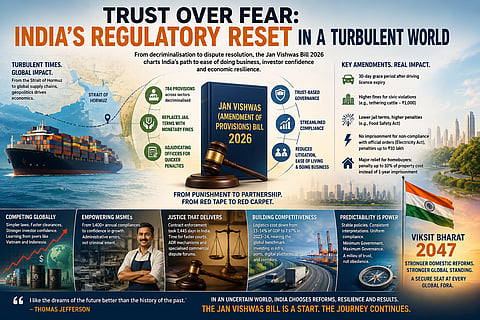
Over the last few months, tensions in West Asia have wreaked havoc on the world order, forcing countries to introspect, strategise and try to find a secure place for themselves – not only on this planet but also on the global negotiating table. The Strait of Hormuz, suddenly coming into focus because of diverted shipping lanes, has resulted in burgeoning insurance costs, domestic upheavals and unsettling energy markets, showing the inextricable link between geopolitics and economics. From the Atlantic Ocean to Western Asia, a booming trade no longer depends on a more arable land or the exchange rate power of the currency, but on strategy and resilience. For India, foreign policy moors itself in domestic success. This depends upon the ease of doing business, where India has consistently ranked low earlier and is now gradually improving its position.
The Jan Vishwas (Amendment of Provisions) Bill, April 2026, brings in a tectonic shift in governance. Passed by the Parliament in April 2026, it aims to amend 79 Central Acts and decriminalise over 700 provisions (compared to its first attempt in 2023 to decriminalise some 183 provisions) to promote ease of doing business and living. It replaces imprisonment with civil penalties or fines for minor, technical or procedural lapses across the spectrum.
The 2026 Bill has replaced jail terms with monetary fines for minor offences to reduce the burden on courts. It covers 784 provisions across various sectors, including finance, health and transportation, reducing excessive compliance. It appoints adjudicating officers to determine penalties, focusing on civil penalties over criminal charges. Procedural violations previously punishable by imprisonment under the Drugs & Cosmetics Act, 1940, now face penalties, such as a maximum of Rs1 lakh or three times the value of confiscated cosmetics. Through all these measures, it has enhanced trust-based governance, streamlined compliance and reduced litigation for businesses and individuals.
After the amendments in the Delhi Municipal Corporation Act, 1947, the fine for tethering cattle on a public road goes up from Rs100 to Rs1,000; fine for defacing or destroying a house number goes up from Rs50 to Rs1,000; fine for discharging fireworks that may cause danger goes from Rs50 to Rs500; while the fine for preventing a municipal official from entering premises is raised from Rs50 to Rs500. Some other legislative amendments include introducing a 30-day grace period after a driving licence expires, considering it to be valid under the Motor Vehicles Act; reducing the maximum jail term for tampering with seized items (such as food or vehicles) from six months to three months under the Food Safety and Standards Act, 2006; and amending the Electricity Act to propose removing imprisonment for non-compliance with official orders, while increasing penalties up to Rs10 lakh.
Under the Slum Areas (Improvement and Clearance) Act, 1956, offences will attract fines of up to Rs10,000 per instance instead of imprisonment. And, in a major relief to homebuyers, the amendment has replaced a one-year imprisonment for allottees failing to comply with Real Estate Appellate Tribunal orders with a penalty of up to 10 per cent of the property cost.
The bureaucratic multiple licence-based module had suffocated the investor and diminished the incoming FDI for decades. By decriminalising certain provisions, India is seriously competing with global peers like Vietnam and Indonesia. In Vietnam, pushing a National Single Window clearance and major amendments to the IP law have streamlined investor entry, contributing to an expanded disbursement of FDI.
A typical MSME complies with over 1,400 annual requirements. By introducing adjudicating officers, the government is taking any lapse to be an administrative error rather than a crime. MSMEs are going to play a major role in achieving Viksit Bharat 2047. The important question that now arise are: how quickly can a dispute be resolved? Historically, World Bank data had indicated that enforcing a contract in India took about 1,445 days, which is significantly longer than in China. Looking at the millions of cases pending across the tiers of our judiciary, it is going to be a Herculean task to ensure that justice is meted out cost-efficiently. Global boardrooms panic at these alarming figures.
For a foreign investor, if contracts are not going to be enforceable (a 10-year period is as good as unenforceable), then he would wonder how the new reforms would help! The Jan Vishwas axiom of ‘executive adjudication’ removes the minor economic offences out of the courtroom, so that the courts may focus on real commercial disputes. There must be a separate sub-court set-up to deal with international commercial disputes – that way, one could remove these important cases from the daily cause-list, which is heavily overburdened. Developed nations focus on alternative dispute resolution mechanisms like mediation and/or arbitration, which will resolve disputes within a stipulated time-frame.
The next phase should be the Aarthik Vishwas Bill, which takes into account questions, such as: How quickly can a company be incorporated? How efficiently can it then grow? Can the red tape of multiple windows turn into a single window clearance? Can land be acquired without prolonged uncertainty? To what extent is the government interference going to be reduced to establish a more market-based economy?
India aspires to be a global manufacturing hub. Any developed economy worth its salt will eventually be tested on the anvil of its cost-competitiveness. If you can make things cheaper in your country than in your neighbour, you win. If not, you lose. If iPhones can be manufactured here with the same level of efficiency and quality, we are doing well. Logistics, which determines a global shift to India, has made significant progress, resulting in a decline from 13-14 per cent of GDP to 7.97 per cent in 2023-24 (according to the DPIIT-NCAER Assessment Report, September 2025), nearing the global benchmark of 8 per cent. Investments in highways, hikes in pay to those involved in the shipping industry, dedicated freight corridors, port modernisation and digital platforms, such as PM Gati Shakti, are beginning to yield results.
In an uncertain world, predictability is often prized more than any sops, moratoria or reliefs. Despite India’s macro-policy being stable, businesses continue to encounter frequent regulatory changes, diverse interpretations of the provisions, and different judgments on the same issues from courts of co-ordinate jurisdiction like the High Courts. Added to this are the different compliance parameters across states. The government’s promise of ‘minimum government, maximum governance’ through the reduction of over 45,000 compliances in November 2025, coupled with this ambitious bill, represents a milieu of trust rather than obedience.
Countries that combine stability with sound, enforceable laws will rule the roost. India has a long way to go, and the Jan Vishwas Bill can only go so far. Today’s geopolitics places self-interest over everything else, and countries that prided themselves on having statesmen with a robust political heft are now bandying leaders with knee-jerk responses that change overnight. In this yo-yo scenario, India must focus on its domestic reforms and strengthen itself to have a solid seat at various global fora.
Thomas Jefferson once aptly said: I like the dreams of the future better than the history of the past. I agree.