
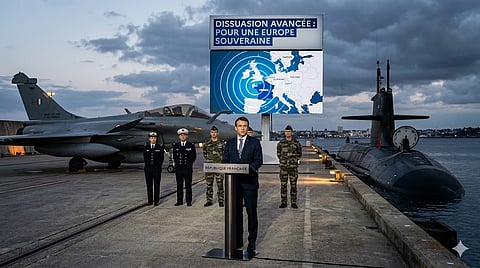
French President Emmanuel Macron has taken the first major step to reduce European subservience to US President Donald Trump as a NATO member by announcing a remarkable revision of France’s nuclear strategy. He did this quietly and without much fanfare on 2 March, a day after American and Israeli bombs started raining death and destruction upon Iran’s distraught people. The move’s political significance cannot be overstated in the midst of the global earthquake triggered by Trump’s hasty war against Iran and Ukraine’s almost forgotten war of survival against Russia.
Nor can the importance for India be overstated of this emerging sea change in the global security order, built around the stability that the US-led NATO has brought to relations between the West and Russia. India, a minor nuclear weapons power compared to the US, Russia and China, is barely managing to continue balancing upon its self-created tightrope over the abyss of West and East on either side.
India is a sibling of France in terms of nuclear war-fighting capabilities, so taking a closer look at Macron’s gamble of using nuclear strategy to climb out of the US abyss might be worthwhile. The key element is Macron’s nuclear posture of ‘forward deterrence’ (dissuasion avancée), which moves its nuclear arsenal from a strictly national defence posture toward a more active offence posture.
This new posture aims to include European countries under its nuclear security umbrella, likely alongside Britain, the region's only other nuclear power. Thus, Europe would become less dependent on the long-standing American nuclear umbrella that US presidents, and Trump in particular, have turned into a weapon to coerce all NATO allies into a position similar to vassals.
Now, Trump’s severe displeasure at the French and NATO refusal to fight in its war of choice against Iran, for which Europe was not consulted, has ripped off the mask of politeness that allowed Europeans to pretend that they are not client states of the US. The Europeans correctly argued that NATO is a defensive alliance designed to collectively defend its members against direct attacks from any outside power. But Trump, who prefers unquestioning loyalty, has called them cowards and is likely to find ways to punish key powers like France and Germany to bring them to heel.
Macron’s new strategy will increase the number of French nuclear warheads and apply a new policy of Strategic Opacity, which means France will no longer publicly disclose the exact size of its nuclear stockpile. That would increase ambiguity and complicate enemy calculations.
In an important break from tradition, France will allow temporary forward deployment of its nuclear-capable Rafale aircraft in allied European countries. At the start, eight countries will co-operate in new nuclear steering groups or joint deterrence exercises —Germany, Poland, Belgium, the Netherlands, Denmark, Sweden, Greece and Britain.
How this would work remains to be seen, because other European governments may not like coming under France’s thumb and prefer US tutelage instead, as it is a far greater military power. More so, because Macron’s new doctrine continues to stand on traditional ‘Gaullist’ pillars. Those pillars prohibit shared command over French nuclear weapons and purposely define vaguely the ‘vital interests’ that would trigger a nuclear response. To his credit, Macron has pledged to include a ‘European dimension’ in those interests.
India might have a lesson to learn from France’s rejection of ‘flexible use’ — an emerging concept supported by many experts that permits tactical or ‘battlefield’ nuclear war fighting. Like France, India could maintain its nuclear arsenal strictly for strategic deterrence and use a single, non-renewable nuclear warning shot (avertissement nucléaire) to restore deterrence before a full-scale strike.
Perhaps inspired by Russia and Iran’s effective use of hypersonic missiles to outmanoeuvre modern interceptors, Macron confirmed the launch this year of an ambitious strategic hypersonic missile program. It will develop fourth-generation air-to-surface nuclear missiles intended to enter service in the mid-2030s. India might keep an eye on these for future collaboration.
Like India, France will accelerate naval modernisation, including the development of third-generation nuclear-powered ballistic missile submarines and new-generation missiles for them. Macron insisted that France’s new strategy will be complementary to NATO and is not intended to replace America’s extended nuclear deterrence within the alliance. But that, too, remains to be seen, because Trump may be so enraged if Iran blocks his military that he might scapegoat NATO’s absence for the failure.
He could simply walk out of NATO, leaving Macron to pick up the pieces as continental Europe’s only nuclear power. Despite its erstwhile Gaullist grandeur, France will find America’s shoes too big to fill.