
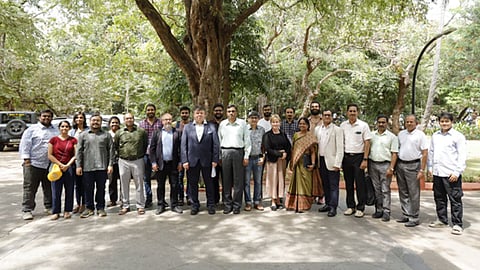
IIT Madras and the Finnish Meteorological Institute (FMI) have established VAYYU (Virtual Research Centre for Modelling Aerosols), a joint research centre featuring a new Rs5 crore urban observatory in Chennai. Situated at the IIT Madras campus, this observatory focuses on coastal tropical meteorology using advanced equipment like lidar, flux towers and aerosol analysers.
Supported by the Research Council of Finland, this endeavour aims to improve local weather forecasting, air quality and climate resilience through high-resolution data. This initiative is part of broader 2026 efforts to expand urban weather monitoring in India.
“India has been facing challenges with the weather issues,” said Petteri Taalas, director general, Finnish Meteorological Institute (FMI), while talking to Business India. “One example is the air quality situation getting worse in Delhi during winter. Burning agricultural waste and additional vehicles on roads have created more difficulties there”.
There is an ongoing collaboration in aerosol monitoring and air quality forecasting between FMI and the India Meteorological Department (IMD). “The India-Finland collaboration through VAYYU marks a significant milestone in bilateral science diplomacy, bringing together IIT Madras' modelling prowess and FMI's climate expertise to tackle aerosol-driven risks to our monsoons and urban health,” Hemant H. Kotalwar, India’s ambassador to Finland, told Business India. “This virtual centre will empower Indian researchers with cutting-edge tools for predictive hydro-meteorology and air quality management, strengthening our shared vision for sustainable development”.
Finnish President Alexander Stubb and Prime Minister Narendra Modi had, during Stubb’s visit to India in March this year, underlined the importance of redoubling efforts to reach sustainable development goals (SDGs). They had also stressed the importance of global co-operation against the challenges of climate change and loss of biodiversity.
The two leaders underscored the importance of implementing the memorandum of understanding on co-operation in the field of renewable energy, encompassing many key areas of collaboration that contribute to sustainability, including bio-energy and waste-to-energy solutions, power storage and flexible renewable energy systems, green hydrogen, as well as wind, solar and small hydro power.
Finland, at present, produces 95 per cent of its electricity through renewables. This has enabled it to become self-reliant during these challenging times, when the world is coping with energy issues due to ongoing conflicts – be they in West Asia or the Russia-Ukraine.

Waste-to-energy
It’s time India invested more in renewable energy and also considered giving an impetus to waste-to-energy production. Finnish companies like Vantaan Energia are drawing a lot of interest for incinerating waste to convert it into energy. “Nearly 370,000 tonnes of waste is processed at Vantaan Energia every year, which provides electricity to 1.5 million people living here,” affirmed Anne Kandolin, on behalf of Vantaan Energia, in a communication with Business India. The company specialises in converting mixed municipal and industrial waste into heat and power. India needs to replicate this.
India’s ministry for new & renewable energy (MNRE) supports projects with financial assistance, focusing on bio-CNG and power generation. The sector faces challenges with low-calorific waste, high costs and operational inefficiencies, with only a fraction of the estimated 1,700 MW potential being realised now.
At present, India has 21 waste-to-energy plants, but most are focused on bio-methanation and not large-scale incineration. These plants process only a small fraction of India’s 150,000-160,000 tonnes per day (TPD) of municipal solid waste (MSW). Also, many plants face challenges due to India's high-moisture, unsegregated waste, which is difficult to incinerate, leading to high failure rates.
The time has come for India to seek support from organisations like Vantaan Energia to incinerate waste and convert it into energy. Not only will it be productive, but it will also ensure that Indian cities become free of garbage and landfills.