
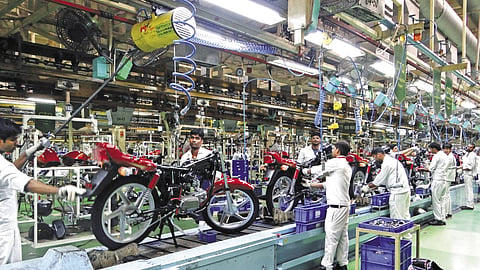
Auto sales take a plunge
After Covid-19 hit in 2020, the Indian automotive industry was the first to recover, led by two-wheelers and followed by passenger vehicles. Everything went smoothly till the festive season. India was slowly returning to normal in early 2021, when the second wave of the pandemic hit even harder, with a new spread of infection across the country creating a huge challenge to our economy and the healthcare infrastructure. In the last month, there has been a dramatic change in the country’s economic mood.
Many auto manufacturers have shut down their plants to stop the spread of the virus or to support the government in oxygen supply. These include Maruti Suzuki, Hyundai Motor India, Honda Cars, Mahindra & Mahindra, Toyota Kirloskar, Hero MotoCorp, Honda Motorcycle and Ashok Leyland.
The April 2021 data, released by the Society of Indian Automobile Manufacturers (SIAM), shows a total production figure of 1,875,698 units in April. With the Covid wave impacting the sales of vehicles in April 2021, sales of passenger vehicles fell by about 10.07 per cent to 2,61,633 units in April 2021, due to various restrictions and lockdown in many states, which had been experiencing a surge in Covid-19 cases. Two-wheeler sales plummeted by 33.52 per cent to 995,097 units in April, while three-wheelers witnessed de-growth of 57.01 per cent to 13,728 units. Supply chain-related production challenges continue, with lockdown restrictions prevailing in many parts of the country. The demand has been clearly impacted by the second wave of Covid-19, both in terms of low consumer sentiments and the closure of dealerships due to lockdown restrictions. If the trend continues, sales in May are also likely to be impacted due to the lockdown.
“As our country battles the second wave of the Covid-19 pandemic, the Indian automobile industry has been providing all essential medical and non-medical support to society,” says Rajesh Menon, director general, SIAM. “Vehicle manufacturing has been restricted and OEMs have come forward to augment oxygen supply for medical use. The industry is increasing the availability of oxygen by providing oxygen generating plants, concentrators, cylinders and mobile oxygen vans, and also setting up vehicle tracking systems in oxygen-carrying vehicles to reduce their turnaround time. In fact, some members have also tied up with PSA plant manufacturers to de-bottleneck their operations and scale up the production of oxygen plants,” adds Menon.
Strong cyclical upturn
According to a research report from Emkay Global on the demand outlook of the automotive industry, near-term demand may remain subdued due to pandemic-related restrictions. However, the industry expects a recovery from the second quarter of 2022 onwards. The positive view on the automobile sector is underpinned by expectations of a strong cyclical upturn, which is expected to last at least three years.
A number of automakers have also come forward to support customers with various schemes. Toyota Kirloskar has announced a second customer connect programme. “We are aware of the extreme difficulties faced by our customers during this pandemic and the uncertainties it has brought,” observes Naveen Soni, senior vice-president, TKM. Our ‘Customer Connect Program 2.0’ is a step further to build confidence and show our commitment to our valued customers by ensuring seamless communication and hassle-free processes to ensure customer convenience and the utmost safety. Our dealerships will continue their efforts to support our customers, and as a responsible corporate citizen we are extending our support to even take care of vehicle sanitisation used by frontline warriors.”
Due to the ongoing lockdown across the country, several customers are unable to service vehicles which are scheduled for maintenance. Tata Motors has announced that customers’ warranty and free service period (not km), due to expire between 1 April 2021 and 31 May 2021, will be extended till 30 June 2021. “The Covid-19 upsurge has led to restrictions on people’s movements,” says Dimple Mehta, head, customer care (domestic & IB), PVBU, Tata Motors. “And, customers across the country are unable to bring or send their vehicles to our authorised service centres for scheduled maintenance or repairs. We are committed to our customers and are offering them the utmost support in these tough times by extending their warranty and free service period till 30 June 2021.”
The cumulative number of Covid-19 vaccine doses administered in the country exceeded 175.1 million by 11 May, according to a Union Health Ministry communiqué. The government is making every effort to vaccinate people across the country and protect them from getting infected. These are tough times for India, the people and the economy. We have gone through many challenges in the past and come back strong. We will fight together and win the battle against the virus this time too, concludes the circular.