
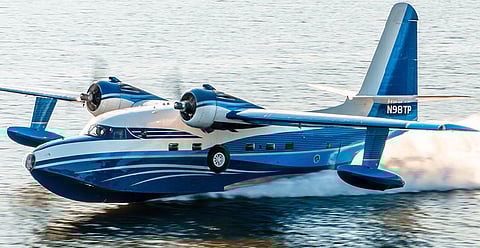
Albatross 2.0 wings its way to India
Australia’s Amphibian Aerospace Industries (AAI) and Indian firm Apogee Aerospace have announced a collaboration to bring the Albatross 2.0 amphibious aircraft to India. To begin with, there is a committed order of 15 aircraft worth Rs3,500 crore, which includes planned investments of up to Rs500 crore to build manufacturing, maintenance, systems integration and training infrastructure in India.
Albatross 2.0 is the world’s first and only FAA or EASA-certified Transport Category amphibious aircraft above 19 seats (up to 28 seats) in the Registered Passenger Transport (RPT) sector. The partnership extends across maintenance, repair and overhaul, training and capability development, simulation, end-to-end systems integration for the militarisation of the aircraft and the establishment of aircraft tail-section manufacturing in India to support the global supply chain.
“India is uniquely positioned to lead the next chapter of amphibious aviation, and this collaboration is a decisive step in that direction,” Khoa Hoang, founder-chairman, AAI, told Business India. “With Albatross 2.0, we are bringing fully certified transport-category capability that can immediately serve India’s military and paramilitary, as also government and strategic civil aviation needs. Partnering with Apogee Aerospace allows us to go far beyond aircraft delivery, focusing on deep industrialisation, systems integration, skills development and long-term sovereign capability. The partnership with Apogee Aerospace would help us focus on deep industrial integration and indigenous capability development, establishing India as a centre for amphibious aviation operations, sustainment and future growth”.
Under the collaboration, Apogee Aerospace has been designated AAI’s exclusive and authorised representative partner for the Indian sub-continent in the restricted category, covering defence and government requirements. Currently, India relies on a mix of fixed-wing aircraft, helicopters, naval vessels and surface transport to execute missions related to coastal security, island logistics, disaster response and surveillance. These activities often require significant ground or port infrastructure and co-ordinated deployment across platforms.

“Engagements with prospective customers in the restricted category over the past two years showed a market for this,” affirmed Wing Commander M.V.N. Sai, CMD, Apogee Aerospace. In the first phase itself, services see a requirement for 20-30 aircraft to familiarise crews, develop SOPs and formalise amphibious mission doctrines. A single transport category aircraft, the Albatross 2.0, consolidates these roles and is capable of operating from land and open sea, including wave heights of up to 6-8 ft.
Strategic insurance
“Albatross is a force multiplier like no other before it, as it fundamentally redefines the point of launch and recovery of air power,” adds Sai. “This intervention provides India with strategic insurance to its status as one of the world’s leading economies through the assured maintenance of its Sea Lanes of Communication.” For a nation with more than 7,500 km of coastline and island territories across the Arabian Sea and the Bay of Bengal, infrastructure-independent reach has clear implications.
Apogee will also invest up to Rs500 crore to establish tail-section manufacturing, maintenance and overhaul facilities, training and simulation infrastructure and advanced systems integration capabilities in India. These system integration facilities will support the development and delivery of indigenised military variants of the Albatross platform for the Indian armed forces. In addition, Apogee Aerospace has invested $7 million (about Rd65 crore) into Amphibian Aircraft Holdings, reinforcing long-term strategic alignment and shared execution commitment between the two organisations.
AAI and Apogee will jointly promote and operationalise the Albatross 2.0 across defence, government and strategic civil applications in India. The platform’s ability to operate seamlessly from land, water, snow and ice, as well as open-sea conditions, positions it uniquely for India’s diverse operational environments. With a standing cabin height of 188 cm, a dedicated luggage compartment, a fully functional washroom and an equipped galley, Albatross 2.0 is designed as a true transport-category amphibian, rather than a niche seaplane solution. This makes the aircraft highly relevant for India’s vast coastline, island territories, riverine geography, humanitarian response requirements and joint military operations, while also aligning with national initiatives such as the Sagarmala Programme, coastal economic development, and enhanced maritime domain awareness.
Amphibious aviation is also a natural enabler of the nation’s long-term vision for strategic island development, including projects in the Great Andaman & Nicobar Islands. The Albatross 2.0 supports connectivity, logistics, surveillance, humanitarian assistance and rapid response across India’s eastern and western seaboards, offering infrastructure-independent reach in both peacetime and crisis scenarios.