
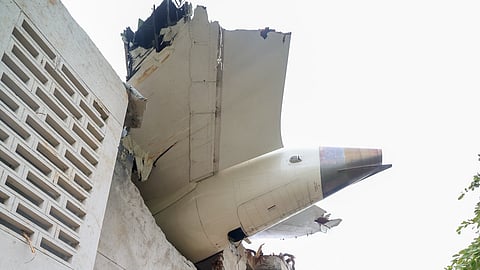
AI 171: The 32-second mystery
Air India’s AI 171 aircraft, which crashed within 32 seconds after take-off from Ahmedabad on 12 June 2025, had left 241 people dead on board and 19 on the ground. The investigation has been ongoing for over a year now by India’s Aircraft Accident Investigation Bureau (AAIB) and a report is expected to be submitted by October. However, Aviation experts believe that it was electrical glitches that brought down the Gatwick-bound Boeing 787-8 Dreamliner.
“The technical log shows that the cockpit crew had made a Pilot Defect Report (PDR) entry in the aircraft for the status message STAB POS XDCR (Stabiliser Position Transducer),” informed C.S. Randhawa, former Air India pilot & president, Federation of Indian Pilots (FIP), while talking to Business India. “An Air India on-duty aircraft maintenance engineer (AME) had performed troubleshooting, according to the Fault Isolation Manual (FIM), and released the aircraft for its next flight leg (which was from Ahmedabad to Gatwick)”. Randhawa debunks any suggestions of human error.
The captain of the ill-fated aircraft, Sumeet Sabharwal, 56, had more than 15,000 hours of flying experience – out of which half were on the Dreamliner. Sabharwal’s father, Pushkar Raj, had accused AAIB investigators of visiting his house in August 2025 under the pretext of offering condolences and then trying to imply that his son was suffering from depression and had moved the switches.
The aircraft that crashed had experienced electrical glitches when it flew from Delhi to Ahmedabad – it had recorded and reported localised electrical and cabin comfort failures. These included failure in air-conditioning, while inflight entertainment was non-operational and passenger call buttons were unresponsive throughout the cabin.
“About 10 automated maintenance alerts were sent by the aircraft to Boeing and Air India ground operation centres during its 32 seconds in the air,” Randhawa adds. “We have urged investigators to direct Boeing to interpret the messages. We have been saying right from the word go that there were electrical problems in the aircraft, which needed to be investigated”.
Meanwhile, families of victims of the crash have filed product defect and negligence lawsuits in the courts in the US against aircraft manufacturer Boeing and component manufacturer Honeywell. While one suit has been filed in the Delaware Superior Court, a plaintiff who lost his mother has filed a case in US Federal Court too, seeking expedited justice.
These lawsuits assert that the cockpit fuel switches – designed by Honeywell and installed by Boeing – had design defects that led to an inadvertent cut-off of fuel supply and a subsequent total loss of engine thrust. The plaintiffs claim that both Boeing and Honeywell were aware of this hazard and refer to a 2018 Federal Aviation Administration (FAA) advisory regarding the locking mechanism. However, the concerned parties failed to mandate inspections, issue proper warnings or provide replacement components to airlines.
The sole survivor of the crash, Vishwashkumar Ramesh, recalling the horror of the ill-fated flight, said that the aircraft felt as if it had come to a standstill and got stuck for a few seconds shortly after take-off, and green and white lights had come on inside the cabin during those moments.
Efficient and versatile
Boeing communications team told Business India: “As the investigation is still ongoing, we will defer to India’s AAIB to provide any information, consistent with the UN International Civil Aviation Organization (ICAO) protocol known as Annex 13”. On its official website, Boeing says it designed the 787 Dreamliner family to be efficient and versatile so that airlines could open new non-stop routes, expand their networks and fly passengers in exceptional comfort. It had flown 1.3 billion passengers and had received orders from 90 global customers.
Air India, which has 26 Dreamliners in its fleet, didn’t share any responses to the queries made regarding the crash. Also, it has reported a net loss of $2.8 billion (Rs22,238 crore) for 2025-26 – the largest loss since it took over in 2022. The airline is seeking $1.5 billion in fresh equity from its promoters Tata Sons and Singapore Airlines. Their original five-year transformation roadmap under strategy Vihaan has been extended and it is presumed that it could take a decade before the airline could turn around.
Air India has faced heightened regulatory and public scrutiny in 2026 due to recurring technical defects, pilot-related incidents and safety audits. There is hope that its new CEO, Tewolde Gebremariam, will turn around the airline, as he had done with Ethiopian Airlines.
Meanwhile, a letter from D. Michael Andrews, who is representing Beasley Allen, attorneys for passengers and families affected by Air India Flight 171, highlighted that Boeing 787 simulator testing did not support the timeline contained in the AAIB Preliminary Report. While the report indicated Ram Air Turbine (RAT) power generation 4-5 seconds after fuel interruption, simulator testing reportedly indicated about 18 seconds. “The letter therefore suggests that RAT deployment may have occurred before fuel control switch movement and may indicate an earlier system or electrical fault requiring further investigation,” argues Randhawa, adding that RAT deployment may be unrelated to fuel system changes and instead may be a symptom of faults occurring before any fuel disruption.
RAT deployment
“Although the preliminary report contains photos showing that RAT is out and visible immediately AFTER take-off, images captured from video from an Ahmedabad airport security camera show that RAT is already out on the runway just before the aircraft rotates for take-off, Randhawa contends. “Taken together, these pieces of evidence tend to indicate that the RAT deployment (a potential symptom of electrical system failure) was not caused by alleged pilot-induced fuel system changes”. He adds that a request had been made to all aviation authorities in India (ministry, regulator) that the AAIB conduct a comprehensive series of Boeing 787 simulator tests.
“The turbine showed that something wasn’t right and this device is used under emergency conditions, when it detects loss of power or loss of hydraulics, which the pilots cannot deploy manually,” says an aviation expert.
The FIP has also shared that, according to a US patent filing for Boeing’s 787 fuel control system, under certain circumstances, the fuel supply to the engines can be automatically shut off without the pilots moving the cockpit switches. . However, the interim report, released a year after the tragedy on 12 June 2026, did not explain why the engine fuel control switches moved from RUN to CUT OFF seconds after take-off.
According to the latest submissions to the Supreme Court and updates from K. Ram Mohan Naidu, minister, civil aviation, the draft final report would be completed by October. Once the draft is prepared, it will undergo a mandatory 30-60-day global consultation phase with international agencies, including the US National Transportation Safety Board (NTSB), before its formal public release.
The investigation is under the scrutiny of the Supreme Court, which is hearing petitions seeking an independent, court-monitored inquiry into the crash. The Supreme Court has scheduled the next hearing for 13 October. In July, the court was informed that four simulation tests had been carried out in connection with an application filed by one of the petitioners.
What would Boeing do if the final report states that electrical or technical glitches led to the crash? What stand would the government of India take? Would the relatives of those who died in the crash finally get closure? Only time can tell.
BOX
A nugget
RAT serves as an emergency backup power source to supply vital electrical and hydraulic power if an aircraft loses its primary engine and electrical generation systems. It stays stowed away inside the fuselage or wing during normal flights and pops out into the rushing airstream automatically if main power fails.
Wind spins the turbine blades. This spinning action drives an electrical generator or a hydraulic pump. It does not power the whole plane. It gives just enough energy for basic flight controls, navigation and essential instruments to land safely.