
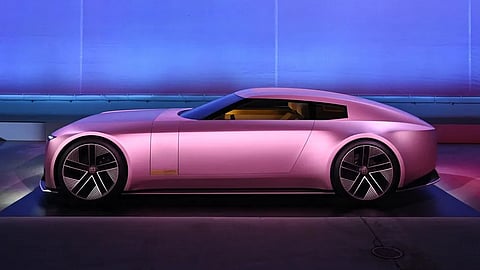
Jaguar’s radical reinvention
When the Citroën BX was unveiled at the Paris Motor Show on 2 October 1982, it provoked considerable controversy. Many Citroën enthusiasts, Citroënistes, were appalled by its angular, boxy styling, which seemed to have little in common with the curvaceous, apparently aerodynamic Citroëns of the past. Even its rakish fastback rear failed to win over many of the marque’s famously loyal followers.
Since its foundation in 1919, Citroën had built a reputation for innovative, often unconventional automobiles. Its futuristic ideas and sometimes quirky designs attracted a devoted following, but they could also alienate more conservative customers. By the mid-1970s, the company was in serious financial difficulty, and Peugeot took control of Citroën in 1976.
The first new Citroën after the takeover was the Visa, developed in-house and widely regarded as a styling failure. With the company’s survival at stake, Citroën took a different approach for the successor to the GS. After rejecting all the in-house design proposals, management turned to Bertone, where chief designer Marcello Gandini created the BX.
Radically different from earlier Citroëns, the BX was nevertheless unmistakably modern, with sharp geometric forms and a distinctive, almost futuristic character. Despite the criticism it initially attracted, the design proved remarkably successful. More than 2.3 million BXs were produced before production ended in 1994, making it one of Citroën’s best-selling models and, in the process, helping to ensure the survival of the marque.
Thus, the question of the day is: is the all-new Jaguar Model 01 Jaguar’s Citroën BX moment?
Jaguar’s history is no less fascinating than Citroën’s. Founded 14 years after Citroën, its development and evolution were shaped to a remarkable degree by one man, its founder William Lyons, much as André Citroën influenced the early years of his eponymous company.
Distinctive design language
Indeed, Sir William Lyons remained closely associated with Jaguar until his death in 1985, having designed, or exercised a decisive influence over the design of, virtually every Jaguar produced from the company’s origins as the Swallow Sidecar Company until 8 February 1985.
Over the decades, this produced a highly distinctive design language: curvaceous, almost voluptuous forms wrapped around low-slung, sleek automobiles that appeared to hug the ground, seemingly poised to pounce when unleashed.
That visual DNA began to fade as Jaguar followed the industry into new segments. The high and mighty F-Pace, for example, was Jaguar’s answer to the rapidly expanding SUV market and went on to become its best-selling model. Yet in abandoning the low, sleek proportions that had defined Jaguars for generations, the marque also risked losing something of its identity. The F-Pace could, at times, have been mistaken for an SUV from almost any manufacturer.
And this is where the new Model 01 enters the story. Like the Citroën BX four decades earlier, it represents a dramatic departure from the visual language that enthusiasts had come to associate with the marque. The question is whether Jaguar’s bold new direction will ultimately be remembered as a disastrous break with its past or as the moment when the company reinvented itself for a new generation.
A daring step
There is perhaps no better perspective on such a radical departure than that of Marcello Gandini, the legendary designer of the Citroën BX. When I met him in January 2024, just a few months before his passing, I asked what he thought of the Tesla Cybertruck. His response was revealing: “Even if I personally don’t like the design of the Cybertruck, I believe it’s an important and daring step, as design should be all about revolutions, and not the gradual evolutions that we see with most manufacturers. I believe that designers must always think out of the box, instead of just reworking what has worked in the past – that’s the job of a stylist, not that of a true designer.”
Whether one agrees with Gandini’s assessment of the Cybertruck or not, his words offer an interesting lens through which to view Jaguar’s Model 01. Great design is not necessarily about preserving what has worked before. Sometimes it requires the courage to break with convention, accept controversy and take a radically different path. The Citroën BX did precisely that. Jaguar is now asking whether its Model 01 can do the same.
Yet there is a cautionary tale here. Despite the initial enthusiasm surrounding the Tesla Cybertruck, it has ultimately failed to deliver the sales that were expected of it. Auto industry veteran Arjab Basu points out that one major reason for its dramatic decline in sales is that it does not meet pedestrian-protection regulations in the European Union, the UK, Australia and New Zealand, as well as several other markets, notably China. “That must have had a serious impact on volumes,” he observes. “Currently it meets only US and Canadian norms.”
Basu, however, is considerably more positive about Jaguar’s new direction. “Jaguar has done brilliantly. It’s controversial, will evoke a lot of conversations and that’s exactly what is required to keep the customers coming into the showroom. And I personally love the styling: clean, minimalistic, monolithic from some angles, edgy, it shreds the design rulebook and teeters on the brink of truly radical automotivThere is little doubt that the traditional, older Jaguar customer is unlikely to be the target audience for the Model 01. Instead, JLR is clearly seeking a younger generation of buyers, perhaps those who might otherwise consider a Porsche Panamera but want something more distinctive: a sporting saloon with attitude and a strong visual identity.
The Model 01 is, after all, the first act in a new Jaguar line-up, a flagship halo car designed to generate attention and establish a new identity. A conventional saloon and perhaps a sports convertible could follow. Hopefully, an SUV will not, although crossovers have become the mainstream of the market. Beyond this, little has been revealed about Jaguar’s future product plans.
Those plans were formulated under erstwhile CEO Adrian Mardell and former chief design officer Gerry McGovern, with the controversial exterior styling of the Model 01 created by Alexey Andreev, who remains with JLR. Much has since changed, however, with PB Balaji now heading Jaguar. The question is whether the new management team can successfully steer the marque back to sales growth and profitability.
Curiously, no figures appear to have been disclosed for Jaguar’s sales ambitions for the Model 01. Perhaps that is not necessarily a bad thing. The most profitable luxury carmakers – Ferrari and Lamborghini among them – operate at relatively low volumes while maintaining exceptional margins and exclusivity. For Jaguar, chasing six-figure production numbers may once again prove less important than finding the right customers, at the right price, for the right cars.