
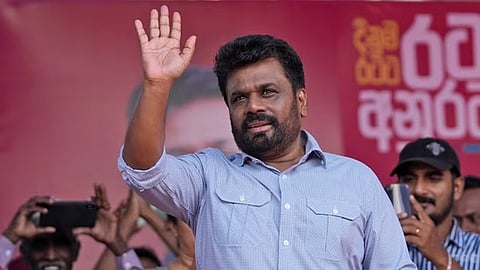
Anura Kumara Dissanayake, 55, popularly known by his initials ‘AKD’, entered Sri Lanka’s Leftist politics in his student days. It was the youngster’s hostility towards the state and ruling class that led him to the student wing of the Janatha Vimukthi Peramuna (People’s Liberation Front), a party of Marxist-Leninist origins. He came from a small farmer household that was not politically active. His father was an office aide in the government’s Survey Department and his mother was a homemaker. He rose up the political ladder and the voters of Sri Lanka, beset with economic woes, have now elected him as the president of the island nation.
Like Bangladesh, the change in Sri Lanka has presented New Delhi with a diplomatic challenge. Clearly, our foreign office was unable to discern the mood for a change and a perceptible shift away from the established, traditional parties and groups that dominated the political landscape. Dissanayake has been dubbed by his critics as a ‘pro-China’ leader. The challenge for New Delhi would be to wean him away from Beijing as Indian businessmen have, of late, made substantial investments in Sri Lanka.
It is remarkable that the JVP, a party with Marxist origins, has been able to get about 42 per cent of the vote share, unlike its poor showing in 2019 and 2020. And though lower than in 2015 and 2019, voter turnout was about 79.5 per cent. Given their constraints, all the contestants conducted themselves in a way that reflected their faith in the democratic system. It is also no surprise that the purpose for which the popular uprising Aragalaya (‘struggle’ in Sinhala) took place, found resonance in the campaign and verdict.
Since this was the first time that Sri Lankans were electing their leader after the unprecedented financial meltdown in 2022, their economic concerns were the chief poll issue. This marked a departure from the island nation’s last few elections that were dominated by promises of ‘eradicating terrorism’ (the country’s three decade-long civil war ended in 2009), and pledges of delivering ‘good governance’, or ‘national security’. All main contenders running for president this time have promised to fix the country’s broken economy, offering mildly different versions of policy outlines tethered to an ongoing International Monetary Fund (IMF) programme.
Twin deficit problem
Sri Lanka’s classic twin deficit problem dramatically escalated when President Gotabaya Rajapaksa resorted to rash policy decisions, including significant tax cuts, an abrupt ban on chemical fertilisers, and a failure to devise a plan to meet debt repayment deadlines, especially after foreign reserves dwindled in the wake of the pandemic and questionable policy. In April 2022, Sri Lanka announced it would default on its foreign loans as the ‘last resort’. As the imports-reliant country ran out of dollars, essential supplies were severely hit. People were forced to contend with long queues for fuel and gas, shortage of food and medicines and prolonged power cuts. With no solution in sight, citizens took to the streets. The agitations soon grew into a formidable mass uprising and evicted Gotabaya from presidency. Soon after, President Ranil Wickremesinghe was elected to the country’s top office through a parliamentary vote.
Dissanayake has told the Indian media that fixing the economy would be among his priorities. Despite being a Leftist, the JVP leader appears receptive to welcoming private and foreign investments. His election manifesto talks of renegotiating, rather than scrapping, with the IMF the $2.9 billion bailout agreement.
What Dissanayake should not overlook is that he has to adopt a consensual path, while implementing his economic policies and programmes, say diplomatic observers. It is also going to be challenging when it comes to the other facets of governance and how he will be able to ensure a ‘system change’, as he has repeatedly attacked the present ‘corrupt political culture’. The promise to hold elections to provincial councils – a tier of government that the JVP had once opposed – must be reassuring to Tamils.
In the area of foreign relations, Dissanayake, accused of having a pro-China tilt, is expected to extend his pragmatism. Perhaps in preparation of this role, he had visited India early this year. His manifesto also mentions that Sri Lanka’s territory would not be allowed “to threaten or risk the national security of any country in the region including India”.
But it remains to be seen how the new President will translate into action his electoral promise of abolishing the current system of executive presidency, a matter that has refused to die down in the political discourse of the country for over 30 years. Dissanayake, who will be assuming charge under not so comfortable conditions, requires understanding and cooperation from every section of Sri Lankan society – and also from India.

Indus Waters Treaty at a new flashpoint
India seeks to reopen Indus Waters Treaty
Pakistan has invited Prime Minister Narendra Modi to the Shanghai Co-operation Organisation’s Council of Heads of Government meeting to be held in Islamabad on 15-16 October. Pakistan holds the rotating chairmanship of the SCO Council of Heads of Government currently. India hosted the SCO Summit last year in virtual mode and it was attended by Pakistan Prime Minister Shehbaz Sharif through a video link.
In all likelihood, S. Jaishankar, external affairs minister, will represent Prime Minister Modi. He will be visiting Pakistan at a time when tensions between the two sides over the renegotiation of Indus Waters Treaty have flared up again. In its fourth notice to Pakistan since January 2023 India has escalated its demand for renegotiation by calling off all meetings of the Permanent Indus Commission (PIC) until Pakistan agrees to sit at the table for talks.
The reason for the current notification appears to differ from the earlier one. While India’s January 2023 notification primarily cited Pakistan’s alleged intransigence as the main concern, the recent notification emphasises the evolving realities within the Indus basin as the primary rationale. “India’s notification highlights fundamental and unforeseen changes in circumstances that require a reassessment of obligations under various Articles of the Treaty,” says a government note summarising the August notification. “Key concerns include shifts in population demographics, environmental challenges such as the need to expedite clean energy development to meet India’s emission targets, and the ongoing impact of cross-border terrorism.”
A timely response
India’s decision to serve notice to Pakistan, according to officials, reflects a timely response to emerging challenges and shifting realities within the Indus River Basin. One of the key factors driving this decision is the significant change in the population demographics of the basin. The Indus River Basin supports the world’s largest system of irrigated agriculture, serving over 300 million people across India and Pakistan.
On the Indian side, about 59 million people rely on the basin’s water resources, and this number continues to rise, placing increased pressure on already limited water supplies. For example, Jammu & Kashmir, which lies at the heart of the Indus Waters Treaty, has seen its population grow from 3.56 million in 1961 to 12.5 million in 2011 – a more than three-fold increase since the treaty’s inception. This demographic shift has intensified the demand for water in the region, particularly for agriculture, domestic use, and industrial purposes.
India’s demand last year followed a logjam in the entire process, once held up internationally as a model template for water-sharing agreements. Even in the new millennium, the tenets of the treaty held firm, and India was able to win two major disputes by adhering to the processes laid out, including the Baglihar Dam project in 2007, and another dispute over allegations that India was interfering with Pakistan’s Neelum project in 2013. The issue over how to proceed on dispute resolution for the Kishenganga and Ratle projects has snowballed since 2016, when Pakistan escalated the disputes – having a neutral expert look at them and demanding a Permanent Court of Arbitration (PCA). In a moment of weakness, that it may come to regret, the World Bank (it is a co-signatory and guarantor of the IWT) decided to allow two parallel processes of the dispute mechanism to run at the same time.
To make matters worse, Pakistan turned its back on the neutral expert’s proceedings, while India has boycotted the PCA hearings at The Hague. Pakistan has been cold to India’s notices on renegotiating the treaty and the decision by the Modi government to stop all PIC meetings has put the future of the process in peril. Unlike in past decades, when the IWT was considered off-limits for partisan politics, leaders on both sides are now not above using fiery rhetoric. Modi’s statement after the 2016 Uri attack, that ‘blood and water’ cannot flow together, is perhaps the most egregious example.
It is no coincidence that the spiral mirrors the unravelling of the India-Pakistan bilateral relationship in the same period. There is no political engagement or trade and the 2021 LoC ceasefire meeting is in danger after growing terror attacks and deaths of Indian Army personnel. It may be possible to re-open the treaty talks, but concluding any agreement will be that much more difficult.
No doubt, new-age issues such as climate change and the need for renewable energy and hydropower options on the Indus necessitate a re-opening of the 64-year-old Treaty. How that is done, along with resolving current disputes, will decide whether the two countries can save the treaty, once referred to as the ‘one bright spot’ in a ‘depressing world picture’ by US President Dwight D. Eisenhower.