
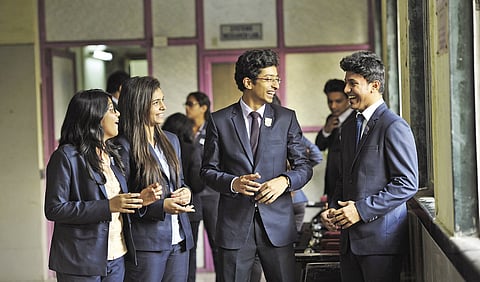
Business schools have mushroomed in India over the last two decades leading to challenges to all the stakeholders. Some notable challenges that stand out are quality learning, quality research, quality industry institute partnership, quality employability, competing with global business schools, shaping students as long-term resources in the form of business leaders, entrepreneurs and responsible citizens.
A business education programme is unlike other conventional post graduate programmes. It grooms students for careers in management that are replete with dealing with everyday uncertainties, exceeding aspirations of stakeholders, managing consistent top line growth, running successful teams, etc. Keeping in mind these challenges, management education must focus on training students in these vital aspects.
We live in a knowledge era that is evolving rapidly. Thanks to technology, knowledge is available at the click of a button. The important stakeholders of business schools, namely students look out for value addition beyond knowledge already available in the form of books and lectures. They are joining business schools to improve their competence, skills and knowledge. If business schools were to thrive and succeed they must incorporate these expectations of students. They can do this by adopting simple rules – hiring and retaining quality teachers, encouraging quality research, exposing students to innovative pedagogies, adopting global practices, ensuring quality student intake, encouraging joint research between industry and academia, to name a few. This, we believe, will enhance the overall quality standards and make the institutes’ position unassailable.
How can we benchmark best management education? We need to create a unique ecosystem, which encompasses the objectives of student well being, encourages effective learning transfer, and instills in them the right set of skills, knowledge and attitudes. Benchmarking has to focus on the areas of Teaching, Research, Institutional development, Community Development and Knowledge sharing, collectively termed trick.
We believe teaching is one of the most important areas that needs to be focussed on by all faculty members in a business school. They must change with the times, adopt latest practices and move away from merely adopting conventional methods of learning transfer. This approach, in my view, makes students more employable.
Research is an important link that connects the faculty competence and skills with industry challenges and issues. It is a good complement for effective teaching, since faculty engage with industry and bring valuable insights into the classroom/case discussion. Students also benefit as faculty members tend to bring inputs through published research papers, case studies and consulting assignments. However, for research to yield dividends, management support is a must. In the long term, dedicated industry-linked research benefits the students, faculty, the institute and industry.
Industry benefits by inducting students, who are familiar with its surroundings. Inducting fresh graduates puts strain on costs by way of employee training and induction. In a competitive scenario, getting talented graduates becomes an even more daunting challenge. We suggest active industry institute linkage by way of student internships, collaborative research programmes and other student immersion activities that expose students to an industry environment. These partnerships will be mutually beneficial – industry gets students who are employment ready while institutes continually upgrade their quality benchmarks as sought by industry. Institutes should also pursue faculty and student exchange programmes with globally renowned business schools.
The modern business school has to take care of community development, which means the publications of the faculty members should help the business community, policy makers and the overall society. Community development can also manifest by adopting best practices in business schools. Maintaining process transparency, sharing timely feedback on student performance with parents and a socially relevant grading mechanism helps students learn and grow.
Knowledge sharing must be an important responsibility for management teachers. Senior faculty members must take on the role of mentors, conduct research seminars and workshops for their younger colleagues and provide the right direction.
To conclude, I believe it is high time that Indian business schools look up to global benchmarks in management education. Indian institutions offering business education should look to global best practices, incorporate the best of the relevant Indian practices and create their own niche. There is a need to form a Global Teaching and Research Forum (GTRF) that can serve as a platform to discuss common agendas and issues facing
management education.