
New focus, new priorities
Given the context of national priorities, I believe one of the most important is that the quality of life for the rural citizens needs to improve. Non-farm rural employment, followed by agricultural productivity, minimisation of losses and value addition, and rural infrastructure would be key areas.
Making India a manufacturing hub, with campaigns like ‘Make-in-India’, with a strong focus on technological research and development, is another important domain. Achieving global trade competitiveness goes along with this. Health and hygiene, inclusion of the challenged, and education (both primary and higher) also need to be addressed. Given the availability of digital technologies, it would be important to explore how such technologies can be used to enable the above.
In my view, the facilitating primary functional areas would be human resources management, supply chain management and legal and regulatory frameworks, supported by an entrepreneurial mindset and skills of data analytics. Rigorous management research is a phenomenon of recent years in India. The top IIMs, while always attempting to be relevant and impact-making, did ‘research’ more for consulting rather than creating knowledge. An important driver and validated test of creating knowledge is publications in top-rated global journals. It is just in the past decade that the top IIMs have started focusing on published research.
In the early years of this need to publish, some of the research has tended to be either narrow or built on developed-country context, with international co-authors. This made it easier to get a publication acceptance. This appears to be a necessary phase since the need for self-confidence that the rigour required for knowledge creation can be achieved was essential. Going forward, one would hope that the ability to marry rigour with relevance for India would be publishable in top-rated journals. India, after all, is a country that the rest of the world is now watching.
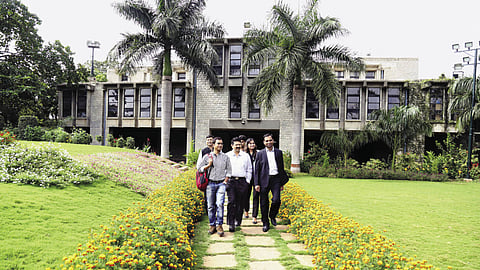
IIM-Bengaluru, for example, has been at the forefront of building a research culture in some of the emerging areas. Some of the high-end publications of IIM-B’s faculty address a variety of questions like how:
• foreign companies can be successful in the Make-in-India vision (by weaving together global and local supply chains);
• a multinational subsidiary navigates identity duality (being local and global);
• relationship-focus of suppliers are influenced by the risk-based incentives of CEOs of customer companies (reduces during normal periods and increases during transition periods);
• careers are shaped post-adult onset of hearing loss (redefinition of identity, moving to roles where disability was an advantage and changing perceptions of ableism in the workplace);
• non-zero-sum stochastic games can be analysed by bringing in risk sensitivity in a multi-state context;
• accelerators influence the development of regional entrepreneurial ecosystem of Bengaluru; and
• a star performer can be integrated into a team with high inter-dependence (the role of the star’s temporary absence).
It is also important that such research flow into educational programmes. In the early days, the problem-solving consulting was viewed as a means by which curriculum would be enhanced and did contribute so, effectively. However, to make significant changes in the curriculum and stay relevant for the future, it is important that knowledge creation happens and then is integrated into the curriculum. Many electives get developed based on such new knowledge. For example, at IIM-B, courses on entrepreneurship or data analytics are offered based on this. These domains would also evolve into programmes. At IIM-B, a doctoral programme on entrepreneurship has now been conceptualised and is admitting participants starting in the summer of 2018. Similarly, a programme on data science is being conceptualised.
I hope, with the large number of B-Schools in India and the consequent competitive atmosphere, a viable ecosystem for high quality management research and education would be created.